Introduction
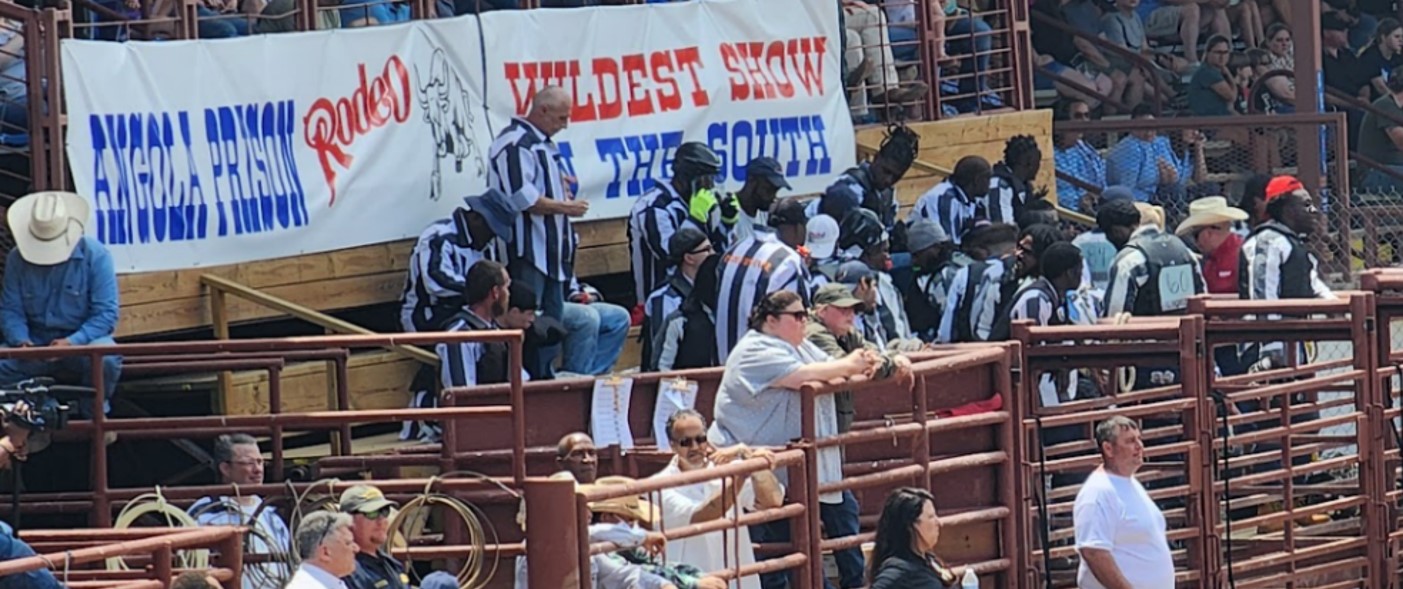
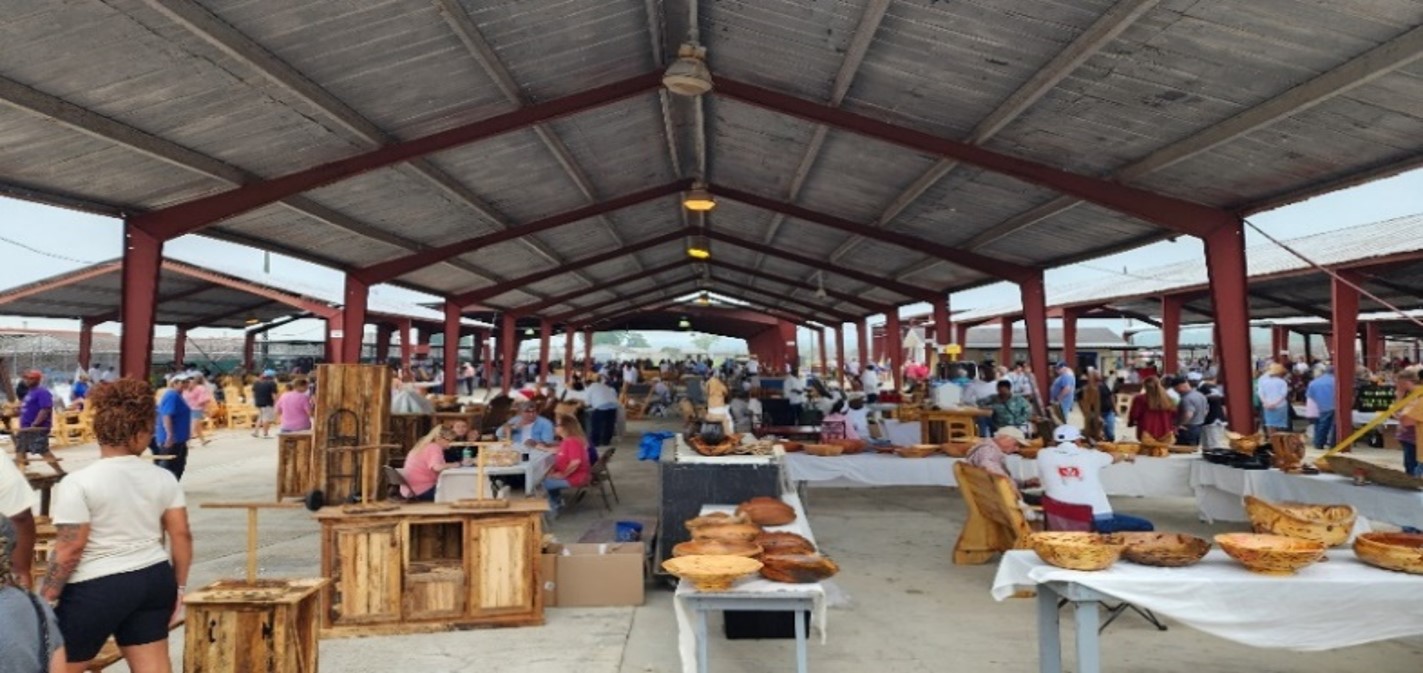
Five weekends a year, visitors from across the Southern United States journey to Angola, Louisiana, to attend what is proudly billed as the “Wildest Show in the South.”1 At first glance the event resembles a typical rodeo fair, complete with a stadium, an extensive hobbycraft market, live musical performances, and a variety of food stalls (see Fig. 1). However, the spectacle at Angola is unlike any other US rodeo. This one takes place inside the Louisiana State Penitentiary, a maximum-security prison. All the performers, artists, and vendors at this rodeo are incarcerated.
Established in 1965 and opened to the public in 1967, the Angola Prison Rodeo is not the first of its kind; throughout the twentieth century, prison rodeos took place in Texas, Oklahoma, and Arkansas, though all have since been discontinued. Angola’s rodeo, however, endures as the longest-running and only remaining prison rodeo in the United States.
Contemporary penal culture is defined by practices of selective visibility, in which the most violent, coercive, and degrading aspects of punishment are hidden behind bureaucratic procedures or architectural barriers, while carefully curated images of security, order, and rehabilitation are placed on display. As scholars have noted, the nature of penal violence itself has shifted: Public corporal punishment gave way to regulated, concealed forms of punishment such as solitary confinement, institutional neglect, or life-long incapacitation. This selective exposure both protects the prison from broader cultural scrutiny and helps embed incarceration within the realm of cultural “common sense,” presenting imprisonment as an inevitable and rational response to crime.
At first glance, the Angola Prison Rodeo appears to violate these cultural norms of modern penal practice. It is a hyper-visible site of active penal tourism that challenges convention in two fundamental ways. First, as an active prison tour, it is immediately distinct because it allows the public significant, direct access to inmates. This level of access contrasts sharply with tours of other active prisons, which usually curate or strictly limit spectator interactions with incarcerated individuals. Second, the rodeo subverts the standard purpose and content of penal tourism itself. While standard penal tourism, often taking place in decommissioned prison sites, typically seeks to obscure the contemporary realities of penal violence, Angola openly showcases spectacular acts of direct corporal violence on inmates sustained before a cheering audience. Such direct and spectacular displays might seem to risk unraveling the carefully maintained legitimacy of the carceral state. Indeed, earlier studies of the Angola Rodeo have debated precisely this point: Some argue that the rodeo reveals a turn back toward overt, racialized violence to uphold prison authority, while others see it as an exceptional ritual that threatens to destabilize the moral foundation of incarceration itself.
Yet despite these apparent risks, the Angola Prison Rodeo not only persists but flourishes, drawing tens of thousands of spectators and generating substantial revenue for the prison. This study addresses this puzzle by drawing on new ethnographic data from the Angola Prison Rodeo. Using a thick description methodology,2 it examines how the rodeo becomes culturally meaningful to both spectators and inmates. Spectators view the rodeo through cultural narratives of discipline, redemption, and entertainment that normalize both imprisonment and inmate suffering as part of a natural social order. Inmates, for their part, see the rodeo as an opportunity—whether for financial gain or an assertion of personal agency—yet their choices are fundamentally shaped by the constraints of incarceration, rendering their participation structured and contingent.
Moreover, the rodeo does more than secure cultural consent of the penal institution. It also recruits the public into the prison’s operations as financial supporters and informal overseers. At the Louisiana State Penitentiary, penal discipline is sustained not only through the prison’s internal panoptic surveillance, where prison authorities monitor inmates; the rodeo introduces a second layer of control: synoptic surveillance, in which the many (spectators) observe the few (inmates). Spectators do not merely witness incarceration; they participate in its economic and disciplinary reproduction.
The Wildest Show in the South
The Angola Prison Rodeo takes place at the Louisiana State Penitentiary, once known as the “bloodiest prison in the South.”3 Originally established in Baton Rouge in 1844, today the prison is located on an 18,000-acre site outside the city. Now the largest correctional facility in Louisiana, it houses approximately 4,000 inmates. The prison’s current location was once a slave plantation and is colloquially referred to as “Angola” after the region in Africa from which many enslaved people were taken.
The rodeo was introduced in the 1960s as part of efforts to reform the prison’s violent reputation.4 Today, it is marketed as family-friendly entertainment and an opportunity to purchase inmate-made crafts. Promotional materials for the “Wildest Show in the South” frame the rodeo as a behavioral incentive, rewarding inmates with the chance to compete in rodeo events for prize money and to sell handmade goods for profit (see Fig. 2). The event is also advertised as support for other rehabilitative programs, with a portion of the proceeds funding “cutting-edge reentry programs”5 through the Inmate Welfare Fund.6
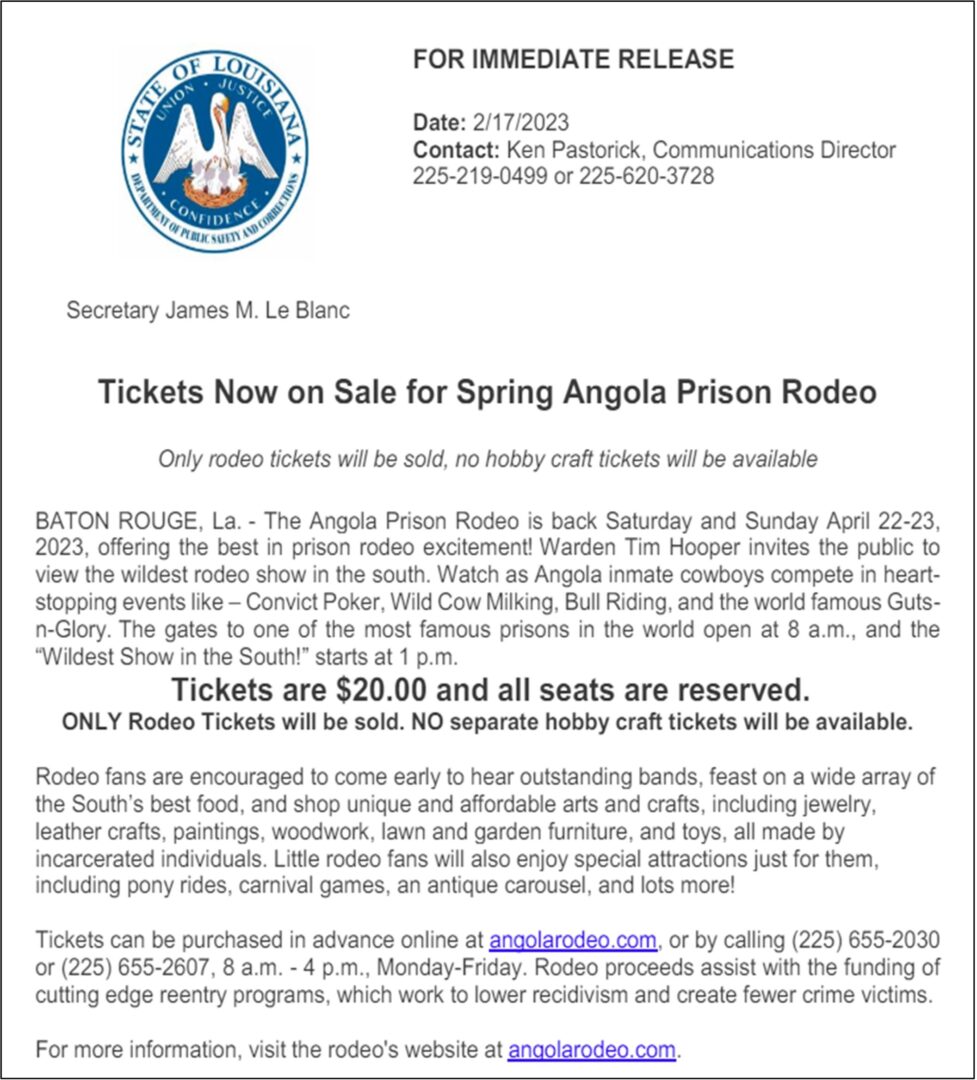
Held six times each year (four Sundays in October and one weekend in April), the rodeo takes place within a large fairground inside the prison grounds. The rodeo stadium accommodates over 10,000 spectators, with tickets typically selling out in advance. Admission costs $20.00, and proceeds from ticket sales and hobbycraft purchases are directed to the Inmate Welfare Fund (see Fig. 3).
During the April 2024 event, inmates reported that the prison takes 20% of credit card and 15% of cash hobbycraft sales, while inmates retain the rest of their sold profit. A 2017 legislative audit for the rodeo revealed that the rodeo generates over $6 million annually for the prison.7
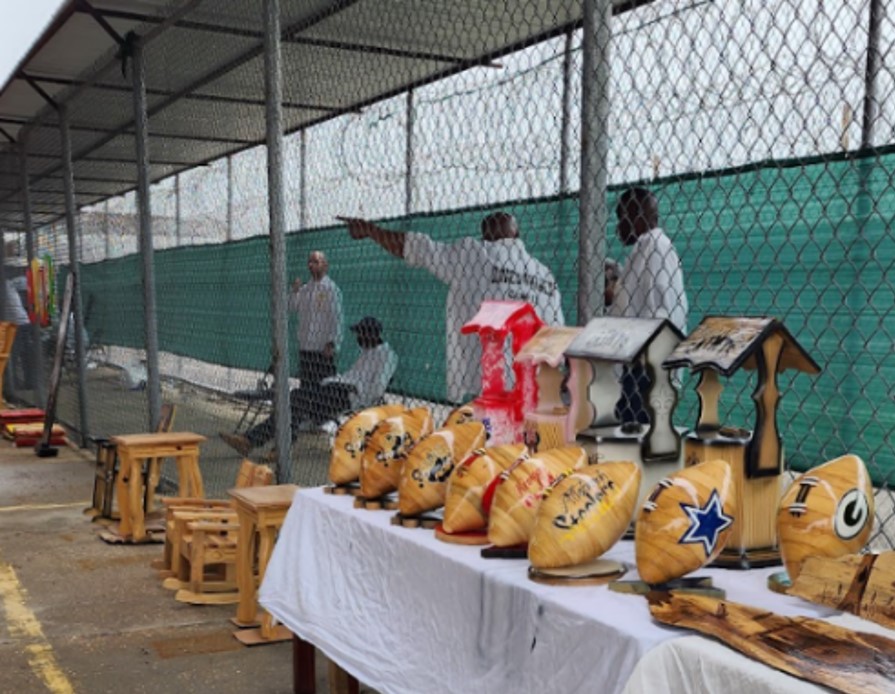
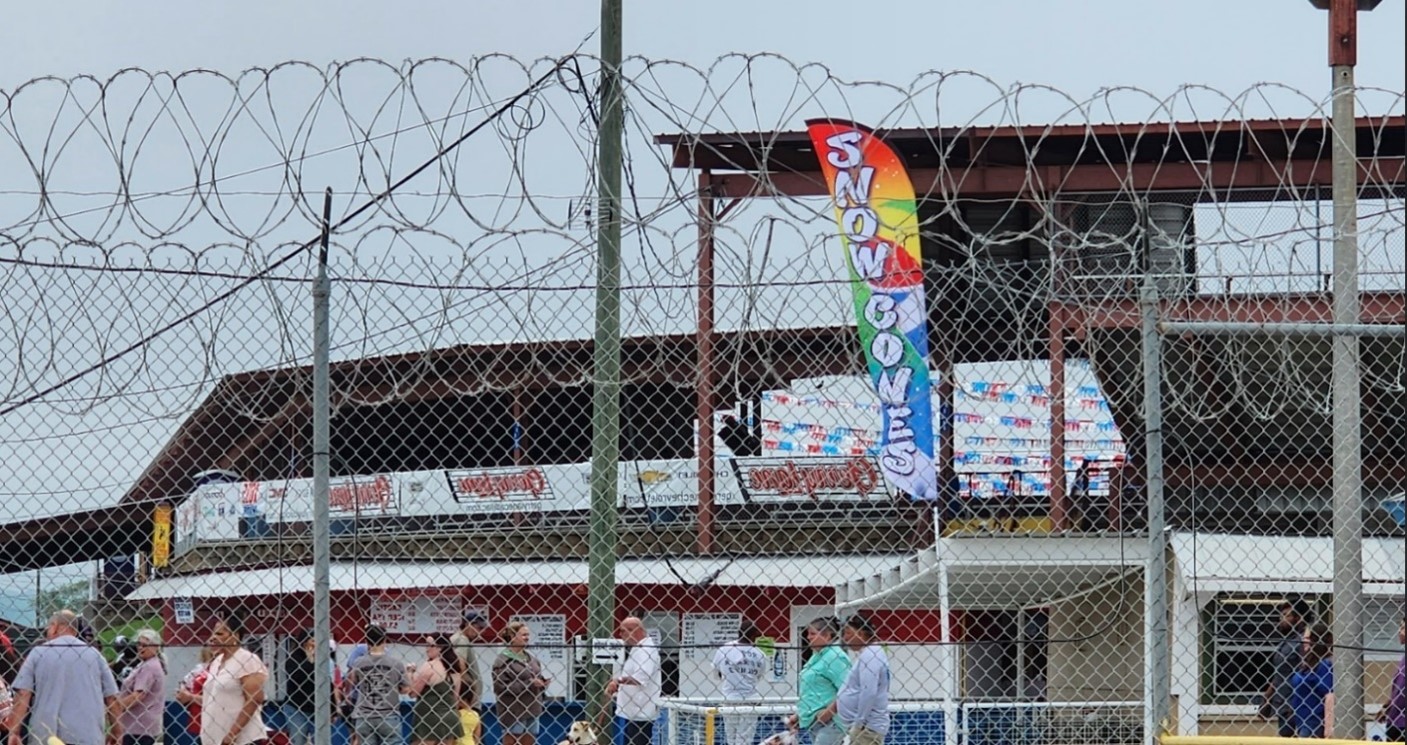
Visitors are allowed into the prison grounds at 8:00 a.m., and many arrive around 10:00 a.m. to browse the hobbycraft stalls. These stalls offer a variety of inmate-produced items, including paintings, wood carvings, leatherwork, and jewelry. Inmates selling hobbycraft are divided into two groups: trustees, who interact directly with customers, and “big-stripe” inmates, who sell their items from behind a chain-link fence on the periphery of the rodeo grounds (see Fig. 4). Although inmates set the prices, prison employees and correctional officers facilitate the sales.
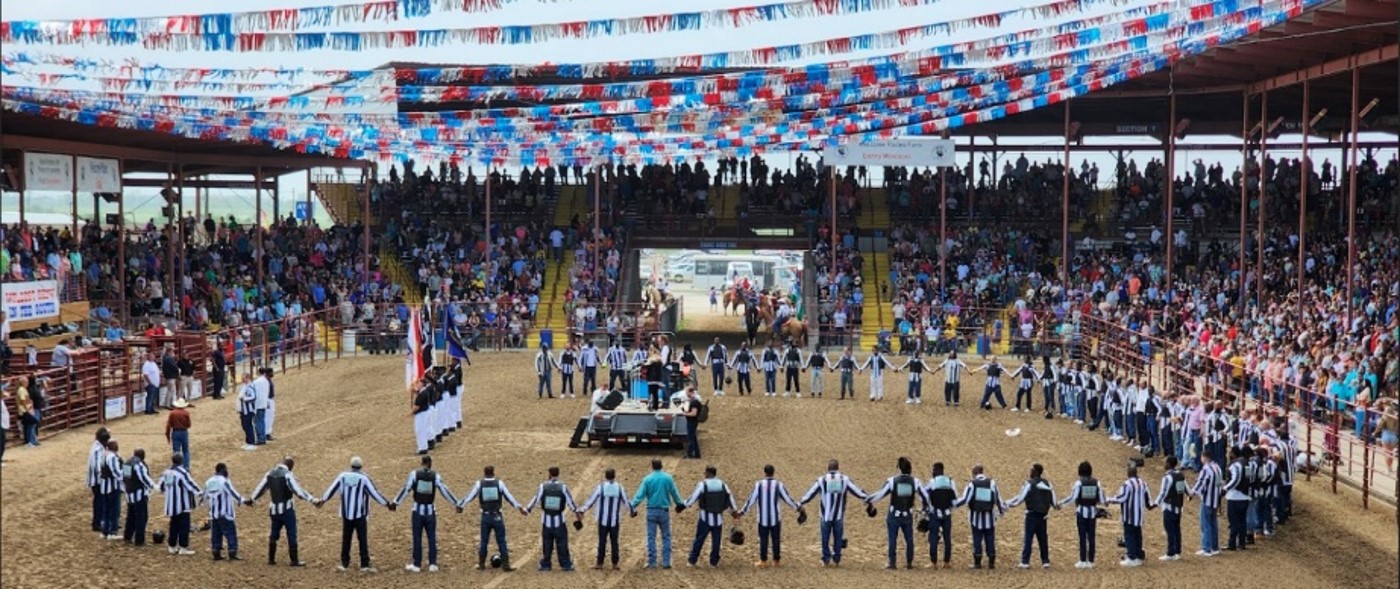
The rodeo itself starts at 1:00 p.m. and lasts about two to three hours. It opens with a Grand Entry featuring several ceremonial elements: the National Anthem, a prayer circle, and a procession by the Angola Rodeo Rough Riders, a group of inmates who ride into the stadium on horseback.
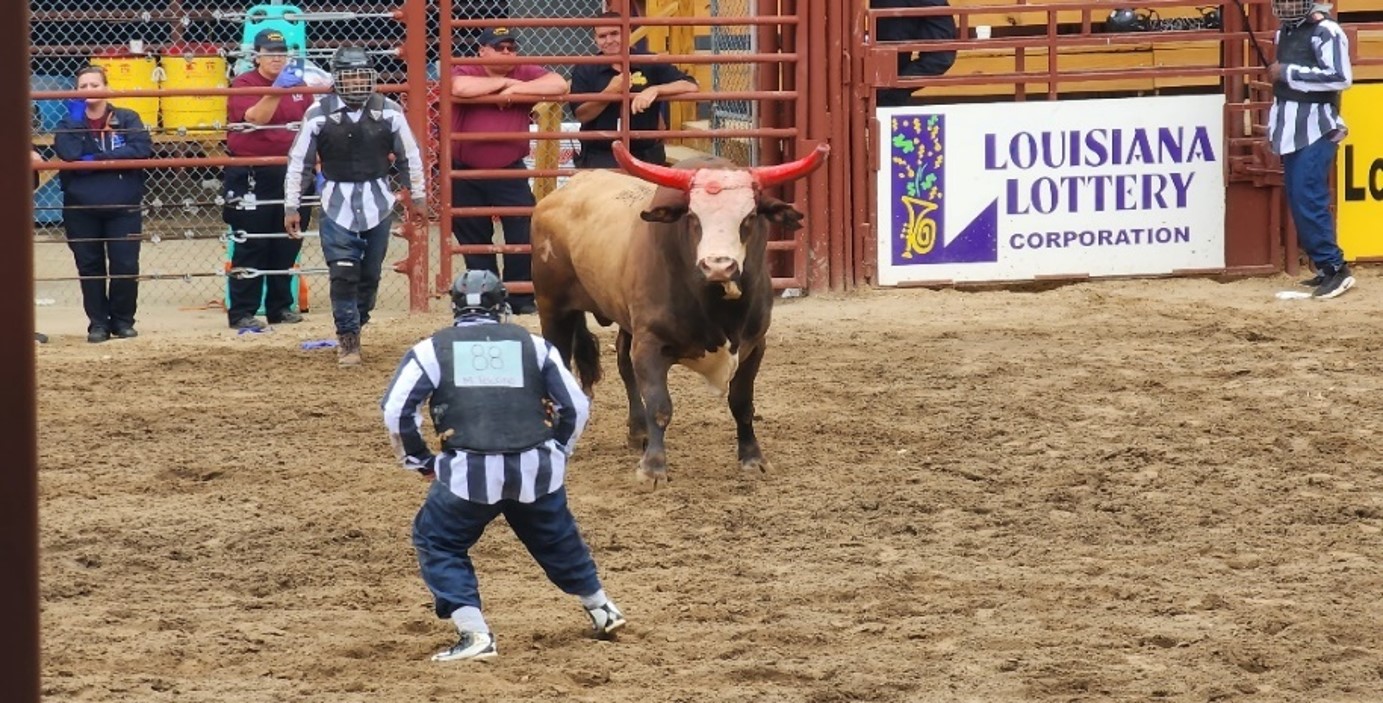
While the rodeo includes traditional events such as bull riding and bareback bronco riding, it is best known for competitions unique to Angola. In Convict Poker, for instance, inmates sit in plastic chairs at a card table while a bull is released into the arena; the last inmate remaining in their seat wins $500. Other events, such as Ring of Fire and Convict Pinball, follow a similar “last man standing” format. The day’s final event, Guts and Glory, is heavily advertised and draws particular attention. In this event, around forty inmates try to grab a poker chip attached to a bull’s forehead. The winner of Guts and Glory receives $1,000 (see Fig. 5).
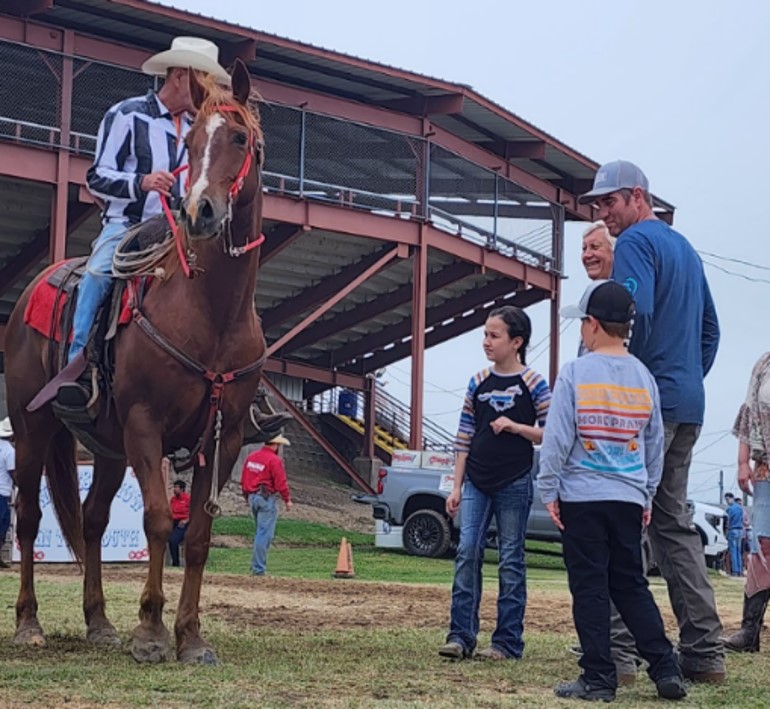
While the rodeo events are the main attraction, spectators spend much of their day browsing hobbycraft stalls and interacting with inmates. Before the event begins, visitors can observe the preparation process in the stadium, watching as animals are brought into the chutes and inmates ready themselves for competition. Rough Riders often engage with families near the stadium entrance, allowing children to pet their horses (see Fig. 6). Spectators and inmates are only definitively separated once the rodeo begins, with visitors seated in designated areas and inmate participants near the animal chutes.
The Puzzle of Visibility and Legitimacy at Angola
The Angola Prison Rodeo presents a striking paradox. In an era when incarceration is typically removed from public life—by geographic isolation, bureaucratic procedure, and institutional opacity—this event thrusts the prison dramatically into public view, offering unusual access to a penal institution rarely seen so openly. This paradox invites reconsideration of how punishment is made visible and legitimated in modern society.
Michel Foucault famously argued in Discipline and Punish8 that punishment moved behind prison walls not to become more humane, but to preserve state legitimacy. Public executions once dramatized sovereign power, but as they increasingly provoked sympathy for the condemned and threatened authority, they were replaced by bureaucratic, routinized forms of discipline. The modern prison, in this account, becomes what Erving Goffman describes as a total institution9: a closed, regimented system removed from daily life and largely hidden from public view. According to Foucault, concealment is not incidental but essential, allowing disciplinary power to operate more efficiently, quietly, and with less resistance.
As Bernard Harcourt and Loïc Wacquant argue, modern prison system maintains its authority by rendering incarcerated people socially invisible to avoid deeper public scrutiny 10 Yet, this structure simultaneously exerts enormous influence over economic structures, racial hierarchies, and public policy 11
As a site of social death,12 the prison materially and symbolically erases incarcerated people from civic life, defining who can and cannot participate as full members of society. Its influence is all the more powerful because it is often misrecognized—visible in certain curated ways but seldom interrogated as a political institution whose legitimacy might be fundamentally challenged.
To understand how such an erasure is sustained, Antonio Gramsci’s theory of cultural hegemony is instructive.13 For Gramsci, state power endures not only through coercion but through cultural consent, produced by rituals, narratives, and symbols that render domination “common sense.”14 In this framework, the question is not simply whether the prison is visible or hidden, but how it is made visible and under what ideological terms that normalize such an institution. Visibility itself becomes a political project—managed to secure consent.
This dynamic is evident in the broader cultural transformations that gave rise to the modern prison.15 Scholars like Norbert Elias and Pieter Spierenburg described how evolving norms around civility reduced public tolerance for overt spectacles of state violence.16 Philip Smith similarly argued that public executions became “polluted rituals,” losing their legitimacy once they were seen as morally excessive.17 As punishment retreated from open display, it was embedded in institutions that appeared rational, neutral, and humane. In this way, the prison evolved not only as a disciplinary apparatus but also as a cultural institution whose legitimacy depended on aligning with prevailing standards of justice, order, and rehabilitation.18
Thus, cultural hegemony is secured not through deception alone, but through repetition, affect, and symbolic framing that translate state violence into common sense. Cultural forms allow punishment to be not only seen but also emotionally experienced and narratively justified—making spectacle itself a tool of governance. Crucially, modern penal institutions do not simply conceal or reveal; they carefully curate what is made public and under what conditions. This selective visibility creates an illusion of transparency while shielding deeper institutional logics from scrutiny. Rather than threatening legitimacy, selective visibility can potentially bolster legitimacy.
Selective visibility also helps to resolve core tensions in contemporary US penal culture. On one hand, US public opinion remains unusually punitive, with strong support for incarceration as a response to crime.19 Yet there is also cultural pressure to see the prison as humane, rehabilitative, and morally justified.20 This paradox creates a demand for visibility that reassures without undermining faith in the institution. Even when aspects of carceral harm become public through documentaries or media reports, they are often framed in ways that neutralize their critical potential. Structural violences such as solitary confinement, exploitative labor, medical neglect, and excessive force persist at the heart of incarceration,21 yet are rationalized as bureaucratic routine—not seen as the spectacular cruelty of the scaffold that Foucault described.
This ideological process is also deeply racialized in the United States. As scholars such as Angela Davis and Simone Browne argued, the US prison cannot be understood apart from the legacies of racial domination that shaped it.22 The narratives that frame imprisonment as necessary or redemptive are themselves products of a post-slavery racial order that continues to define who is punishable and how. Joy James describes how the disciplinary logic of the plantation was reconstituted in the prison, rendering Blackness criminalized and Black bodies perpetual objects of state surveillance and cultural punishment.23 In this context, carceral visibility does not interrupt systemic violence; it makes it culturally legible and acceptable, embedding it as a familiar feature of the US social order.
Of course, this is not to deny the long histories of prison reform or abolitionist critique. Indeed, movements for prison reform have often driven the “civilizing” shifts in penal practice. Contemporary abolitionist critics offer sustained challenges to the prison’s legitimacy itself.24 Yet these remain countercurrents within a broader cultural hegemony that rarely questions the prison as a foundational institution.
Visibility, Violence, and Legitimacy at the Penal Tour
Most forms of penal tourism closely adhere to practices of selective visibility. Penal tourism usually takes place in now-defunct prisons (e.g., Alcatraz,25 Eastern State Penitentiary,26 or Robben Island27) and the tours largely dwell on historical brutality, presenting past penal practices as excessively harsh and outdated. These sites cater to the morbid curiosity of dark tourism,28 blending education with entertainment,29 while romanticizing or abstracting the suffering of former prisoners.30 At the same time, they omit the bureaucratized violences that define modern incarceration, implicitly framing today’s prison as more humane and progressive by contrast. Even tours of active prisons maintain this selective visibility.31 Interactions with incarcerated people, if permitted at all, are highly choreographed under the watchful eye of correctional authorities. What is revealed and what remains concealed is curated to serve institutional interests, offering a controlled glimpse that reinforces the legitimacy of the carceral state.
Against this backdrop, the Angola Prison Rodeo appears to violate these norms of selective exposure. Unlike traditional penal tours, the rodeo grants spectators direct, informal access to incarcerated individuals. Inmates sell hobbycraft, converse with visitors, and perform publicly with minimal supervision. Correctional officers largely recede into the background, temporarily suspending the strict social divisions that typically define incarceration. This seemingly open interaction disrupts expectations of the total institution as a sealed, tightly monitored space.
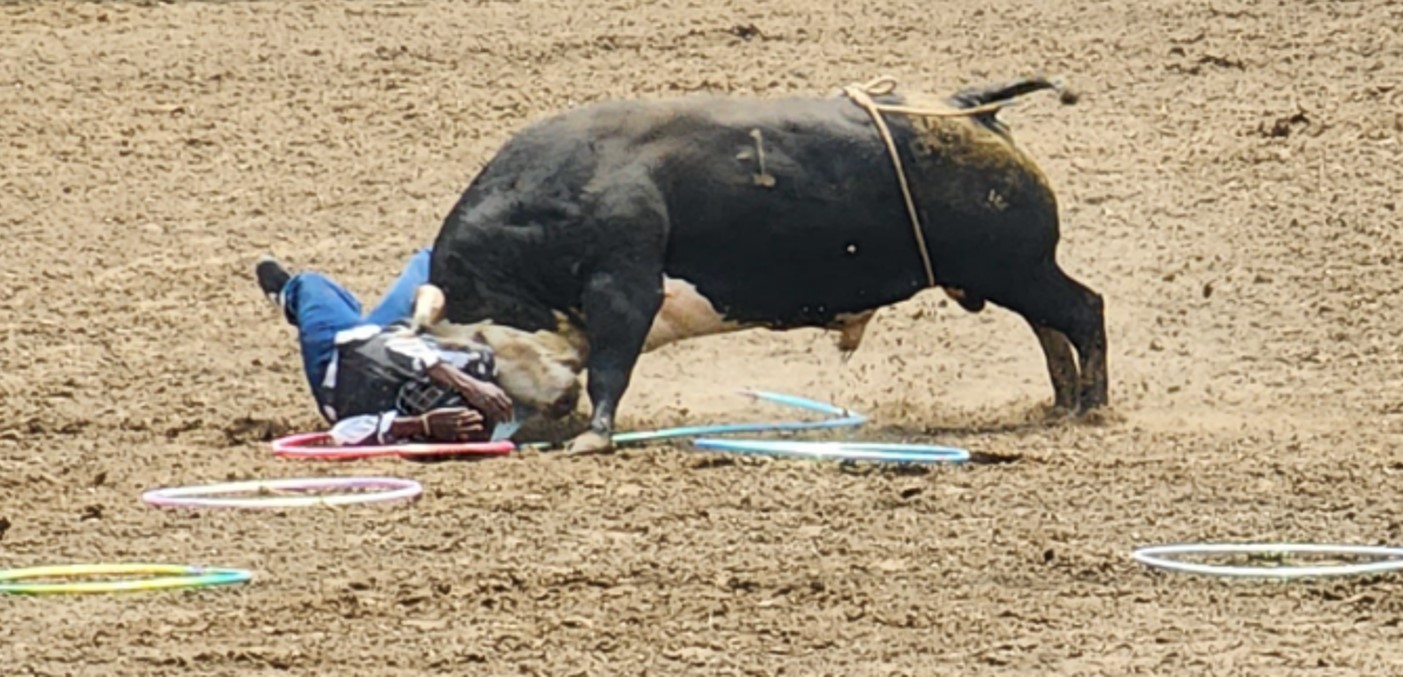
Even more striking is how the Angola Rodeo makes violence spectacularly visible. Unlike the hidden, bureaucratic harms that characterize most prison life (e.g., solitary confinement, exploitative labor, or medical neglect) the rodeo presents overt physical risk staged before a cheering audience (see Fig. 7). The very architecture of the arena evokes Foucault’s pre-modern spectacle of the scaffold, drawing collective attention to the suffering body within the prison’s walls.
Crucially, the violence at Angola is not merely a hidden undercurrent of punishment but a public performance. It also differs markedly from conventional rodeos, where risk is mitigated by skill, training, and professional expertise. In Angola’s events like Convict Poker or the Ring of Fire, inmates often participate with little preparation, facing hazards that depend more on chance and endurance than on practiced technique. This dramatically increases the likelihood of serious injury. During the April 2024 rodeo, for instance, an inmate was thrown from a horse and left the arena in an ambulance.
While participation in the rodeo is officially presented as voluntary, this voluntariness is deeply structured by the punitive realities of incarceration. Inmates navigate decisions about whether to compete within a landscape of economic deprivation, restricted autonomy, and institutional pressures that transform consent into a negotiation inside a fundamentally coercive system. In this context, what appears as choice is itself a mode of discipline, compelling inmates to weigh bodily risk against the scarcity and constraints of prison life. As a result, the harm endured in the rodeo is not simply collateral—it is a continuation of the prison’s punitive regime, recast as personal decision. The rodeo thus fuses the bureaucratic constraints of modern incarceration with a resurrected spectacle of corporeal jeopardy, producing a form of punishment that is simultaneously indirect and overtly corporal.32
This level of explicit violence situated within a prison context runs counter to the hegemonic cultural expectation that contemporary incarceration should be minimally violent and bureaucratically humane. Penal institutions generally sustain legitimacy by distancing themselves from overt physical harm, masking structural violence within routines that appear rational and rehabilitative. By contrast, the Angola Prison Rodeo places incarcerated bodies and their suffering on open display, unsettling the cultural logics that typically uphold the prison’s moral authority.
This unusual visibility complicates how we understand the maintenance of penal legitimacy. It raises critical questions about whether such spectacles reinforce the cultural common sense that sustains incarceration or risk exposing its contradictions.
Previous Studies and the Legitimacy of the Prison
Scholars of the Angola Prison Rodeo have long recognized the paradox it poses for understanding visibility and legitimacy in the penal sphere. On one hand, by placing incarcerated people on public display in moments of profound vulnerability and risk, the rodeo appears to threaten the very social order it seeks to uphold.33 Jessica Adams, for example, argues that the event “presents the spectacle of social order as constantly endangered at the very site of its enforcement.”34 Public interactions with inmates temporarily collapse the boundary between incarceration and freedom, raising the possibility that spectators might not only glimpse the realities of prison life but also question the broader cultural logics that sustain it.
Yet despite these potentially subversive elements, the Angola Prison Rodeo has persisted as a celebrated tradition for over sixty years. Mary Rachel Gould contends that rather than undermining the prison’s authority, the rodeo ultimately reaffirms it. Drawing on Foucault’s concept of the scaffold, she suggests that staging inmate risk and suffering before a crowd serves as a demonstration of the prison’s power to discipline and endanger those it confines.35 Still, this analysis leaves open a critical question: By what broader cultural mechanisms does such a violent spectacle become absorbed, rendered legitimate, and even celebrated within a penal culture that otherwise claims to be bureaucratic and humane?
Some scholars locate the answer in racialized logics. Kathryn Gillespie argues that the rodeo reinforces penal practices that normalize violence against the inmates’ body normally associated with Blackness.36 This connection is particularly pronounced at Angola, a former plantation now functioning as a penal institution with a predominantly Black population (72.4%), 78.8% of whom are serving life sentences.37 Inmates at Angola labor for as little as two cents an hour, cultivating crops like cotton, corn, and milo—commodities sold for public profit.38 As Andrea Armstrong argues, this system represents a modern iteration of racialized labor, embedding Angola within a historical continuum of slavery and state-sanctioned violence.39 Within such a context, the rodeo’s spectacle of harm is less an aberration than an extension of cultural frameworks that have long rendered violence against Black bodies acceptable.
Others emphasize that this is not simply a hidden or residual dynamic. Melissa Schrift challenges the notion that penal violence has disappeared into bureaucratic obscurity, arguing instead that the Angola Rodeo satisfies a cultural appetite for witnessing real-time harm on the condemned body.40 Unlike heritage tours of closed prisons that safely historicize brutality, the rodeo caters to fascination with immediate, embodied suffering. From this perspective, the rodeo does not contradict modern penal sensibilities so much as reveal a society increasingly comfortable with spectacular forms of punishment.
Despite substantial scholarship, there remains little consensus on what precisely the Angola Prison Rodeo accomplishes, culturally or ideologically. Existing analyses variously portray it as destabilizing, reaffirming, or simply perpetuating the racialized violence at the heart of US punishment. What remains underexplored are the concrete mechanisms through which such a visibly violent and seemingly archaic practice maintains legitimacy—not only among outside spectators, but also among those inside the prison who help produce it.
Moreover, much of this scholarship centers external audiences while overlooking the perspectives of incarcerated participants themselves. This is a significant omission. Inmates are not passive objects of display; they are active performers whose decisions to participate, and interpretations of what that participation means, are crucial to how the rodeo operates and resonates culturally. Their experiences reveal how carceral power adapts under cultural and ideological pressures, transforming structural coercion into apparent choice.
By foregrounding both spectator perceptions and inmates’ own accounts, this study addresses these gaps. Drawing on new ethnographic data from the 2023 and 2024 rodeos, it examines how the Angola Prison Rodeo functions not merely as a spectacle imposed from above, but as a relational, participatory process that underwrites penal legitimacy from within—blending cultural consent in a Gramscian sense with the diffuse disciplinary power Foucault describes. In doing so, it illuminates how the prison continues to entrench itself as both a social and moral institution, even in forms that appear most at odds with modern sensibilities.
Methodology
This study employs an interpretive ethnographic approach to investigate how the Angola Prison Rodeo reproduces carceral power through spectacle, ritual, and affect, shaping public and inmate perceptions of incarceration and legitimacy. Drawing on Clifford Geertz’s method of thick description,41 the analysis situates participants’ actions and interpretations within broader cultural “webs of significance,”42 revealing how cultural consent and disciplinary power intersect at the rodeo.
Data Collection
Ethnographic data were collected at the Angola Prison Rodeos on October 15, 2023, and April 20, 2024 through a combination of semi-structured interviews, field observations, and media analysis.43
Interviews were conducted with nine spectators and eight inmates, recruited through convenience and snowball sampling.44 All participants provided informed consent and were anonymized to protect confidentiality, which was especially important for incarcerated respondents. Interviews addressed perceptions of incarceration, motivations for attending or participating, reactions to the rodeo’s risks, and views on public visibility and social engagement. Conducted informally on-site, interviews encouraged candid reflections.
Field observations documented the spatial, performative, and symbolic dimensions of the rodeo. Particular attention was given to how visibility was structured through the layout of the grounds, inmate-spectator interactions, and the choreography of events that spotlighted inmate bodies. Photographic records complemented these observations by capturing the rodeo’s physical settings, hobbycraft markets, and staged competitions.
To contextualize these firsthand accounts, a media analysis examined promotional materials, advertisements, and journalistic coverage of the rodeo. This provided insight into how the event was framed for broader audiences and how such representations contributed to sustaining the prison’s cultural legitimacy.
Analytical Approach
Data analysis followed an iterative thematic coding process45 that produced four interrelated themes: (1) “Visibility and the Spectacle of Incarceration,” examining how the rodeo manages penal visibility; (2) “Rehabilitation and Performance,” exploring the narratives of reform as experienced by inmates and spectators; (3) “Violence and Redemption,” addressing how cultural factors mitigate perceptions of harm; and (4) “Synopticism and Penal Authority,” considering how the event recruits spectators into the prison’s disciplinary regime, normalizing carceral power through participatory observation.
Visibility and the Spectacle of Incarceration
The Angola Prison Rodeo offers the public unprecedented access to inmates within a penal institution, but this visibility is not unmediated. The visible prison is carefully curated to prioritize spectacle over scrutiny. Rather than exposing the structural realities of incarceration, the rodeo reframes them through performance, producing an experience that is emotionally engaging but ideologically contained. The rodeo constructs a visible, participatory spectacle that shapes public perceptions of the prison—simultaneously reinforcing its legitimacy even as inmates attempt to assert narratives that complicate or contest it.
Spectating the Hidden Prison
Promotional materials for the Angola Rodeo openly acknowledge its prison setting but primarily frame the event as family entertainment rather than as a genuine encounter with the penal system. This framing is reinforced upon arrival. Spectators pass through checkpoints marked by barbed wire, watchtowers, and armed guards—unmistakable emblems of incarceration. Yet once inside, these carceral symbols recede as visitors are funneled into spaces designed for leisure: carnival rides, live music, concession stands, and a bustling marketplace (see Fig. 8).
This spatial choreography offers a carefully managed glimpse of the prison, shielding its more routine forms of deprivation, discipline, and control. Instead of confronting the underlying structural violence of incarceration, visitors are invited to experience the prison through affective and aesthetic encounters that render it approachable—even charming.
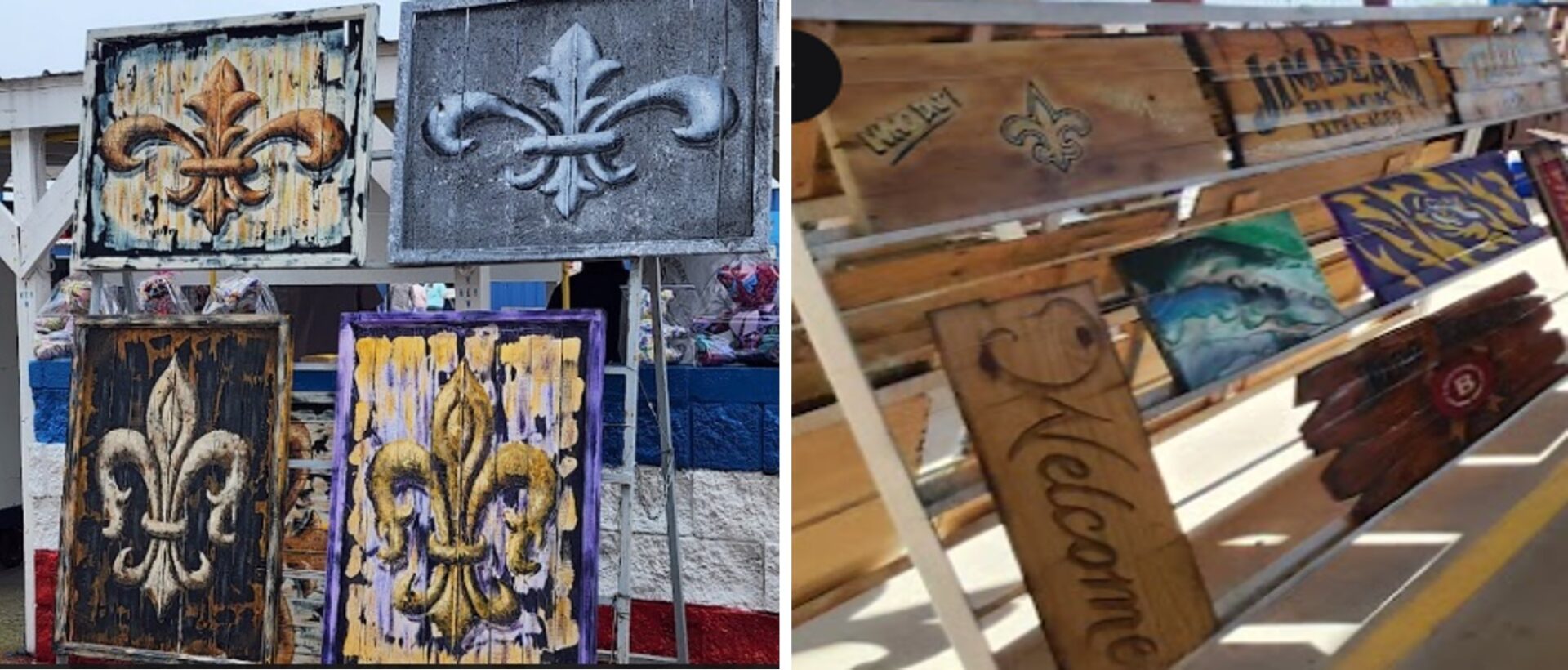
Interviews with spectators underscore this framing. When asked why they attended, seven respondents emphasized entertainment, describing the event as part of a broader Southern rodeo tradition. One regular attendee of regional rodeos characterized Angola’s event simply as another stop on his circuit. Others highlighted the appeal of inmate-made crafts—often featuring local icons like the fleur-de-lis or Louisiana sports teams (see Figs. 9–10)—treating these items as artisanal curiosities detached from their carceral origins. Some highlighted the appeal of the rodeo as stemming from its family-friendly attractions like carnival rides and live music (n = 4). Even visitors who had incarcerated relatives at Angola (n = 2) focused on the day’s recreational aspects, relegating the prison context to the background.
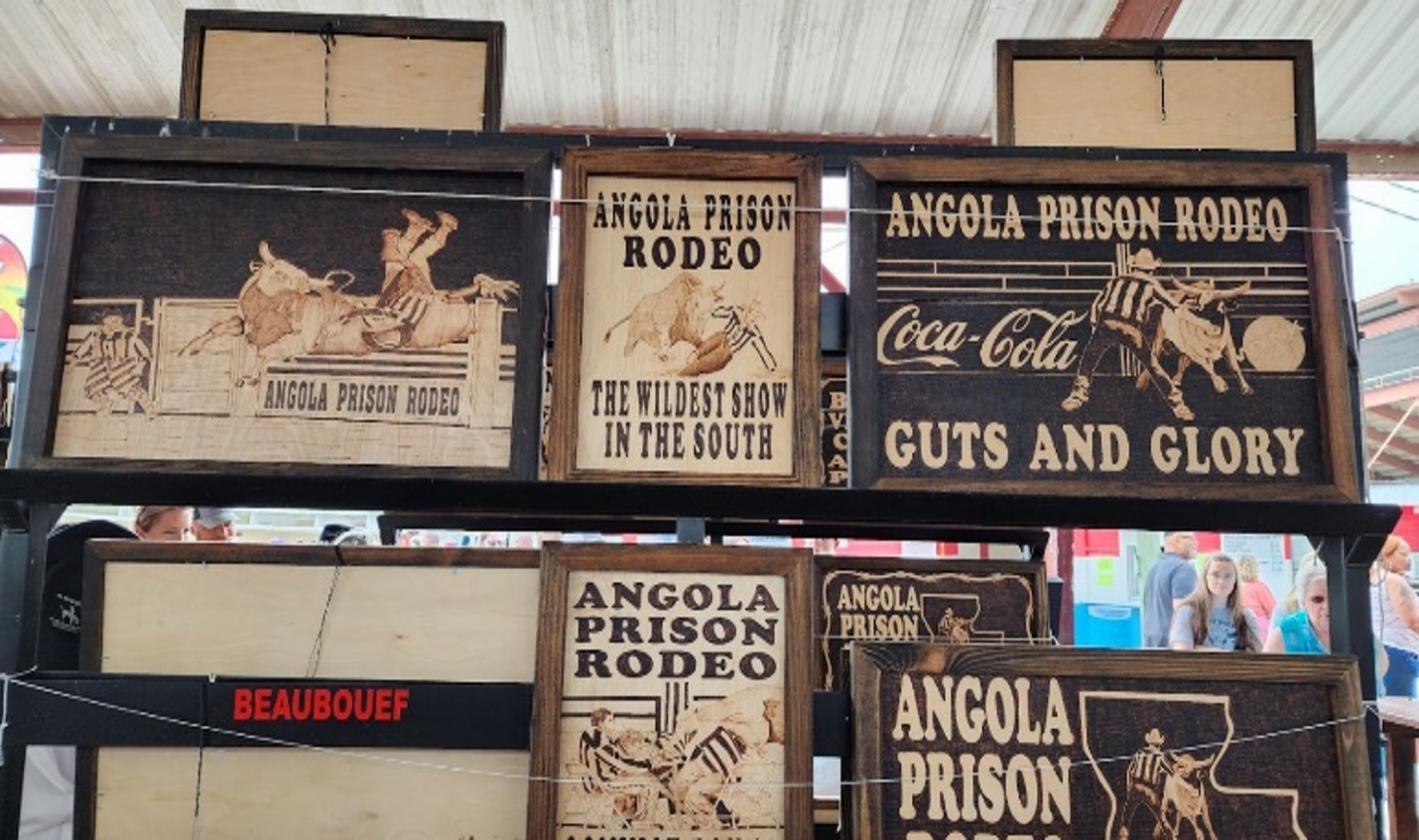
In these ways, the Angola Prison Rodeo transforms the visibility of the prison into a marketable spectacle. It invites the public to engage with incarceration not as a site of punishment and constraint, but as a venue for entertainment and consumption.
Inmate Visibility as Cultural Challenge
While spectators largely consume the Angola Prison Rodeo as entertainment, incarcerated individuals use the event to assert a more complex kind of visibility—one that subtly contests dominant perceptions of imprisonment. Visuality, as Nicholas Mirzoeff defines it, is not merely the act of seeing; it is a political system that organizes what can be seen, by whom, and for what ends.46 Emerging alongside the projects of slavery and empire, visuality naturalizes social hierarchies and legitimates domination by determining whose lives are rendered visible, and in what ways. Within this framework, incarcerated people are largely subjected to a carceral visual regime that keeps them out of public sight—socially and spatially removed—except when institutions selectively display them in ways that reinforce their subordinate status and uphold the legitimacy of punitive systems.
Yet at the rodeo, incarcerated individuals seize on this carefully controlled moment of visibility to challenge the meanings imposed upon them. Many engage in what Mirzoeff terms countervisuality: collective practices through which marginalized groups assert the right to be seen differently, or on their own terms. In interviews, most inmates (N = 7) described the rodeo as a chance to challenge entrenched stereotypes and reassert their humanity. As one participant put it:
People come in here under one perception. They freak out when they see an inmate convicted of murder being this close to you. Then they see that we’re not obviously this way. We are just like them. The only difference is we’re behind a fence and they’re not.
In these moments, incarcerated individuals sought not to erase their status as prisoners, but to redefine it—presenting themselves not as dangerous others, but as complex, moral subjects. This offers a subtle, yet deliberate critique of the prison system’s social logics (see Fig. 11).
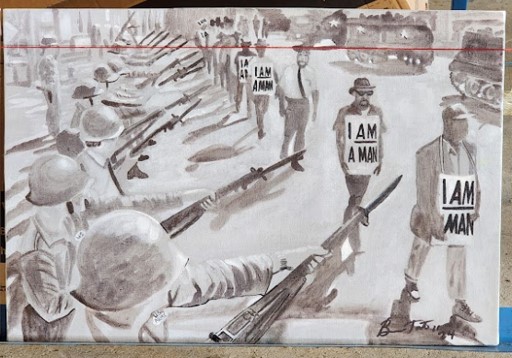
However, this countervisuality is tightly constrained by the structure of the event. The rodeo’s consumer-driven, celebratory framework shapes the kinds of visibility inmates can safely inhabit. Uniformly dressed in jeans and white shirts, inmates move through roles as artisans, performers, and vendors—identities legible within a logic of entertainment and commerce, but which obscure the daily realities of confinement and control. Interactions with spectators rarely broached the subject of imprisonment directly, instead centering on craft sales, personal charm, or performances that entertained and reassured.
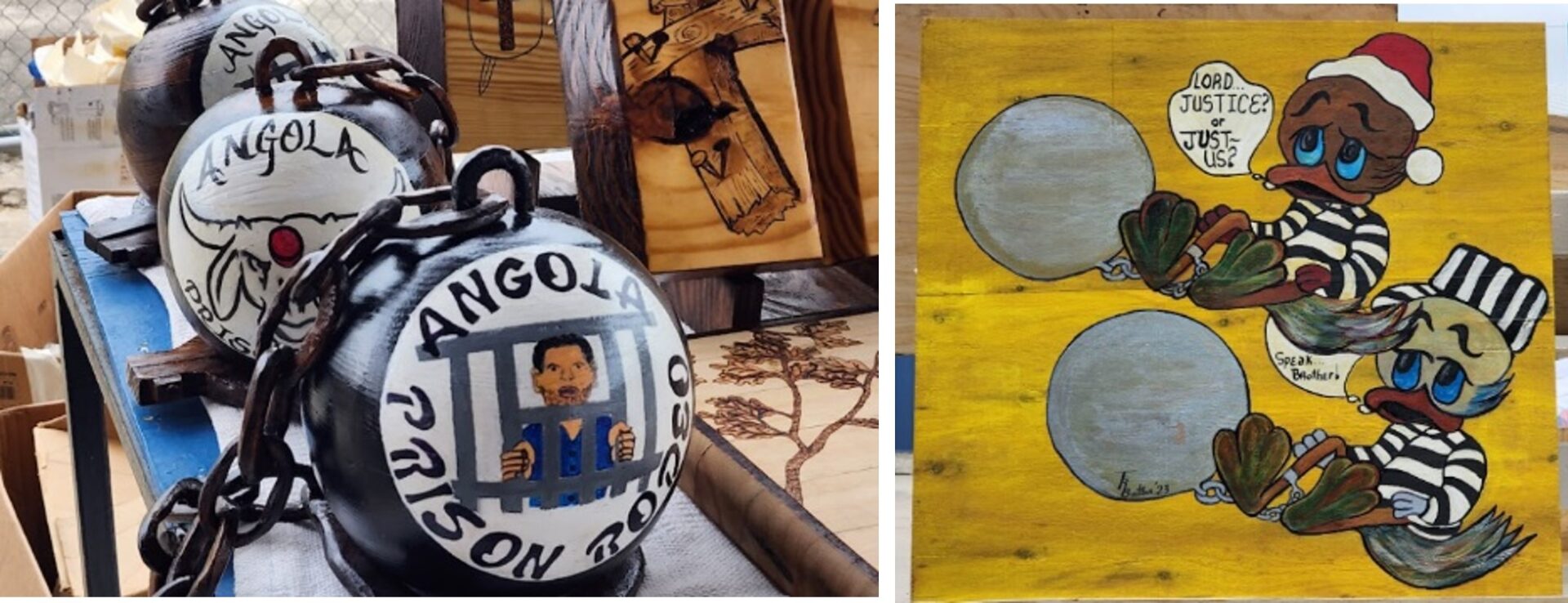
Inmate-produced hobbycraft exemplifies this dynamic. Crafts rarely addressed the experience of incarceration itself, focusing instead on culturally resonant themes like regional sports or rodeo imagery (see Figs. 9–10). These choices reflected inmates’ strategic awareness of market demand; prior research has shown that crafts explicitly referencing prison life are less likely to sell. While some inmates created pieces highlighting the carceral setting (see Fig. 12), these were rare and often overshadowed by decorative or utilitarian items like cutting boards, leather goods, and jewelry—objects devoid of overt critique. Thus, inmates’ ability to engage in countervisuality remained sharply limited by the consumption-oriented structure of the event, which ensured that spectators encountered little direct challenge to prevailing ideas about punishment.
Class Divisions and Tacit Legitimacy
The tension between inmates’ constrained efforts at countervisuality and spectators’ primarily entertainment-driven engagement reveals a broader pattern of managed carceral visibility. While the rodeo appears to break down entrenched class divisions between the incarcerated and the free—allowing unprecedented interaction—this proximity is tightly orchestrated. Rather than collapsing social hierarchies as previous scholars have argued,47 the event repackages them into a structure of consumption that privileges the comfort and expectations of spectators.
Unlike traditional penal tourism, which often focuses on historical punishment and invites limited reflection on the past,the Angola Prison Rodeo obscures both historical and contemporary functions of incarceration. It stages no tours of cell blocks, no discussions of sentencing, no depictions of solitary confinement or forced labor. Instead, like carefully managed tours of active prisons, the rodeo shapes the spectator experience through spatial choreography and thematic framing. Visitors are steered toward sanctioned sites where incarceration is aestheticized and stripped of its political and structural dimensions.
This curated visibility offers the illusion of access while reinforcing dominant ideologies of incarceration. By allowing spectators to see inmates only within festive, market-driven contexts, the rodeo aestheticizes imprisonment, converting it into a spectacle of leisure that demands no substantive critique. The inmate becomes legible not as a political subject, but as a craftsperson, a performer, or a source of thrilling risk—figures that ultimately bolster, rather than unsettle, the legitimacy of the institution.
In this way, the Angola Prison Rodeo demonstrates that visibility itself can be a powerful mechanism of cultural legitimation. It constructs a version of the prison that is entertaining, emotionally resonant, and aligned with broader cultural values about punishment.
Rehabilitation and Performance
While the day-to-day realities of penal life are obscured from the public, the Angola Prison Rodeo selectively stages visibility to align with dominant cultural expectations of the prison as a rehabilitative institution. As Benjamin Reiss observes, nineteenth-century asylums often organized concerts, plays, and art exhibits to demonstrate residents’ supposed moral improvement, reinforcing the institution’s legitimacy.48 Similarly, the Angola Prison Rodeo transforms the penitentiary into a theatrical space where inmates’ performances symbolize rehabilitation under institutional guidance. Even when inmates attempt to resist or reinterpret this framing, the rodeo carefully curates their visibility in ways that ultimately affirm the prison’s narrative of moral correction.
Spectating Rehabilitation
Promotional materials frame the rodeo as both a behavioral incentive and a fundraiser for reentry programs (see Fig. 2). Media perpetuate this narrative. In a 2014 interview with Al Jazeera, former warden Burl Cain framed the rodeo as integral to rehabilitation, stating, “Today [the inmates] can be king for a day. […] This is part of the rehabilitative program and part of our reentry is to do this rodeo.”49
The physical layout of the event reinforces these themes. Food vendors prominently display signs for affiliated prison support networks and sober living initiatives, embedding messages of redemption into the consumer landscape. The rodeo itself opens with a prayer circle (see Fig. 13), framing the prison as a site of moral transformation. These orchestrated displays construct a spectacle of reform that spectators consume alongside the entertainment.
Spectator interviews reveal how deeply this narrative is internalized, with two dominant themes emerging. First, most spectators viewed rodeo participation as a privilege earned through good behavior (n = 8). As one explained, “The rodeo is a great morale booster…. If you’re not in a good position, they don’t allow you to participate. A lot of guys are motivated to behave themselves.” In this framing, visibility is conditional: Only those deemed rehabilitated are permitted to appear before the public, thereby reinforcing the legitimacy of the prison’s internal disciplinary regime.
Second, spectators see the rodeo as a motivating future rehabilitation (n = 8). One explained:
This lets them know what they’ve missed and that they want to get back to us. So, in order to get back to us, they’re going to have to rehabilitate themselves and say, “Hey, this is not where I want to be. I want to be in the outside world. So, I’m just going to do what’s necessary, not just to get out there, but to stay out there.”
This framing casts the rodeo less as a penal ritual and more as a “free-world” event that inmates must earn the right to join. It simultaneously obscures the carceral nature of the institution and situates the rodeo as a redemptive incentive, encouraging inmates to align their conduct with prison directives. In this way, the rodeo affirms class divisions even as it appears to momentarily collapse them: For spectators, it is entertainment; for inmates, it is evidence of their supposed transformation.
Yet crucially, this rehabilitative spectacle coexists with an unabashed endorsement of retributive justice. Nearly all spectators also articulated explicitly punitive views of imprisonment (n = 7). As one formerly incarcerated respondent put it, “Even though I did 24 years, I did something wrong to be here.” Another spectator, blending both rehabilitation and punishment, remarked: “I feel like [the rodeo] is a wonderful program for them to show some of that talent. But some criminals don’t need to be in society.”
Even when spectators acknowledged systemic injustices or the possibility of wrongful convictions (n = 2), these were treated as exceptions—rare deviations that did not undermine the prison’s moral authority. In this logic, rehabilitation and retribution are not opposed but mutually reinforcing: The prison punishes, and thus it earns the right to rehabilitate. The rodeo stages this relationship for public consumption, converting penal power into a redemptive spectacle that legitimizes the institution through its selective, carefully curated display of inmate transformation.
In Doubt of Rehabilitation
In striking contrast to spectators, inmates expressed deep skepticism about the prison’s rehabilitative capacity. Like the broader public, most inmates nonetheless endorsed incarceration as a necessary institution (n = 8). One remarked, “If you did the crime… you need to take responsibility. So it’s a necessary thing. It’s necessary to give repentance.”50
Yet this endorsement was rarely unconditional. Many inmates drew symbolic boundaries between themselves and what they described as a persistent “delinquent class” (n = 6). As one explained, “I believe that prison is a necessary evil… some people don’t want to change, and you see that around here.” By distinguishing themselves from others deemed irredeemable, inmates simultaneously affirmed the need for incarceration while positioning themselves as exceptions—individuals who should not bear its harshest retributive consequences.
However, when it came to the prison’s rehabilitative function, inmates were largely dismissive (n = 5). They argued that incarceration did little to foster meaningful change, often intensifying rather than remedying criminal tendencies. One observed, “You take a guy, and you lock him up for 20 years; he’s either one hundred times better or one thousand times worse.” For most, rehabilitation was an individual endeavor divorced from institutional efforts. As one inmate put it succinctly, “It’s about how you apply yourself while you’re in prison.”
Others pointed to the fundamental lack of reintegration opportunities, especially for Angola’s many lifers. One inmate lamented:
They should have an outlet for offenders. You should not have to spend the rest of your life in prison. You know, I’ve been here 29 years…. So, it should be an outlet. It should be a revolving door. If you decide to come back, then that’s fine. But at least say good luck and be a model civilian. And you should be able to stay out there.
These perspectives lay bare a central contradiction: While the rodeo publicly stages the prison as a site of moral transformation, inmates themselves overwhelmingly view such institutional claims as hollow. Their critical insights remain largely invisible to the spectators consuming the event, highlighting how the rodeo manages not just what is seen, but whose interpretations are heard.
Proximity and Critique
These divergent perspectives on rehabilitation illustrate the remarkable cultural resilience of the prison. Both spectators and inmates ultimately endorse incarceration as a legitimate punitive institution, reinforcing the hegemonic US penal ethos. Yet their proximity to the realities of imprisonment profoundly shapes how they interpret the prison as a rehabilitative institution.
For spectators, the rodeo affirms the prison’s dual purpose: punishment and rehabilitation. This reflects broader trends in Southern penal institutions, where incarceration is framed not only as a means of punishment but as a necessary moral and social corrective.51 The rodeo reinforces these views by staging inmates as reformed artisans and performers, temporarily bridging the divide between the free and the confined. That this spectacle occurs at Angola—a prison where over 78% of inmates serve life without parole52—underscores the symbolic, rather than practical, nature of this promise. Still, because spectators encounter the prison only through the carefully curated frame of the rodeo, they readily accept a vision of incarceration where retribution and redemption work hand in hand.
By contrast, inmates’ closer proximity to the institution’s contradictions fosters a more critical stance. They overwhelmingly reject the idea that the prison fosters rehabilitation, emphasizing instead its failures to prepare individuals for reintegration or to promote genuine change. Yet notably, this critique does not translate into a wholesale rejection of the institution itself. Like spectators, inmates largely affirm the prison’s punitive role, often by situating themselves apart from others they see as unworthy of reform.
This reveals a paradox central to the cultural durability of the prison: The closer one is to its daily contradictions, the more apparent its failures become, yet this proximity does not necessarily undermine belief in its necessity. Inmates recognize the hollowness of institutional rehabilitation while still accepting the broader legitimacy of punishment. Spectators, insulated from these contradictions by selective visibility, more easily embrace the rehabilitative narrative as evidence of the prison’s moral authority. In both cases, the institution’s legitimacy is reaffirmed.
Ultimately, the Angola Prison Rodeo exemplifies how selective visibility serves as a potent mechanism of cultural legitimation. Like the 19th-century asylum performances Reiss described, the rodeo does not document rehabilitation as a concrete institutional practice; it theatrically enacts its appearance. By channeling inmates’ visibility into narrowly sanctioned performances of reform and craft, the rodeo reassures spectators, silences deeper critique, and sustains the affective and symbolic frameworks that are crucial to maintaining state power.
Violence and Redemption
The rodeo extends the entwined logics of rehabilitation and retribution to its staging of violence. Unlike the bureaucratically obscured harms of solitary confinement, medical neglect, or forced labor—forms of violence that operate out of public view—the Angola Prison Rodeo places corporal risk and injury at the center of its spectacle. This return to visible, bodily punishment appears to break from the “civilizing process” that genealogies of the prison often highlight. Yet paradoxically, this heightened visibility does not threaten the prison’s cultural legitimacy. Instead, it is absorbed into the institution’s disciplinary narrative, reframed through entertainment and the symbolic language of redemption. Here, spectacular violence coexists with and even bolsters the bureaucratic order of the penal institution.
Violence as Rehabilitation: The Impact of Rodeo Culture
Field observations reveal that spectators did not revel in inmate injuries. Rather than deriving pleasure from harm in the rodeo, they winced, gasped, or groaned when inmates suffered serious falls. While victories were rare—only one inmate successfully completed an eight-second bronco ride, and none succeeded in bull-riding or the Guts and Glory event—spectators erupted in cheers for inmates’ near triumphs. These responses suggest that spectators were primarily invested in celebrating inmates’ perseverance and resilience, rather than in the spectacle of harm for its own sake.
Interview data reinforces these observations. Many respondents expressed discomfort with witnessing injuries (n = 5), mirroring the sympathetic reactions observed during the events. Some justified the risks by emphasizing the inmates’ apparent voluntariness (n = 3), while two explicitly situated the danger within a broader rodeo tradition, where physical risk is an inherent—and culturally valorized—aspect of the sport.
This reading aligns closely with Elizabeth Lawrence’s analysis of mainstream rodeo culture, which frames its physical violence as a “badge of conquest of fear and pain.” Within this cultural logic, harm is not gratuitous but is recast as evidence of a competitor’s mastery over bodily limits and natural forces. As Lawrence observes, rodeo participants “free themselves from their own bodily limitation […] they are liberated to the highest degree possible from the restrictions of nature itself.”53 The cowboy’s mastery over physical danger and natural forces is central to the cultural appeal of the rodeo, transforming risk into a performance of discipline and control.
At the Angola Prison Rodeo, this dynamic is intensified by the heightened risks inmates face. Unlike professional rodeos, Angola’s events prioritize luck over skill, exemplified by the “last man standing” format, where inmates must withstand physical harm rather than demonstrate technical expertise. Even in skill-based events, such as bronco riding, inmates lack access to training or practice facilities, further exacerbating their vulnerability. This elevated danger, however, demands an even more pronounced display of discipline than traditional rodeo work: Inmates must demonstrate not only the courage to face unpredictable harm but also the composure to submit to institutional structures that orchestrate their risk. Within the cultural logic of rodeo, such willingness becomes a heightened badge of mastery over one’s own body, over fear, and ultimately over the moral trials the prison claims to administer. Thus, what might appear as raw exploitation is reframed as a testament to inmates’ extraordinary self-control, reinforcing the very ideals of order and personal reform that justify the prison’s authority.
This convergence of the penal institution and the cultural tradition of the rodeo creates a hybrid spectacle that is at once punitive and redemptive. As Rebecca Scofield argues, prison rodeos function as a form of “social salvation,” where enduring physical hardship serves as proof of an inmate’s capacity for reform.54 Under this logic, violence becomes rehabilitative: It is not understood as excessive coercion, but as a necessary ordeal that reveals moral fortitude and discipline.
Far from undermining the prison’s legitimacy, the rodeo’s highly visible violence reinforces it. By embedding state-sanctioned harm within a cultural form already steeped in narratives of redemption and self-overcoming, the event transforms what might otherwise appear as brutality into evidence of the prison’s corrective mission. The inmate who risks bodily harm does not expose the cruelty of the carceral state; rather, they become a living testament to its moral purpose. In this way, the Angola Prison Rodeo exemplifies how spectacular violence can be reconstituted within existing cultural frameworks to secure the very legitimacy it might otherwise endanger.
For Cash and Glory
As previous findings illustrate, inmates overwhelmingly doubted the prison’s rehabilitative function and did not describe their participation in the rodeo in rehabilitative terms. Instead, their motivations were largely instrumental, driven by two central incentives: financial necessity and the opportunity to engage in countervisuality.
Prize money and hobbycraft sales were central motivations for participation. Rodeo winnings and craft revenues provided inmates with means to support themselves and maintain ties beyond the prison walls. As one participant explained, “We don’t make much here. It’s $0.06 an hour. So this gives you something. It relieves the burden on your family to care for you.” Financial pressures thus transformed the rodeo from mere entertainment into an economic lifeline.
Still, those who chose to compete in physically dangerous events rather than sell crafts often emphasized the personal thrill and symbolic stakes of competition. As one inmate recounted, “I’ve been shell-shocked a few times… Broke my arm in an event, but won it.” Despite injuries, he described an almost compulsive draw to the arena: “I started becoming more attracted and addicted to it . . . If you win an event, they cheer . . . it’s like an adrenaline rush. I like a challenge.” Others echoed this sentiment, highlighting the fulfillment that came from overcoming fear and pain. One noted simply, “They like challenges and danger. That’s what they enjoy.”
Here, rodeo violence was not framed as institutional exploitation but as a personal proving ground—mirroring dominant rodeo culture, where risk signifies individual mastery and toughness. Importantly, inmates distinguished this type of violence from the bureaucratic, impersonal harms they routinely criticized in prison life, such as isolation or medical neglect. Within the cultural logic of rodeo, even state-organized bodily risk could be reimagined as voluntary, identity-affirming, and meaningful.
Field observations reinforced these narratives. Inmates often celebrated small victories with theatrical gestures, like climbing the stadium fence to salute the cheering crowd. Such moments offered more than economic gain: They provided a stage for inmates to challenge their stigmatized identities, stepping into the culturally valorized role of the cowboy.
Yet this assertion of agency was deeply constrained by the institutional structure that made such participation necessary. Several inmates described starting in the arena for prize money, then shifting to craft sales once they secured access to materials through privileged prison jobs (n = 4). As one hobbycraft vendor noted, “If I lose my job, I’ll probably be back out there [competing in rodeo].” Those working on Angola’s Farm Line or in other less favored assignments often lacked such access, leaving dangerous rodeo participation as one of the only routes to modest financial support or public interaction. In this way, the prison transformed economic deprivation and social marginalization into a controlled spectacle of consent. What appeared as freely chosen risk was often a carefully structured decision under the shadow of institutional power and an internal labor hierarchy. By presenting this participation as voluntary, the rodeo obscured the coercive context shaping inmates’ choices and recast compliance and bodily risk as personal agency.
Moreover, even as inmates attempted to assert some form of countervisuality in these rodeo performances, the broader spectacle reabsorbed their individual agency into the legitimating logic of the prison. Spectators did not see these performances as critiques of incarceration or expressions of resistance. Instead, they interpreted them as evidence of the prison’s rehabilitative success. In this sense, the spectacle neutralized the countervisual message.
Staging Violence, Concealing Power
Taken together, these findings show how spectacular violence is transformed into an affirmation of penal order. Spectators and inmates alike did not interpret rodeo injuries as state-inflicted violence. Instead, risk was framed through familiar cultural narratives that rendered it voluntary, redemptive, and even necessary. For spectators, the rodeo’s dangers did not appear to violate the prison’s moral purpose. On the contrary, the event harmonized with broader cultural scripts that blended punishment with moral uplift. As interviews revealed, spectators often saw inmates’ willingness to compete—and endure harm—as evidence of both individual reform and the prison’s successful guidance.
This cultural rationalization challenges Schrift’s argument that spectators attend primarily to witness inmate suffering as dark tourists. In this study, spectators frequently expressed discomfort with visible harm but quickly reframed it through the rodeo’s logic, where risk signals courage and moral worth. Injuries did not challenge the institution’s legitimacy; they became markers of inmates’ moral rehabilitation, reinforcing the prison’s disciplinary authority.
For inmates, too, the cultural logic of rodeo structured how they made sense of the event. Rather than viewing the rodeo as a mechanism of institutional control, they described it as a source of financial support, personal excitement, and public recognition—a “challenge,” a chance to display strength and skill before an engaged audience. Within these constraints, inmates framed their participation as an act of agency.
Yet even these attempts at countervisuality—where inmates sought to reclaim a visible, dignified identity—were ultimately reabsorbed into the prison’s legitimating framework. As Lawrence observes, “the surrounding and supporting society exerts a profoundly influential force in the ritual itself.”55 Inmates’ performances of discipline and endurance, while deeply meaningful to them, were read by spectators not as challenges to their carceral status, but as evidence of successful rehabilitation. In this way, the rodeo did not merely showcase the prison’s control over inmate bodies, as Gould suggests,56 but also aligned that control with cultural expectations of compassion and reform—portraying incarceration itself as a humanitarian penal practice.
Further complicating this legitimating spectacle are the event’s racial dynamics. While the rodeo features racially diverse participants and audiences, the majority of inmate competitors are Black, while most spectators are white. This pattern echoes longstanding carceral logics in which Black suffering is rendered culturally acceptable. As Gillespie argues, cultural narratives around Blackness and delinquency shape public perceptions of the rodeo, reinforcing a racialized framework in which harm against Black bodies is more easily justified.57 In this context, the rodeo’s violence is legitimized through two interwoven dynamics: the cultural logic of rodeo, which frames physical endurance as proof of moral redemption, and the racialized logic of punishment, which normalizes Black suffering within the carceral state.
By embedding the rodeo within narratives of courage and redemption drawn from Southern rodeo traditions and by tapping into racialized penal scripts, the prison reframes spectacular violence as a natural extension of its corrective mission. In doing so, it legitimizes the rodeo as a plausible penal practice and fortifies its own moral authority. The risks and injuries on display become not signs of institutional failure, but of its rehabilitative promise. In this way, the prison’s disciplinary power is sustained not just by bureaucratic routine or overt coercion, but by its deep entanglement with widely held cultural logics that normalize and justify its practices.
Synopticism and Penal Authority
The Angola Prison Rodeo illustrates how selective visibility enables the prison to thrive not only as a cultural symbol but also as a powerful disciplinary institution. The rodeo does more than bolster the prison’s moral legitimacy; by shaping how punishment is publicly seen and understood, it actively expands the institution’s reach. Spectators become more than passive onlookers. Through their collective gaze and financial participation, they are drawn into sustaining and extending the prison’s power.
The Public as Synopticon: Strengthening Institutional Power
As David Garland observes, penal rituals such as public executions, sentencing hearings, etc. work on two levels: they operate as Durkheimian ceremonies that reaffirm shared moral values around crime and discipline, while also serving as Foucauldian instruments that normalize state authority and make carceral power appear both necessary and natural.58 In Escape to Prison, Michael Welch extends this insight to the realm of penal tourism, arguing that visits to carceral sites are not merely about satisfying curiosity. Instead, they draw the public into performative rituals that cultivate cultural consensus around punishment and deepen support for the very institutions that administer it.
Yet at Angola, this process of consent and complicity begins long before spectators enter the prison grounds via synoptic advertising. Where Foucault’s panopticism describes the few watching the many to enforce discipline, Thomas Mathiesen asserts that in a media-saturated society, the many watch the few.59 This mass-mediated gaze does not disrupt institutional power but reinforces it, as authorities carefully curate what is visible to manufacture legitimacy and secure compliance. The synopticon does not replace the panopticon; it operates alongside it, embedding surveillance and discipline within popular culture and everyday life.60
The Angola Prison Rodeo exemplifies this synoptic mechanism. Through pervasive advertising and cultural marketing, the rodeo shapes public perceptions of the prison well before visitors arrive, portraying Angola as both a morally necessary institution and a site of personal transformation. Once inside, spectators encounter a choreographed landscape that recasts violence as entertainment and moral trial, ensuring what they see conforms to dominant narratives of rehabilitation, grit, and social order.
Critically, this managed visibility does more than produce ideological consent; it has immediate material effects. Unlike typical penal tours of abandoned sites, the Angola Rodeo takes place within a functioning prison economy. Revenues from tickets, concessions, and hobbycraft purchases directly support inmate programs that expand the institution’s disciplinary capacity. Spectators thus become not only cultural consumers of the prison’s spectacle but also financial underwriters of its ongoing operations.
In this way, the Angola Prison Rodeo demonstrates how modern punishment is reproduced through intertwined cultural and economic mechanisms. It fuses Gramscian cultural consent with Foucauldian disciplinary power that extends its reach through managed visibility and public participation. By inviting the public to watch, endorse, and materially sustain its operations, the rodeo does not merely uphold the prison’s authority; it deepens and entrenches it, showing how contemporary punishment is secured as much through cultural allure and economic flows as through overt force.
The Synoptic Gaze and Inmate Compliance
The synopticon at the prison rodeo also functions as a direct instrument of discipline, extending carceral power through the public’s gaze. As surveillance studies have long argued, disciplinary power is diffuse; it does not end at institutional walls but radiates outward, incorporating social observers into its machinery.61 At Angola, this diffusion is evident in how the prison merges its internal panoptic surveillance of inmates with the synoptic surveillance of the public.
Inmates actively seek out this public gaze. They pursue it as a way to earn money through rodeo participation or hobbycraft sales, and as a rare chance to present themselves beyond the narrow identity of “offender”—even though these self-presentations are ultimately recoded by the institution to reinforce its legitimacy. Crucially, however, access to the synoptic gaze is contingent on prior compliance with the prison’s disciplinary expectations. As several inmates emphasized (n = 5), participation in the rodeo is not a right but a privilege earned through demonstrated good behavior: “We have to work to earn it,” one noted.
This structure is deeply stratified. Trustee inmates—those who most reliably conform to prison regulations—gain the broadest access to spectators. They move with relative freedom, engage directly with visitors, market their crafts, and reap economic and social rewards from synoptic exposure. By contrast, big-stripe inmates in more restrictive classifications are positioned behind fences, permitted only limited participation with far fewer chances to benefit from the public gaze and sell their goods. In this way, the synoptic gaze is not passive observation; it operates as a disciplinary incentive, selectively granted to those who first submit to the prison’s panoptic authority.
Through this process, the public gaze becomes an instrument of carceral control. By tying access to spectators—and the economic and symbolic benefits this brings—to prior obedience, the prison effectively enlists the public in its disciplinary project. The Angola Prison Rodeo does not merely display the prison to society; it makes society an active participant in governing the incarcerated. Spectatorship itself becomes a tool that legitimizes, sustains, and materially strengthens the prison’s authority, weaving everyday people into the ongoing enforcement of institutional discipline.
Penal Tour, Penal Ritual, Penal Practice
Taken together, these findings show how the Angola Prison Rodeo relies on carefully orchestrated acts of selective visibility to secure and expand the prison’s power. Selective visibility is a defining feature of contemporary punishment culture: Prisons highlight certain aspects of their operations while obscuring others, shaping public understanding and legitimating incarceration. This process embeds the prison within the cultural realm, thereby making imprisonment appear both natural and beneficial, a mechanism that can be understood through Gramsci’s concept of “common sense.” These orchestrations do more than mold beliefs: They function as technologies of social control, a framework supported by Foucault’s analysis of disciplinary power. This extends the prison’s disciplinary reach by recruiting the public to watch, fund, and participate in its operations. Unlike conventional penal tourism, which typically focuses on historical or decommissioned sites, the Angola Rodeo offers direct access to a functioning prison. In this way, it aligns with active prison tours, which also rely on selective visibility within the active prison site. Yet, where standard active tours exert institutional control through the micromanagement of spectators’ interaction with inmates, the rodeo takes a critical step further. Instead of relying on this direct oversight from prison personnel, it employs a massively staged spectacle to manage visibility. The framing of the event as entertainment and rehabilitation performs the function of control for the prison, actively governing what is revealed and what is concealed. This strategic orchestration is achieved by fusing vivid spectacles of bodily risk with familiar narratives of rodeo valor and longstanding racialized ideas of punishment. It transforms what might otherwise be seen as coercive state violence into a culturally resonant performance of rehabilitation and moral order. Rather than exposing the contradictions of mass incarceration, the spectacle conceals them, rendering punishment ordinary, entertaining, and culturally resonant.
This study builds on existing scholarship but also advances it in key ways. As Gould noted, the rodeo does affirm the prison’s authority62; as Gillespie noted, it does so by drawing on the racialized history of incarceration.63 However, this study suggests that the rodeo’s legitimacy is not rooted primarily in overt, spectacular violence, as Schrift argued.64 While the event draws on racial scripts that legitimate carceral power, it does so by embedding violence within a rehabilitative, culturally familiar framework of rodeo competition. This framing normalizes inmate harm, not as a rupture in penal order, but as evidence of its moral purpose. More critically, this study reveals that the rodeo does not merely produce cultural narratives—it materially expands the prison’s disciplinary apparatus. Through spectators’ financial investments and the synoptic gaze, the public becomes directly entangled in the carceral project, underwriting and socially enforcing its authority.
Taken together, these insights show how the Angola Prison Rodeo exemplifies the modern prison’s capacity to fortify itself through both Gramscian cultural consent and Foucauldian discipline. By managing what is seen and how it is understood, the rodeo embeds incarceration within everyday moral and cultural frameworks, while simultaneously deepening the reach of carceral power. By tracing how selective visibility, racial scripts, public investment, and diffuse surveillance intersect, this study demonstrates that penal power is not merely maintained but actively enlarged. The Angola Prison Rodeo thus reveals how contemporary punishment operates not only through hidden bureaucratic mechanisms, but also through public rituals that make carceral authority appear natural, redemptive, and indispensable.
Conclusion
This study acknowledges several limitations that shape its findings. First, while the spectators interviewed here overwhelmingly viewed the rodeo as a positive or benign event, this is not a universal cultural interpretation. Journalistic accounts have compared the Angola Prison Rodeo to exploitative gladiatorial combat, with critics calling it “warped” and “inhumane.”65 Such critiques reveal that the rodeo’s legitimizing effects are not uncontested, pointing to important sites of cultural resistance that warrant further exploration. Nonetheless, the rodeo’s capacity to generate revenue and reinforce disciplinary control ensures its endurance, even amid some public objection.
Second, this study focuses exclusively on inmates who gained institutional approval to participate in the rodeo—whether through direct competition or hobbycraft sales—thus representing a privileged subset of Angola’s incarcerated population. Many others, excluded by disciplinary status, security classification, or personal choice, may view the rodeo not as an opportunity but as an inaccessible privilege or even a coercive spectacle. By analyzing the perspectives of only those permitted to engage, this study captures a key mechanism of discipline while highlighting the need for future research on non-participating inmates, whose perspectives may complicate or challenge these findings.
Beyond the Angola Prison Rodeo, broader shifts in mass media continue to reshape the visibility of the prison. The rodeo allows an unprecedented level of visibility with incarcerated individuals, but reality-based media like Scared Straight!66or Lockup67has intensified existent cultural fascination with media portrayals of punishment.68 The popularity of recent releases like Netflix’s Unlocked: A Jail Experiment 69 illustrates how synoptic media continues to fuel public interest in crime and punishment. These portrayals do more than satisfy public curiosity: They teach societal norms, extend carceral power into civilian life, and encourage incarcerated individuals to regulate their own behavior in anticipation of external scrutiny. Meanwhile, vast dimensions of prison life remain strategically hidden from view, which helps sustain the cultural legitimacy of the prison via mass media.
The Angola Prison Rodeo thus serves as a revealing case study for how selective visibility, cultural scripts, and the synoptic mechanism work together to naturalize incarceration. This research shows how carefully curated spectacles can anchor prisons more deeply in the cultural imagination. Drawing on Gramsci, it highlights how penal rituals like the rodeo manufacture cultural “common sense,” making incarceration appear morally necessary and inevitable. At the same time, following Foucault, it reveals how these rituals extend disciplinary power beyond prison walls, recruiting the public as financial supporters and informal overseers of the carceral state.
By tracing these intersections of spectacle, surveillance, and social control, this study contributes to a deeper understanding of how penal power is not merely maintained but actively enlarged. The Angola Prison Rodeo does more than reflect the authority of the prison—it amplifies it, ensuring that incarceration persists not only as a legal institution but as a vital cultural practice, woven into the fabric of life in the US.
Notes
- “Wildest Show in the South!,” Angola Prison Rodeo, http://www.angolarodeo.com. ↩
- Clifford Geertz, The Interpretation of Cultures (Basic Books, 1973), 3–30. ↩
- “History of the State Penitentiary,” Louisiana Prison Museum and Cultural Center, https://www.angolamuseum.org/history. ↩
- Ibid. ↩
- State of Louisiana Department of Public Safety & Corrections, “Tickets Now on Sale for Spring Angola Prison Rodeo,” Press release, February 17, 2023,https://doc.louisiana.gov/wp-content/uploads/2023/06/2.17.23-Tickets-Now-on-Sale-for-Spring-Angola-Prison-Rodeo.pdf. ↩
- Ibid. ↩
- Julia O’Donoghue, “Angola Rodeo Finances Will Be Investigated Further by Legislative Auditor,” NOLA.com, March 22, 2017, https://www.nola.com/news/politics/angola-rodeo-finances-will-be-investigated-further-by-legislative-auditor/article_0af3e9eb-1864-59cb-8078-1bdd1c8051d5.html. ↩
- Michel Foucault, Discipline and Punish: The Birth of the Prison, translated by Alan Sheridan (Vintage Books, 1991). ↩
- Erving Goffman, “On the Characteristics of Total Institutions,” in Asylums: Essays on the Social Situation of Mental Patients and Other Inmates (Anchor Books, 1961), xiii. ↩
- Bernard E. Harcourt, “The Invisibility of the Prison in Democratic Theory: A Problem of ‘Virtual Democracy,'” The Good Society 23, no. 1 (2014): 6–16, https://doi.org/10.5325/goodsociety.23.1.0006; and Loïc Wacquant, Punishing the Poor: The Neoliberal Government of Social Insecurity (Duke University Press, 2009), https://doi.org/10.1215/9780822392255. ↩
- Marie Gottschalk, The Prison and the Gallows: The Politics of Mass Incarceration in America (Cambridge University Press, 2006), https://doi.org/10.1017/cbo9780511791093; and Jonathan Simon, Governing Through Crime: How the War on Crime Transformed American Democracy and Created a Culture of Fear (Oxford University Press, 2007), https://doi.org/10.1093/oso/9780195181081.001.0001. ↩
- Lisa Guenther, Solitary Confinement: Social Death and Its Afterlives (University of Minnesota Press, 2013), https://doi.org/10.5749/minnesota/9780816679584.001.0001; and Joshua M. Price, Prison and Social Death (Rutgers University Press, 2015), https://doi.org/10.2307/j.ctt15jjc08. ↩
- Antonio Gramsci, Selections from the Prison Notebooks, ed. and trans. Quintin Hoare and Geoffrey Nowell Smith (International Publishers, 1992). ↩
- As extended by Raymond Williams and Stuart Hall, this “common sense” naturalized institutional power by embedding it in familiar cultural logics. See Raymond Williams, Marxism and Literature (Oxford University Press, 1977); and Stuart Hall, “The Problem of Ideology: Marxism without Guarantees,” Journal of Communication Inquiry 10, no. 2 (1986): 28–44, https://doi.org/10.1177/0196859986010002. ↩
- Michael Ignatieff, A Just Measure of Pain: The Penitentiary in the Industrial Revolution (Pantheon Books, 1978); and John Pratt, Punishment and Civilization: Penal Tolerance and Intolerance in Modern Society (SAGE, 2002). ↩
- Norbert Elias, Essays II: On Civilising Processes, State Formation and National Identity (University College Dublin Press/Dufour Editions, 2009); and Pieter Spierenburg, The Spectacle of Suffering: Executions and the Evolution of Repression (University of Chicago Press, 1984). ↩
- Philip Smith, Punishment and Culture (University of Chicago Press, 2008). ↩
- David Garland, “Sociological Perspectives on Punishment,” Crime and Justice 14 (1991): 115–65, https://doi.org/10.1086/449185 . ↩
- David Garland, The Culture of Control: Crime and Social Order in Contemporary Society (University of Chicago Press, 2001), https://doi.org/10.7208/chicago/9780226190174.001.0001; James Q. Whitman, Harsh Justice: Criminal Punishment and the Widening Divide between America and Europe (Oxford University Press, 2005), https://doi.org/10.1093/acprof:oso/9780195182606.001.0001; and Peter K. Enns, Incarceration Nation: How the United States Became the Most Punitive Democracy in the World (Cambridge University Press, 2016), https://doi.org/10.1017/CBO9781316471029. ↩
- Christopher A. Innes, “Recent Public Opinion in the United States Toward Punishment and Corrections,” The Prison Journal 73, no. 2 (1993): 220–36, https://doi.org/10.1177/003285559307300200; Brandon K. Applegate, Francis T. Cullen, and Bonnie S. Fisher, “Public Support for Correctional Treatment: The Continuing Appeal of the Rehabilitative Ideal,” The Prison Journal 77, no. 3 (1997): 237–58, https://doi.org/10.1177/003285559707700300; and Francis T. Cullen, Bonnie S. Fisher, and Brandon K. Applegate, “Public Opinion About Punishment and Corrections,” Crime and Justice 27 (2000): 1–79, https://doi.org/10.1086/652198 . ↩
- Michelle Brown, The Culture of Punishment: Prison, Society, and Spectacle (New York University Press, 2009). ↩
- Angela Davis, “Racialized Punishment and Prison Abolition,” in A Companion to African-American Philosophy, ed. Tommy Lott and John Pittman (Blackwell Publishing, 2006), 362, https://doi.org/10.1002/9780470751640.ch23; and Simone Browne, “Notes on Surveillance Studies: Through the Door of No Return,” in Dark Matters: On the Surveillance of Blackness (Duke University Press, 2015), 31–62, https://doi.org/10.2307/j.ctv11cw89p.5. ↩
- Joy James, “Erasing the Spectacle of Racialized State Violence,” in Resisting State Violence: Radicalism, Gender, and Race in U.S. Culture (University of Minnesota Press, 1996), 26. ↩
- Ruth Wilson Gilmore, Golden Gulag: Prisons, Surplus, Crisis, and Opposition in Globalizing California (University of California Press, 2007); Judah Schept, Progressive Punishment: Job Loss, Jail Growth, and the Neoliberal Logic of Carceral Expansion (New York University Press, 2015); and Mariame Kaba, We Do this ‘Til We Free Us: Abolitionist Organizing and Transforming Justice (Haymarket Books, 2021). ↩
- Jacqueline Z. Wilson, Prison: Cultural Memory and Dark Tourism, (Peter Lang, 2008). ↩
- Michael Welch, Escape to Prison: Penal Tourism and the Pull of Punishment (University of California Press, 2015). ↩
- Carolyn Strange and Michael Kempa, “Shades of Dark Tourism: Alcatraz and Robben Island,” Annals of Tourism Research 30, no. 3 (2003): 386–405, https://doi.org/10.1016/s0160-7383(02)00102-0. ↩
- John Lennon and Malcolm Foley, Dark Tourism: The Attraction of Death and Disaster (Continuum, 2000); and Richard Sharpley and Philip R. Stone, eds., The Darker Side of Travel: The Theory and Practice of Dark Tourism (Channel View Publications, 2009), https://doi.org/10.21832/9781845411169. ↩
- Jacqueline Wilson terms this as “infotainment.” See Prison: Cultural Memory, 217. ↩
- Welch outlines how visitors in penal tours are offered a mediated encounter with the gruesome and brutal past of punishment practices like interrogation under starvation, systematically crushed limbs of condemned individuals, and interactive chopping blocks. See Welch, Escape to Prison, 3–4, 17. ↩
- Brown, The Culture of Punishment; and Justin Piché, and Kevin Walby, “Problematizing Carceral Tours,” The British Journal of Criminology 50, no. 3 (2010): 570–81, https://doi.org/10.1093/bjc/azq014. ↩
- The harm inflicted by bulls and horses mimics state-sanctioned punishment, even in the absence of direct state actors. See also pages 3–6 in Foucault, Discipline and Punish, where Foucault describes the execution of Robert-François Damiens by quartering with horses, as a parallel to the use of animals for state-sanctioned public punishment. ↩
- Jessica Adams, “‘The Wildest Show in the South’: Tourism and Incarceration at Angola,” TDR 45, no. 2 (2001): 94–108, https://doi.org/10.1162/105420402760157709; Melissa Schrift, “Angola Prison Art: Captivity, Creativity, and Consumerism,” The Journal of American Folklore 119, no. 474 (2006): 257–74, https://doi.org/10.1353/jaf.2006.0035; and Elissa Marek, “Sport, Spectacle and Carceral Othering: The Angola Prison Rodeo and the Prison View Golf Course,” in The Palgrave Handbook of Prison Tourism, ed. Jacqueline Z. Wilson, Sarah Hodgkinson, Justin Piché, and Kevin Walby (Palgrave Macmillan, 2017), 1011–28, https://doi.org/10.1057/978-1-137-56135-0_48. ↩
- Adams, “‘The Wildest Show in the South,’” 96. ↩
- Mary Rachel Gould, “Discipline and the Performance of Punishment: Welcome to ‘The Wildest Show in the South,’” Liminalities 7, no. 4 (2011): http://liminalities.net/7-4/discipline.pdf. ↩
- Kathryn Gillespie, “Placing Angola: Racialization, Anthropocentrism, and Settler Colonialism at the Louisiana State Penitentiary’s Angola Rodeo,” in Colonialism and Animality: Anti-Colonial Perspectives in Critical Animal Studies, ed. Kelly Struthers Montford and Chloë Taylor (Routledge, 2020), https://doi.org/10.4324/9781003013891-11. ↩
- “Demographic Dashboard,” Louisiana Department of Public Safety & Corrections, https://doc.louisiana.gov/demographic-dashboard/. ↩
- “Agriculture,” Prison Enterprises, https://www.prisonenterprises.org/agriculture/. ↩
- Andrea C. Armstrong, “Slavery Revisited in Penal Plantation Labor,” Seattle University Law Review 35, no. 835 (2012): 873. See also Robert Perkinson, Texas Tough: The Rise of America’s Prison Empire (Metropolitan Books, 2010). ↩
- Melissa Schrift, “The Angola Prison Rodeo: Inmate Cowboys and Institutional Tourism,” Ethnology 43, no. 4 (2004): 331–44, https://doi.org/10.2307/3774031. ↩
- Geertz, The Interpretation of Cultures, 3–30 ↩
- Anneke Meyer, “Investigating Cultural Consumers,” in Research Methods for Cultural Studies, ed. Michael Pickering (Edinburgh University Press, 2009), 68-86, https://doi.org/10.1515/9780748631193-006. ↩
- The data for this project (study #942) were collected after approval from the Institutional Review Board at Xavier University of Louisiana on September 26, 2023. ↩
- During the October data collection period, a formerly incarcerated respondent took a strong interest in the project and voluntarily guided me through the fairgrounds for three hours before the rodeo. He provided detailed explanations of both the prison and the rodeo, offering valuable insights from his perspective as a former inmate and current spectator. Additionally, he helped mitigate common challenges in ethnographic research, such as respondent suspicion and mistrust, by recruiting several inmates he knew from his time in prison. He introduced me to a broad cross section of inmates involved in various aspects of the rodeo. Six of the interviewed inmates were hobbycraft participants, four of whom held trustee status, allowing them to interact directly with spectators, while two were big-stripe inmates selling their crafts behind a chain-link enclosure. One respondent was actively competing in rodeo events during the interview, and half of the total respondents (n = 4) had previously participated in rodeo events. Additionally, one inmate was not involved in the rodeo or hobbycraft but worked with the Prisoners Assisting Warrior Service (PAWS) program, training service dogs for veterans with post-traumatic stress disorder. This study was greatly enriched by the contributions of this formerly incarcerated respondent. ↩
- Jennifer Attride-Sterling, “Thematic Networks: An Analytic Tool for Qualitative Research,” Qualitative Research 1, no. 3 (2001): 385–405, https://doi.org/10.1177/146879410100100307. ↩
- Nicholas Mirzoeff, The Right to Look: A Counterhistory of Visuality (Duke University Press, 2011), 24, https://doi.org/10.1515/9780822393726. ↩
- Adams, “’The Wildest Shown in the South’”; Schrift, “Angola Prison Art”; and Marek, “Sport, Spectacle and Carceral Othering.” ↩
- Benjamin Reiss, Theaters of Madness: Insane Asylums and Nineteenth-Century American Culture (University of Chicago Press, 2008), https://doi.org/10.7208/chicago/9780226709659.001.0001. ↩
- Andy Gallacher, “Rodeo Show Inside US Prison Draws Flak,” Al Jazeera, May 8, 2014, https://www.aljazeera.com/news/2014/5/8/rodeo-show-inside-us-prison-draws-flak. ↩
- This alignment with the prison’s punitive function echoes broader research on penal legitimacy, which shows that incarcerated individuals themselves often view punishment as justified, even as they doubt the institution’s ability to truly reform. See Steven Patrick and Robert Marsh, “Perceptions of Punishment and Rehabilitation Among Inmates in a Medium Security Prison,” Journal of Offender Rehabilitation 33, no. 3 (2001): 47–63, https://doi.org/10.1300/j076v33n03_03; Mark Halsey, “On Confinement: Resident and Inmate Perspectives of Secure Care and Imprisonment,” Probation Journal 54, no. 4 (2007): 338–67, https://doi.org/10.1177/0264550507083535; and Marguerite Schinkel, “Punishment as Moral Communication: The Experiences of Long-Term Prisoners,” Punishment & Society 16, no. 5 (2014): 578–97, https://doi.org/10.1177/1462474514548789. ↩
- Perkinson, Texas Tough. ↩
- “Demographic Dashboard,” Louisiana Department of Public Safety & Corrections, https://doc.louisiana.gov/demographic-dashboard/. ↩
- Elizabeth Atwood Lawrence, Rodeo: An Anthropologist Looks at the Wild and the Tame (University of Chicago Press, 1984), 210. ↩
- Rebecca Scofield, “Restorative Brutality: Violence and Social Salvation at the Texas Prison Rodeo,” in Outriders: Rodeo at the Fringes of the American West (University of Washington Press, 2019), 63–98, https://doi.org/10.1515/9780295746050-004. ↩
- Lawrence, Rodeo, 24. ↩
- Gould, “Discipline and the Performance of Punishment.” ↩
- Gillespie, “Placing Angola.” ↩
- Émile Durkheim, The Division of Labor in Society, trans. George Simpson (Free Press, 1964). ↩
- Thomas Mathiesen, “The Viewer Society: Michel Foucault’s ‘Panopticon’ Revisited,” Theoretical Criminology 1, no. 2 (1997): 215–34, https://doi.org/10.1177/1362480697001002003. ↩
- Mathiesen, “The Viewer Society,” 226. ↩
- David Lyon, The Electronic Eye: The Rise of Surveillance Society (University of Minnesota Press, 1994); Kevin D. Haggerty and Richard V. Ericson, “The Surveillant Assemblage,” British Journal of Sociology 51, no. 4 (2000): 605–622, https://doi.org/10.1080/00071310020015280; William Staples, Everyday Surveillance: Vigilance and Visibility in Post Modern Life (Rowman and Littlefield, 2000); David Lyon, Surveillance Society: Monitoring Everyday Life (Open University Press, 2001); and John Gillion and Torin Monahan, SuperVision: An Introduction to the Surveillance Sociey (University of Chicago Press, 2012), https://doi.org/10.7208/chicago/9780226924458.001.0001. ↩
- Gould, “Discipline and the Performance of Punishment.” ↩
- Gillespie, “Placing Angola.” ↩
- Schrift, “The Angola Prison Rodeo.” ↩
- Shamiyah Kelley, “Angola Rodeo Blurs Line between Fun, Exploitation,” The Reveille, October 21, 2013, https://www.lsureveille.com/entertainment/angola-rodeo-blurs-line-between-fun-exploitation/article_92faa0a8-3aaa-11e3-bb51-001a4bcf6878.html; Gallacher, “Rodeo Show inside Us Prison Draws Flak”; and Aidan McCahill, “Angola Prison Rodeo: Last Vestige of Gladiators,” The Tulane Hullabaloo, November 6, 2023, https://tulanehullabaloo.com/64613/news/angola-prison-rodeo-the-last-vestige-of-gladiators/. ↩
- Scared Straight!, dir. Arnold Shapiro (Golden West Television, 1978). ↩
- Lockup, prod. 44 Blue Productions (MSNBC, 2005–2019). ↩
- See, for example, Richard Sparks, Television and the Drama of Crime: Moral Tales and the Place of Crime in Public Life (Open University Press, 1992); Nicole Rafter and Michelle Brown, Criminology Goes to the Movies: Crime Theory and Popular Culture (New York University Press, 2011), https://doi.org/10.18574/nyu/9780814745298.001.0001; and Charles J. Ogletree and Austin Sarat, eds., Punishment in Popular Culture (New York University Press, 2015). ↩
- Unlocked: A Jail Experiment, prod. Lucky 8 (Netflix, 2024). When Unlocked was available to stream on Netflix in April 2024, it debuted as the second most watched English language series of the week with 3.9 million views. See Selome Hailu, “Netflix Top 10: ‘Ripley’ Sees a Low 2.5 Million Views in Its First Full Week, Crime Doc ‘What Jennifer Did’ Leads the Chart,” Variety, April 16, 2024, https://variety.com/2024/tv/news/netflix-top-10-streaming-ratings-april-8-1235979475/. ↩