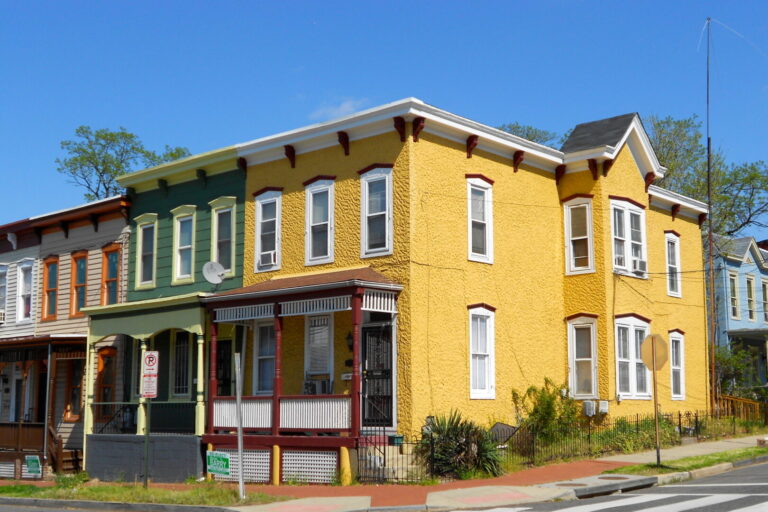
This article explores how platforms reinforce structures of racism and coloniality in Washington DC’s majority-Black Ward 7 and Ward 8. Drawing on ethnographic research with Black hosts who short-term rent on Airbnb, I follow how Black residents’ imaginaries of space are superseded by platform-enabled white users’ imaginaries through Airbnb’s “Location” star ratings. This rating draws down hosts’ overall ratings based on guests’ racist experiences of feeling “unsafe” in majority-Black working-class neighborhoods—resulting in lower visibility on Airbnb’s app, decreased bookings, and financial losses. Using a geopolitical conception of racism on platforms which I call the Colonial Racial Capitalist Stack (CRCStack), I show how these ratings enable platform-mediated conceptions of space and land that discursively reinforce racist depictions of Wards 7 and 8. I read Benjamin Bratton’s design concept of “the Stack” through Ruha Benjamin’s analytic of “discriminatory design” to argue that platforms are key sites for the exploitation and ongoing dispossession of land and labor under systems of racism, settler and franchise colonialisms, and capitalism across a variety of historical and geographical contexts, as described by Koshy, et. al. Through an exploration of the Stack’s layers (User/Interface/Address, City/Cloud, and Earth), I argue that the CRCStack makes racism, as a social technology, more durable by entrenching as a racialized geopolitical ordering of the world into the life worlds of Black people living in Wards 7 and 8. Durability is a key metric by which platforms are measured. Platforms that are unable to cultivate durability—whether by cultivating a loyal user community, harnessing the network effect, or technological necessity—are quickly replaced by other platforms. Reading technology as a racializing and racialized tool helps us understand how racism, as a system, is innovated and entrenched through technological means. I demonstrate how platforms act as the latest technological innovation created to extend the durability of existing systems of racialization and colonization that are required for racial capitalist economies to function. I theorize how racism on the CRCStack operates at multiple overlapping layers, focusing specifically on how discrimination on Airbnb impacts users, neighborhoods, cities, and the wider real estate market. In doing so, I not only explore how platform-enabled racism restricts Black residents’ spatial imaginaries but also trace how Black hosts push back against the CRCStack through Airbnb Support complaints, grassroots practices of negotiation with racist guests, and social movement actions in conjunction with state authorities. I conclude by thinking through what dismantling the CRCStack would require for platform corporations like Airbnb, its users, and city residents.
Articles by Nina Medvedeva
Nina Medvedeva is Assistant Professor of Women’s, Gender, & Sexuality Studies at Winona State University. Medvedeva earned her PhD in Feminist Studies from the University of Minnesota, Twin Cities. Her project, “At Home in the Sharing Economy: An Ethnography in Boston, San Francisco, and Washington DC,” draws on feminist political economy, queer of color critique, economic anthropology, urban geography, and social movement studies to analyze how short-term rentals like Airbnb reconfigure the home as central to the functions of racial capitalism. She shows how municipal debates over short-term rentals create new arrangements of urban governance and inspire new housing justice social movements. Her work has appeared in a special issue of Feminist Studies on feminism and capitalism, Antipode, Real Life magazine, and the Platypus blog. Medvedeva previously served as a postdoctoral fellow in Women’s and Gender Studies at Hamilton College.