Felipe is sitting on a low concrete bench between the Geffen Contemporary and a car park in Downtown Los Angeles when his phone chimes. The thirty-seven-year-old, originally from the Mexican state of Sinaloa, pulls his smart phone from a plastic bracket on his backpack’s shoulder strap and opens the DoorDash app. A new job: pick up from a deli in Chinatown, deliver to a home on Alvarado Street, where the neighborhood of Echo Park ends and Silver Lake begins. Pay is estimated between $7.49 and $9.49, plus tip. He nods at me, “let’s go,” and clips his phone back into its holster. He lifts a black bicycle helmet from the bench next to him, flips it on his head, and closes the buckle. He takes his bike by the handlebars, pushes it toward the parking lot and in one fluid motion lifts his right leg over the saddle and begins pedaling. It takes me a moment to pack away the small notebook and pen I was just using to jot down a field note and I take my own bike to hurry after him. As he rolls away, Felipe whistles a goodbye to his two colleagues, still perched on the benches. Underneath the boxy bright red backpack with the DoorDash logo he wears a gray long sleeve t-shirt. On one wrist dangles a single bike key from a coiled elastic band. Short brown hair peeks out under the helmet. He is wearing sneakers, crew socks, and baggy, knee-long shorts, as well as a utility pouch on his hip with a U-lock slid into the belt. His bicycle is a flat-bar mountain bike from the 1990s or early 2000s, a light blue Specialized. He exits the car park, crosses the sidewalk, and merges into the traffic on Temple Street before turning left on Alameda. It takes Felipe just under nine minutes to reach the sandwich shop on Broadway. I wait outside and as he opens the door of the deli, the smells of traffic are laced with yeast and relish.
Introduction
Workers like Felipe have become a common sight in today’s cities. Working for food delivery platforms such as Postmates and Uber Eats, they move meals by car, motorcycle, bicycle, e-bike, scooter, and by foot. They play an integral role for companies promising the almost instantaneous availability of any meal at the push of a button. “The goal ultimately,” as DoorDash CEO Tony Xu explains, “is to bring you everything inside your city in minutes, not hours or days.”1 Or, even more ambitiously: “We are trying to catalog, to digitize, the physical world.”2 What is being imagined is a new kind of urban life, revolutionized by technological innovation: cities rebuilt “from the internet up.”3 But narratives of this sort are reductive. As anthropologist and media scholar Shannon Mattern puts it, “We’re left with the sense that everything knowable and worth knowing about a city can fit on a screen—which simply isn’t true.”4 In reality, the transposition of the physical world into the digital remains necessarily incomplete and complicated.5 Platforms like DoorDash continue to rely on physical spaces, goods, and labor to operate. And while in some places delivery drones are now seen rehearsing an alternative future for this industry,6 it is still more likely, convenient, and affordable that workers like Felipe pick up and deliver our orders. They connect restaurants with customers and in doing so bridge the virtual marketplace provided through the app and the physical world in which the food is prepared and consumed.
It is important to recognize the extent to which delivery platforms rely on this bridge to function. But while it is clear that the task of delivering an order is a key component of food delivery services, it is important to consider the ways in which delivery workers provide far more labor and value to the platforms than what is contained in the act of the delivery. By acknowledging that the delivery itself is usually performed at a loss and that the work of the courier does not begin and end with pick-up and drop-off, we can refine our understanding of where and how value is generated in these processes: It becomes apparent that couriers are more than just delivery workers.
In what follows, I will first return to the opening vignette of a single delivery by a bicycle courier working for the platform DoorDash in Los Angeles. This account is synthesized from ethnographic fieldwork and offers an illustration for the subsequent argument. I then survey the economics behind platform food delivery to highlight what true costs are associated with an order and how companies like DoorDash have been operating at a loss for over a decade. This brings into focus some of the ways in which delivery workers produce value for platforms beyond the delivery itself. After that, I explore accounts of the eighteenth-, nineteenth-, and twentieth-century history of the sandwich on the one hand and the advertising strategy of “sandwichmen” on the other. This double history of the sandwich reveals a deep-rooted connection to wealth disparity and privilege in food delivery and long-standing practices of employing human billboards. I argue bicycle delivery riders in today’s cities are “sandwichmen” in both senses of the word: delivering meals to the wealthy and employed as human billboards traversing urban space. Making these connections brings into focus the variegated, and uneven, ways in which delivery riders are “put to work” in the platform economy.
Vignette of a Sandwich Delivery, continued
This vignette was synthesized from over two years of fieldwork with bike couriers in Los Angeles and narrativizes Felipe’s delivery of a single sandwich.7 After collecting data and identifying themes and subthemes, I constructed a credible ideal type8—what Max Weber called a Gedankenbild 9—to illustrate some of the common dimensions of bicycle delivery work.
I see Felipe approach the counter, then turn around. Our eyes meet through the window and he taps an imaginary watch on his wrist: the order is not ready, yet. He is offered a cup of water as he waits and watches the person behind the counter slice a baguette and stuff it with shredded pork and pickled vegetables. It is wrapped, cut, wrapped again, and slid into a plastic bag before it changes hands above the countertop. Felipe steps out of the shop before he swings the backpack off his shoulder and onto the pavement. The silver insulation material sparkles in California sunlight as he slides the plastic bag into the backpack. Felipe checks the delivery address on his smartphone, then gives me a thumbs up and smiles. We ascend Cesar Chavez Avenue and Sunset Boulevard before turning to side streets toward our destination. It is a ride of twenty minutes. Felipe uses bike paths unless they are blocked by parking cars or food trucks. When we approach intersections he merges into the lane and filters through slowing traffic to the front of the line, avoiding vehicles that could make a right turn without paying attention to bikes. As we get closer to the delivery address, Felipe grabs his phone and hits pause in the DoorDash app. This way he will not be assigned a new job after completing the current one and he has up to thirty-five minutes before he is forced to log on again. He explains that he does not want to get stuck out here. What can happen is that more jobs will be assigned to him in the periphery, taking the rider further and further from the center—to the extent that Los Angeles even consists of periphery and center—or keeping him in an area with a low order volume and too many steep hills. “It’s not worth it.”
Felipe turns onto Alvarado Street and rises from the saddle as the road steepens. We pass one or two houses before the road splits into two one-way lanes: the right side leads further up the hill, while the left side flattens. The delivery address is on the left and so Felipe turns against the direction of traffic and rides to a gray, single story building. He dismounts and leans his bike against the wall, pulls his U-lock out of the holster, and locks his rear wheel to the bike’s seat tube. Felipe slides out of his red, cubical backpack and extracts the sandwich out of the bag’s reflective innards. A few low steps inset into the building’s façade lead to the front door, separated from the sidewalk by a slim white column and two narrow arches that remind me of the paintings by Giorgio de Chirico. Following the instructions in the app, he leaves the sandwich at the doorstep, snaps a picture, and returns to his bike. No time is lost on the way back: Felipe rides back along Sunset Boulevard at full pace. He wants to be back downtown for the next job, minimizing unpaid time. As we approach the 110 Freeway crossing, Felipe unpauses his shift on the DoorDash app. Ready for another order but unsure where the pick up may be, Felipe coasts through the grid of Los Angeles’ downtown, roughly positioning himself in proximity to a few restaurants he knows can get busy around this time. After a handful of minutes, his phone chimes again.
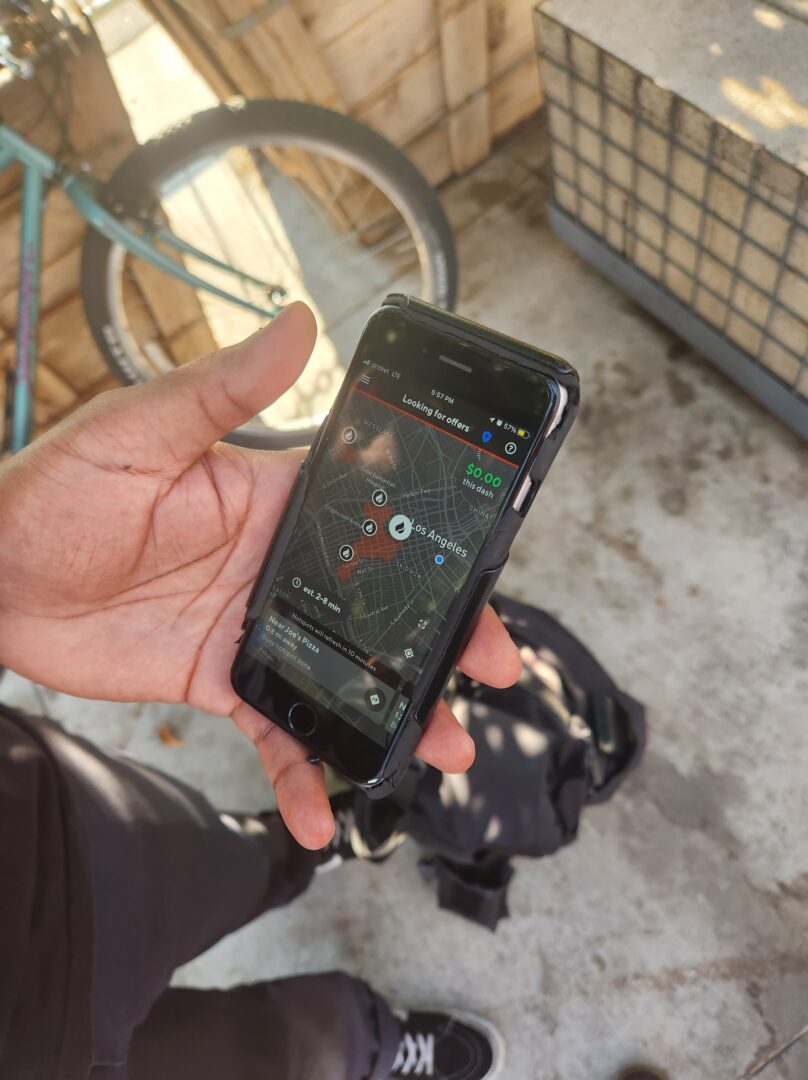
Felipe’s journey to Echo Park and back illustrates many of the important elements observed in my interviews and fieldwork: Spending time with riders, I witnessed how much time was spent standing by while logged on, waiting for assignments; how they inserted their expertise through shortcuts or trying to predict when orders might be ready for pick-up; I noted their dependence on tips for anything close to a living wage; and their engagement with and use of the platform, which affords them with a pause function that they employ strategically to claw back some control over where their shift will take them. Furthermore, it highlights some of the many pieces of expertise and anecdotal knowledge which the riders possess and which inform the way they ride and work, producing best practices over time—ranging from how to filter through traffic to knowing what areas promise higher order volumes. Felipe also serves as an ideal type as a male rider from an immigrant background, two demographic factors that are overrepresented among bicycle couriers. Other elements involved in the transaction do not become apparent in the vignette and are usually opaque to the riders: how the architecture and design of the app encourages particular orders and behaviors from patrons; how much the person spent on the order; how much DoorDash charged the restaurant; how Felipe’s payout was calculated; and if the job was first offered to other delivery workers. These dimensions require a closer look at the economics behind food delivery services.
Economics of Platform Delivery Work
At face value, the vignette presents a straightforward example of the economic process behind the delivery: A customer ordered lunch and received it, paying for the food and its delivery. Felipe brought the requested sandwich from the restaurant to the customer’s home, earning less in the process than what was paid for the delivery. The difference presents the profit margin for the delivery company and offers an example of the surplus value produced by Felipe’s labor. We can complicate this basic equation with a closer inspection of the charges involved. DoorDash set their delivery fee between $1.99 and $5.99 (unless the client signs up for a monthly subscription instead), an additional small orders fee for any delivery under $15, a service fee that is usually around 10%, local taxes, and sometimes additional fees for peak pricing or surge charges when demand is higher than usual. Simultaneously, DoorDash charges restaurants for using their services on the other end. Commission fees range from 10% to 25% of the order, a service fee of 10% to 15% is applied, the restaurant is charged an additional delivery fee that ranges between $2 and $8, and an additional small orders fee may be applied. In a real world example, this means that if a user without a subscription orders a $20 sandwich in Los Angeles, DoorDash may bill them between $5.74 and $9.74 while charging the restaurant in the range of $6 to $16. On what would have been a $20 transaction between the restaurant and patron, DoorDash might earn a minimum of $11.74 and a maximum of $25.74.10
It goes without saying that Felipe would earn significantly less than that. The median net hourly earnings for delivery workers in California was $7.12 in 2022.11 They desperately depend on tips from their customers, but even those are not always uncontested. An independent study by Working Washington showed that DoorDash systematically lowered the base pay on orders that had higher tips attached to them, meaning that larger tips did not result in proportionally more pay. Even after the company claimed to have adjusted their model to prevent the misappropriation of tips, real life data showed that jobs with higher tips still tend to have lower base pay.12 On top of that, riders in California continue to be classified as independent contractors, stripping them of many of the privileges and protections that would result from employment. In 2020, Proposition 22—to which gig companies such as DoorDash and Uber donated a combined $205 million13—overturned Assembly Bill 5, which would have promised stronger protections against worker misclassification.
With Prop 22, certain minor concessions were made for workers: delivery riders like Felipe are now eligible for a monthly “healthcare stipend” if they consistently complete a certain amount of active riding time per week. If a rider manages to work for at least fifteen active hours per week for an entire quarter, they receive a bonus of $792.12, or roughly $61 per week.14 So in the vignette above, Felipe is riding both for the payout attached to the delivery and toward fulfilling his riding time requirements. However, while this may incentivize riders to slow down, they remain interested in completing as many orders as possible in order to maximize pay. This is further stimulated by the app’s internal structure, which groups its workers in different tiers such as “Silver,” “Gold,” or “Platinum” based on their weekly acceptance rates, completion rates, and number of jobs. While DoorDash does not disclose how these classifications affect riders exactly, there is a direct link between higher tiers on the one hand and shorter wait times and more lucrative orders on the other. During my fieldwork, I noticed that riders who were in DoorDash’s second highest “Gold Tier” spent more time waiting than out for delivery. As a result, moving up into “Platinum,” which depends on the total number of jobs, as well as job acceptance and completion rates, becomes even more difficult—especially for riders juggling multiple jobs or other responsibilities. “Dashers” like Felipe will often work at least thirty hours to achieve the fifteen hours of active riding time required for a healthcare stipend. This adds to the general frustrations of not being able to reliably predict earnings, or even the logic by which jobs are assigned and pay-outs calculated.15
A rider’s services to DoorDash also include waiting in between orders while logged on, or returning into busy areas after a delivery has been made. Immediate availability of riders is of course an important element of DoorDash’s business model but riders are neither paid for this labor, nor does it count toward their active riding time. Being logged in and available is required of riders to be assigned work, and necessary for the platform to function, but is not itself remunerated in any way. Couriers find all sorts of ways to pass that time: riding around, standing by together, chatting, drinking, reading, playing games; but ultimately they remain ready to accept the next job at a moment’s notice and actively provide a service to the company as they stand by. Geographer Lizzie Richardson speaks of “coercive flexibility” whereby the free choice of a customer to order—in this case a sandwich from Chinatown to Echo Park—is enabled by the relative coercion into flexibility of a delivery worker, who needs to be ready and nearby, accept the order, and deliver it in a timely manner. Richardson outlines a threefold flexibility by which riders have to make themselves available, accept the risk that they might not earn anything at all, and when they are offered an order agree to variable rather than fixed pay.16 This organizing relationship also means that the risk involved in managing supply and demand has largely been outsourced to the riders themselves. Since their availability standing by does not result in pay, too much competition by other riders or too few orders are a much bigger problem for the delivery workers than the platform.
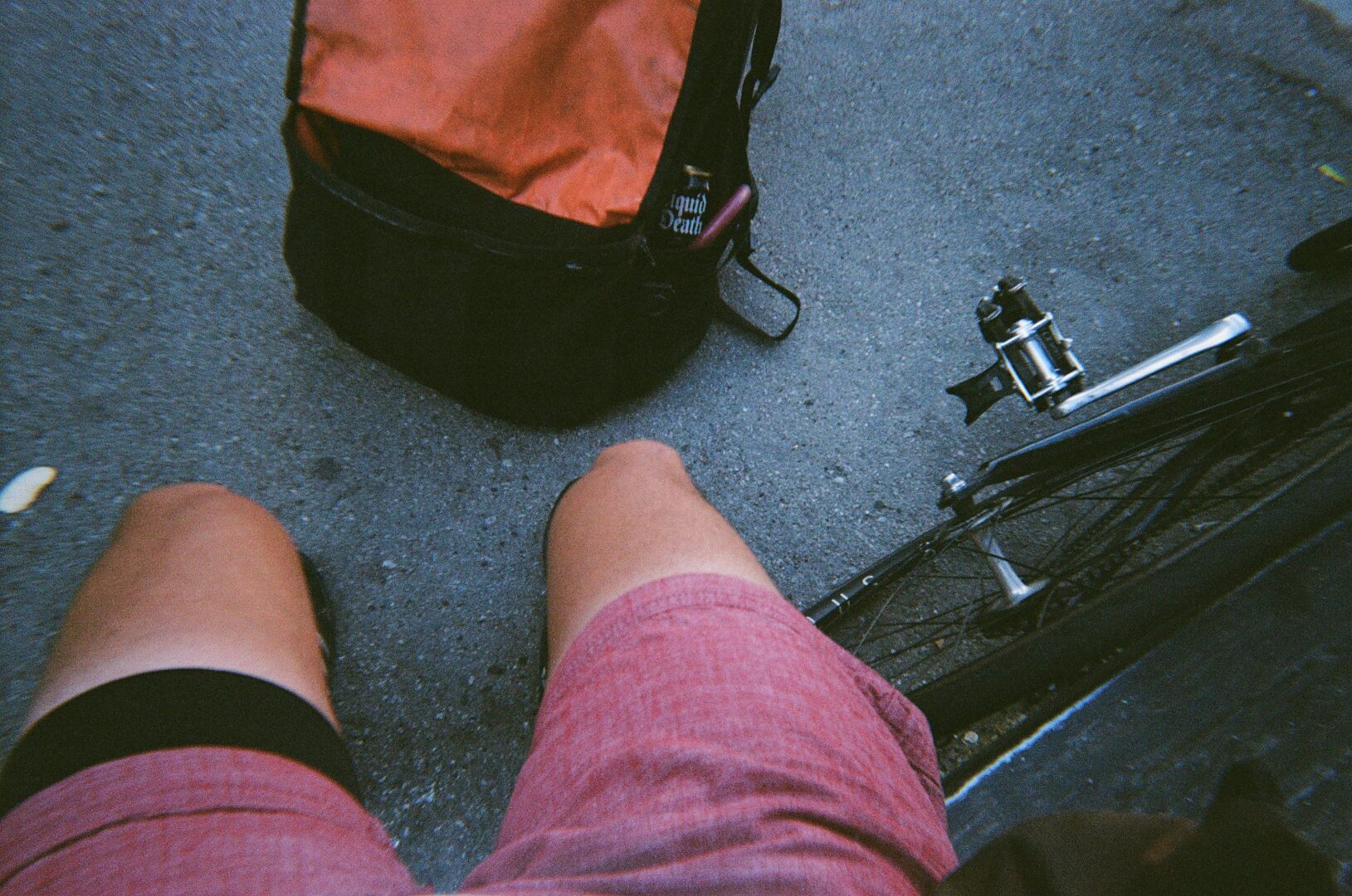
What becomes apparent is that the value generated from our exemplary delivery would include not only the trip from the deli to the Echo Park neighborhood, but also various forms of unpaid labor such as the waiting time before an order was assigned and at the pick-up location, as well as Felipe’s return to downtown. And while these complications add further nuance to the equation of food delivery, an even larger contradiction has to be discussed. Despite their valuations, and the large amount of spending power big delivery platforms possess, for example when it comes to advertisement, lobbying, and legal expenses, most delivery companies rarely make a profit. In fact, the four largest standalone food delivery platforms have already racked up over $20 billion in operating losses since becoming publicly listed.17 Uber has reported its first profitable year in 2023 since its inception in 2009 but does not disclose whether its food delivery subsidiary Uber Eats is operating at a profit or loss.18 Similarly, Delivery Hero, which began in 2011, reported its first profitable year in 2023, but only using the adjusted EBITDA metric which calculates earnings excluding certain irregular costs.19 Delivery Hero’s Spanish subsidiary Glovo is confident that it can achieve its profitability goals and honor its debt payments mostly due to diversification away from pure food delivery and the integration of wide-reaching advertising integration into the app’s ecosystem.20 Across the industry, early bullishness is waning and external investors are more cautious when it comes to injecting venture capital into the delivery industry.21
Start-ups will explain that they operate in untested territory where quick growth is more important than actual sustainability and that loss-making is a temporary cost in their fight over the market. As outlined by science and technology studies scholar Jathan Sadowski, this aligns with the general principles of urban platform businesses, who are “more directly connected to consumers . . . more intent on rapid scaling-up . . . and more antagonistic to government regulations and incumbent industries.”22 That the strategy of aggressively absorbing losses is at least partially working can be seen in various cases around the world: After Spain passed stricter workers’ protections under the ley riders (riders’ law) in 2021, some companies, such as Deliveroo, ceased local operations23 while market leader Glovo was able to leverage its position and continue to grow, despite being fined hundreds of millions of euros.24 Another example shows how independently owned companies are often forced out of business: PDQ Couriers, a local courier company in Los Angeles, was forced to close after years of trying to compete with the artificially low rates offered by big apps.25 Without the deep pockets of investors or venture capital, local businesses cannot afford to operate at a loss and thus struggle to remain open when platforms such as Uber Eats pursue a business model that can absorb losses for over a decade. Another argument is that the valuation of the company is based less on revenue than technological innovation. Investors are drawn to the infrastructures built by these platforms, rather than to the delivery service itself. This is in line with the mentality common among start-up ventures, who try to strike a big idea and sell, rather than building companies that promise sustainable long-term returns. These attempts to maximize market share and appeal to investors probably explain why DoorDash spends about 20% of its revenue on marketing.26
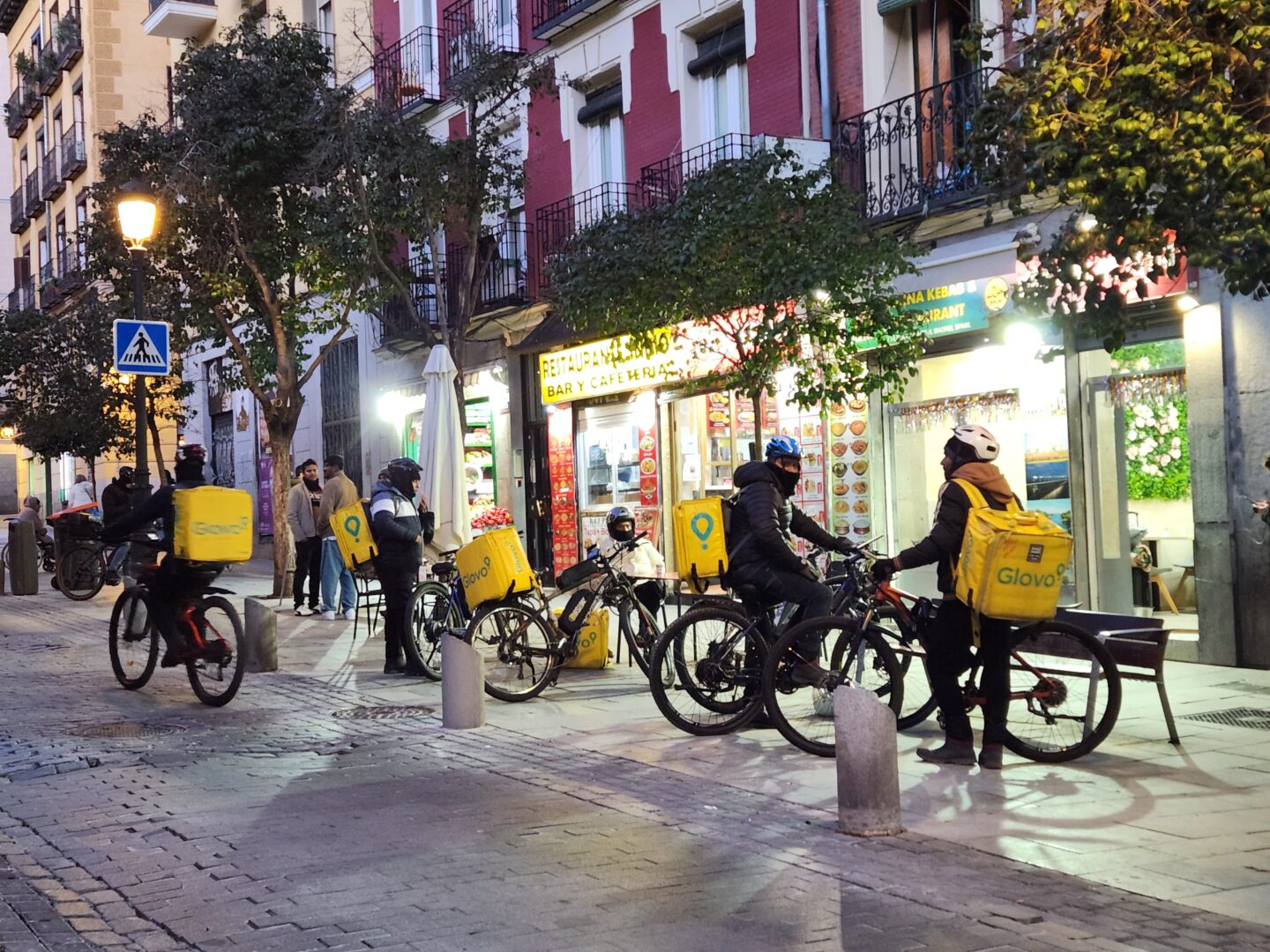
Visibility is key in contested markets. And it is no surprise that most companies have realized that they have access to extremely cost effective exposure: Their delivery riders move through the cities all day, often traversing the busiest and most compact urban cores, or standing by in areas close to restaurants. Many companies require or encourage uniforms, and hand out branded, on-color jackets and large insulated backpacks with the company logo. In the United States, platforms cannot obligate their riders to wear a uniform or branded bags, since couriers are classified as independent contractors. But companies still encourage it by selling their equipment at low rates and implementing certain size and insulation requirements for couriers. In some cases, branded gear is even available for free, for example during the early years of Caviar, a food delivery company that sold to DoorDash in 2019.27 Advertisement is also increasingly becoming an active income stream for courier companies who offer vertical integration directly into their app’s user interface. Delivery Hero began ad integration in 2022 and offered their clients “the opportunity to build a loyal fan base from scratch on our platform.”28 Similarly, a new initiative at DoorDash promises advertisers to “leverage DoorDash’s extensive first-party data to target customers based on purchase behavior, preferences, and other predictive insights.”29 As such, platforms’ ability to collect large amounts of personal data is a driving appeal for investors. From location data to purchases, ratings, browsing history, personal identifiers, and user content, platforms are able to collect a plethora of data points from their users—as well as their riders. It may be no surprise, then, that delivery platforms are often considered among some of the most invasive apps people install.30 As Sadowski argues, data can be understood as a form of capital, and to collect as much of it as possible is an essential element in many contemporary business models.31 The result is an economic regime in which the capture, extraction, and accumulation of data becomes an ideological imperative in its own right.32 This data is leveraged for internal efficiency improvements as well as to attract potential advertisers, but it also forms a speculative economy as a key factor in company valuation. Geographer Julia Wagner shows how the data collection practiced by digital platforms has become mutually constitutive with processes of financialization and urbanization.33 Bicycle couriers and other platform workers find themselves subjected to constant “dataveillance.”34 The continuous requirement of being connected to and surveilled by the company app is part of what labor scholar Ursula Huws has termed “logged labor:” Platform work is compartmentalized into a “log” of discrete tasks, worker activity is logged through constant surveillance, and the platform requires workers to always be logged on.35
What becomes increasingly clear is that value generation for delivery platforms does not happen exclusively or even primarily through their deliveries. In fact, in many instances the deliveries themselves are loss-making. Instead, advertisement, data extraction, and capital acquisition are the driving forces for companies like DoorDash and Delivery Hero. This challenges the equation of surplus value in the riders’ delivery work outlined at the beginning of this section. Delivery riders are, in fact, not generating company profits by making deliveries. Instead, we need to understand their role in not-at-issue processes of the delivery, as their movement through and existence in urban public space generates data and brand visibility. Returning to our vignette, Felipe did not only bring a pork sandwich from Chinatown to Echo Park. His work for the company began when he logged into the platform to become available for assignments and included the time spent standing by before and after the delivery. He also generated unique data for DoorDash in the process and displayed a large red cube with the company’s logo on it throughout the day. Ultimately, riders like Felipe are being put to work in various ways beyond the delivery. The datafication that affects their work—where and what they deliver, how they are managed, and how much they get paid—has itself become a labor process they are providing to the platform.
The Double History of the Sandwich
Two echoes of the sandwich linger in Felipe’s delivery. That of its invention, and that of a “sandwichman,” a person carrying advertising signs on their torso to serve as a human billboard. The term “sandwich” dates back to the eighteenth century, when John Montagu, Fourth Earl of Sandwich, is said to have popularized the habit of eating beef between two slices of bread. Without naming the earl in question, the French traveller Pierre-Jean Grosley gave the following account from an English gaming club in 1772:
A minister of state passed four and twenty hours at a public gaming table, so absorbed in play, that, during the whole time, he had no subsistence but a bit of beef, between two slices of toasted bread, which he eat [sic] without ever quitting the game. This new dish grew highly in vogue, during my residence in London: it was called by the name of the minister who invented it.36

The origins of the sandwich are linked to leisure and wealth. It began as a way for the Earl of Sandwich to remain at the gaming table, from where it grew in popularity among the bourgeoisie throughout the late eighteenth and early nineteenth centuries with picnics organized around the handheld food item becoming particularly fashionable.37 Despite the fact that we might think of the sandwich today as a humble meal, perhaps a packed lunch of a worker or student, the origin story and our vignette reveal another layer. After all, these sandwiches are prepared for and delivered to their patrons by others, indicating an entirely different type of convenience than the packed lunch. In fact, philosopher Susan Buck-Morss considered if perhaps the sandwich became “the traditional lunch of the worker [to] make it possible for him to remain at his work station, like Lord Montagu [sic] at his gaming table.”38 What allows the Earl of Sandwich to pursue leisure is later incorporated into modern labor conditions as a way to streamline one’s break or avoid unnecessary spending at work.
Delivery work requires a similar flexibility. And although their work station is more mobile than the factory floor Buck-Morss evokes, as long as they are logged in for a shift, couriers need to be ready for the next order. Bringing a packed lunch, something I observed a lot during my fieldwork, allows riders to stay available and is a way to save money. It is possible that Felipe would have been carrying two sandwiches to Echo Park: one prepared at home this morning to provide him with sustenance during his shift and one ordered through the app and to be delivered to a stranger. Between these two sandwiches opens the digital divide of the platform economy, pointing not only at the separation of who has access to certain culinary experiences but also to the privilege of mobilizing another body for their delivery. Many of the places riders deliver from are outside of their own price range. Additionally, very few use the platform services they participate in. As one rider put it when I asked him if he uses DoorDash, “No, never. Why would I pay money for that? Maybe, if I am really busy, I could see using Instacart, you know, save myself the trip to the supermarket. But if I get food from somewhere I call and I go pick it up.”
The history of the sandwich shows that privilege has been one of its earliest ingredients. This meal enabled the Earl of Sandwich and other members of the aristocracy and bourgeoisie to give even more time to leisure—to such an extent that Grosley suggested it came “at the expense of their repose and their health.”39 But it should also be noted that the story of the sandwich’s invention Grosley provides us with does not make visible those who prepared and delivered the meal to John Montagu. While the Earl lives on, Felipe’s predecessors disappear. Our vignette on the other hand does not reveal the context of Felipe’s customer and to be sure, there are a myriad of reasons why they may have ordered this meal to be delivered. But it is possible to imagine a similar scenario to the eighteenth-century earl: A peek through the window at the Echo Park address may well have revealed a body on a sofa, head turned toward a screen and hands clutching a gaming controller, absorbed, like the Earl of Sandwich, in play. Today, class distinction materializes both in the meal and its delivery. By and large, delivered meals used to be an exclusive domain of affordable take-away cuisines, like Chinese or pizza. But with delivery platforms like DoorDash, the market of home delivery spread to all types of restaurants, including artisanal sandwiches and even fine dining.40 But these insights do not have to lead to overdeterminism. As the work of geographer David Bissell shows, while power imbalances are certainly an integral part of platform infrastructures, users also relate to these tools in complex, variegated, and changeable ways.41
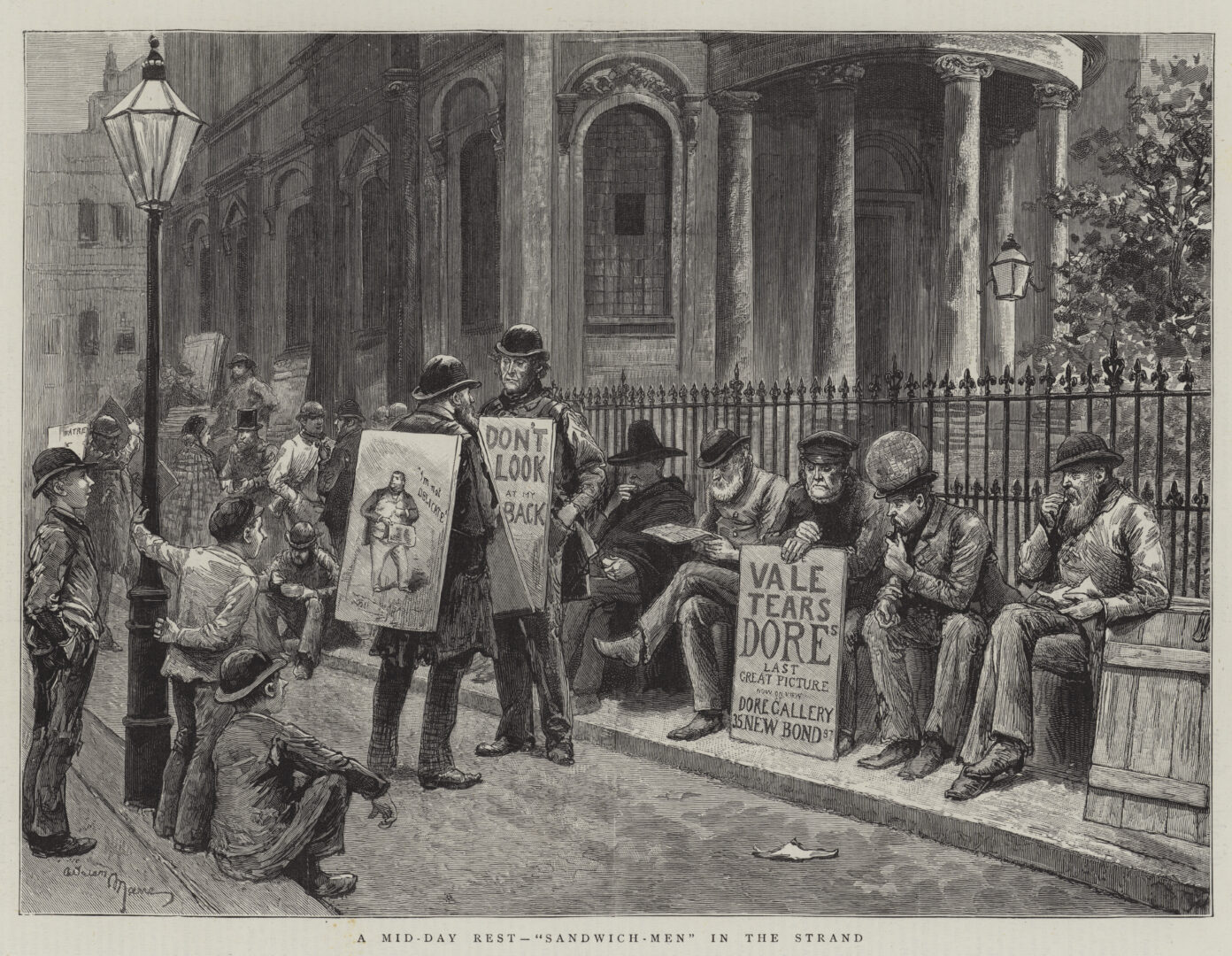
The second echo evoked by the vignette of a delivery is that of the sandwichman, a human billboard who carries a sandwich board of advertisement strapped to their torso. This was a common practice for urban advertising in the nineteenth and early twentieth centuries. The term sandwichman is traced back to Charles Dickens who, in a collection of literary sketches about everyday life in London, mentions “an animated sandwich, composed of a boy between two boards.”42 In the story, the boy wearing a sandwich board is advertising a grand ball hosted by a member of the King’s Theatre, intimating who was able to afford human billboards. Dicken’s poignant style also draws out the levels of objectification these laborers may have experienced. In his arcades project, philosopher Walter Benjamin repeatedly shows interest in the figure of the sandwichman, whom he labels the final incarnation of the flâneur,43 or a “flâneur salarié,” a salaried flâneur.44 What Benjamin meant is that both urban experience and existence of the flâneur were primarily mediated by consumption and that this convergence of consumerism and traversing urban space culminated in the sandwichman, whose advertising of consumer products was no longer just an undercurrent of a practice of loitering—as was the case with the flâneur—but the explicit assignment. Just as for the invention of the sandwich at the hands of a gambling eighteenth-century aristocrat, the Dickensian “animated sandwich” has a social history marked by class. As Buck-Morss explained with reference to this advertisement practice in twentieth-century Paris:
The sandwichman was a denigrated, yet familiar figure in Paris in the 1930s, one which would have entered the perceptive range of most city-dwellers. Human billboards, they advertised and publicized the products and events (cinemas, store sales) of bourgeois consumer culture. Yet they themselves, despite the uniforms they were loaned to give a respectable appearance, were associated closely with poverty.45
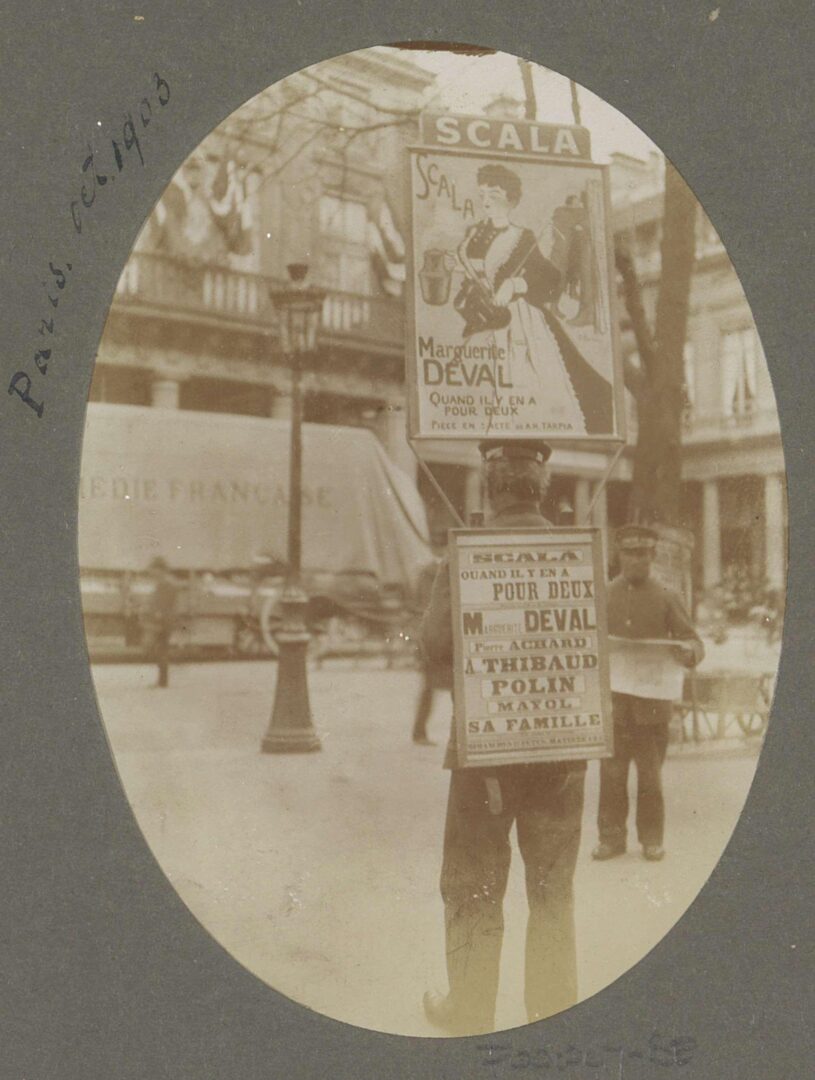
Those advertising the perks and offerings of a bourgeois lifestyle did not have access to those perks themselves. They were usually recruited from “clochards,” Paris’ unhoused population, of which there were around twelve thousand registered in the 1930s,46 and were employed as casual, part-time, and non-unionized workers.47
Buck-Morss’s project of revisiting Benjamin’s interest in the sandwichman alongside the history of the sandwich is one of reintroducing the political and social reality to both stories: that of labor and that of consumption. She leaves us with an image of the sandwichman that invites many parallels to today’s food delivery workers. In the same vein as sandwichmen were paid to be reduced to a sign, part of the value delivery workers provide is as a human billboard. The recognizable image of a cyclist with a colorful cubicular backpack has become not only a representation of food delivery, but a symbol of gig work itself. And if we remember that most companies do not actually turn a profit with their deliveries, it becomes even more crucial that delivery riders are put to work in this fashion.
Just as Buck-Morss’s sandwichmen, bicycle couriers are sometimes offered uniforms—branded jackets, shirts, and delivery bags—on loan or at reduced cost.48 And they too are non-unionized and employed casually, classified as independent workers, which allows companies to circumvent additional costs associated with employment, such as sick days, paid leave, or health insurance coverage. Today’s food delivery workers come from all walks of life, but are often marginalized and economically disadvantaged, as platforms tend to recruit a workforce that is particularly vulnerable. During my fieldwork in Los Angeles, only two interlocutors were white and most of them came from migrant communities. Similar to how illegality is instrumentalized as an economic tool for profitability in the construction of “impossible subjects,”49 the vulnerability of certain surplus populations is leveraged to sustain low wages and poor conditions in this industry. In the United States, as in many parts of the world, what political theorist Nick Srnicek calls “platform capitalism”50 goes hand in hand with racial capitalism51—a connection that is further mirrored in the supposed freedom of independent contractors who often remain dependent on the platform employer in variegated ways.52
Buck-Morss reminds us that her review of the 1930s still matters today, when she says that “the clochards of Paris”—those who were employed as sandwichmen—“are still with us. Capitalism replenishes their number, if not drastically via Depressions, then gradually via automation.”53 Both these factors also play a role in the case of delivery workers: The platform economy—and its urban expressions—grew out of the Great Recession and the 2008 financial crisis. Many platform companies today, including major food delivery platforms, all launched right around that moment, when workers were desperate for income and governments reluctant to spend on services and infrastructure. Their management has been automated, which makes many of the decisions and mechanisms more opaque, black-boxed in the app’s algorithms. This has made it easier for companies to underpay or produce uneven remuneration54, and harder for workers to organize. Simultaneously, further automation in the form of drone delivery is already being tried and is looming over workers, potentially increasing their willingness to compete at low pay.55 Capitalism still replenishes the numbers of those willing or required to work under exploitative conditions in the gig economy, both by depressions and automations. Many of the attributes of the sandwichman observed by Dickens, Benjamin, and Buck-Morss resonate with today’s food delivery workers, riding through our streets, advertising a consumer culture largely out of their own reach, precarious flag bearers of the platform city.
Conclusion
Meanwhile, Felipe has returned to his colleagues near the Geffen Contemporary. They stand by together, sharing anecdotes of their day, trading stories of close encounters in traffic, generous customers, and long wait times. They talk about their families and TV shows. They watch their phones and passersby. While this article has made apparent some of the ways in which bicycle delivery workers are “put to work,” it is also worth remembering that there are elements of the job that are meaningful and enjoyable to riders.56 Everyday life, in this sense, continues to be a “process in excess,” despite much of the precarity it brings for platform delivery workers.57 Using the vignette of a delivery of a single sandwich in Los Angeles as its starting point, I have examined the value a rider contributes to the delivery platform that neither begins nor ends with the delivery. Their work also includes their flexibility in when and where they make themselves available for work, the data they generate while logged in, and the advertising they provide for the app. These not-at-issue ways of providing value become more important when considering that the primary labor, that of the delivery itself, is often performed at a loss.58 These other forms of value generation, as well as some of the inherent power imbalances of platform labor are interrogated through the double history of the sandwich: that of the invention of the meal and that of the practice of employing “sandwichmen” for advertising.
Delivery riders have to be understood as offering more to their employers than the delivery of an item, providing value by occupying public space; participating in urban data collection; managing labor, time, and supply and demand; and parading the company brand on their bags and uniforms. Bicycle couriers are twenty-first-century sandwichmen in both senses of the word: they deliver sandwiches—and other meals, of course—to those more affluent than themselves and simultaneously act as human billboards for companies competing over market share and visibility. As Uber Eats, DoorDash, and Postmates offer us fantasies of urban futures, their army of sandwichmen pours onto the streets, waits in public squares, and squeezes through rush hour traffic. They peddle promises to potential customers, while their data flows back into the digital infrastructure through which they are interpellated. Strapped to a bag that is also a billboard, they advertise comfort, convenience, and chow mein.
Notes
- Kelsey Doyle, “DoorDash CEO Tony Xu on Why Obsession With Detail Matters,” Insights by Stanford Business, June 16, 2021, accessed April 29, 2025, https://www.gsb.stanford.edu/insights/doordash-ceo-tony-xu-why-obsession-detail-matters. ↩
- CNBC Television, “DoorDash CEO on Q1 Growth, Inflation Impact, Worker Demand and AI Plans,” YouTube, May 4, 2023, accessed April 28, 2024, https://www.youtube.com/watch?v=OvLl-JPn2Lo. ↩
- Daniel Doctoroff, “Reimagining Cities from the Internet Up,” Sidewalk Talk, November 30, 2016, accessed April 29, 2025, https://medium.com/sidewalk-talk/reimagining-cities-from-the-internet-up-5923d6be63ba; see also Carlo Ratti and Matthew Claudel, “Life in the Uber City,”Design Indaba, July 14, 2014, accessed April 30, 2025, http://www.designindaba.com/articles/point-view/opinion-life-uber-city. ↩
- Shannon Mattern, A City Is Not a Computer: Other Urban Intelligences (Princeton University Press, 2021). ↩
- Aaron Shapiro, Design, Control, Predict: Logistical Governance in the Smart City (University of Minnesota Press, 2020). ↩
- And most often, even delivery bots like “Coco” still depend on human pilots. See Ronald D. White, “Who’s Driving That Food Delivery Bot? It Might Be a Gen Z Gamer,” Los Angeles Times, March 17, 2022, https://www.latimes.com/business/story/2022-03-17/california-autonomous-sidewalk-food-delivery-robots-coco-starship-kiwibot. ↩
- For a similar approach, see Moritz Altenried, Stefania Animento, and Manuela Bojadžijev, “Plattform-Urbanismus: Arbeit, Migration und die Transformation des urbanen Raums,” sub\urban. Zeitschrift für kritische Stadtforschung 9, no. 1/2 (2021): 73–91, https://doi.org/10.36900/suburban.v9i1/2.605; see also Chiara Rabbiosi and Alberto Vanolo, “Are We Allowed to Use Fictional Vignettes in Cultural Geographies?” Cultural Geographies 24, no. 2 (2017): 265–78, https://doi.org/10.1177/1474474016673064. ↩
- Emily Stapley, Sally O’Keeffe, and Nick Midgley, “Developing Typologies in Qualitative Research: The Use of Ideal-Type Analysis,” International Journal of Qualitative Methods 21 (2022): 1–9, https://doi.org/10.1177/16094069221100633. ↩
- Max Weber, Gesammelte Aufsätze zur Wissenschaftslehre (Mohr, 1968), 190–91. ↩
- Brett Helling, “How Much Does DoorDash Cost? 2024 Cost, Fees & Pricing,” Teach Me Delivery, accessed March 9, 2025, https://teachmedelivery.com/learn/doordash-cost. ↩
- Ken Jacobs, Michael Reich, Tynan Challenor, and Aida Farmand, “Gig Passenger and Delivery Driver Pay in Five Metro Areas,” UC Berkeley Labor Center, May 20, 2024, accessed August 1, 2025, https://laborcenter.berkeley.edu/gig-passenger-and-delivery-driver-pay-in-five-metro-areas. ↩
- “No Free Lunch, but Almost: What DoorDash Actually Pays, After Expenses, and What’s Happening with Tips,” Pay Up, January 16, 2020, accessed March 11, 2025, https://payup.wtf/doordash/no-free-lunch-report. ↩
- Levi Sumagaysay, “Uber, Lyft, DoorDash workers remain contractors due to California Supreme Court ruling,” CalMatters, July 25, 2024, https://calmatters.org/economy/2024/07/prop-22-california-gig-work-law-upheld. ↩
- “Guide to the Prop 22 Healthcare Stipend,” DoorDash, accessed August 1, 2025, https://help.doordash.com/dashers/s/proposition-22-healthcare-faq?language=en_US. ↩
- On the epistemological problem of black-boxed systems and methodological responses to studying them, see Desiree Fields, David Bissell and Rachel Macrorie, “Platform Methods: Studying Platform Urbanism Outside the Black Box,” Urban Geography 41, no. 3 (2020): 462–468, https://doi.org/10.1080/02723638.2020.1730642. ↩
- Lizzie Richardson, “Platforms, Markets, and Contingent Calculation: The Flexible Arrangement of the Delivered Meal,” Antipode 52, no. 3 (2020): 628–29, https://doi.org/10.1111/anti.12546. ↩
- Camilla Hodgson and Yasemin Craggs Mersinoglu, “Food Delivery Apps Rack Up $20bn in Losses in Fierce Battle for Diners,” Financial Times, May 28, 2024, https://www.ft.com/content/675f5c8b-6029-4393-8eba-d6f00327e090. ↩
- Hodgson and Craggs Mersinoglu, “Food Delivery Losses.” ↩
- Louis Goss, “Delivery Hero Shares Climb After Glovo Owner Posts First Full-Year Profit,” Market Watch, February 14, 2024, accessed April 28, 2025, https://www.marketwatch.com/story/delivery-hero-shares-climb-after-glovo-owner-posts-first-full-year-profit-9e8d79ab. ↩
- Clara Ludmir, “In the Struggling Sector of Quick Commerce, Glovo Might Have Found the Winning Formula,” Forbes, July 12, 2023, accessed March 9, 2025, https://www.forbes.com/sites/claraludmir/2023/07/12/in-the-struggling-sector-of-quick-commerce-glovo-might-have-found-the-winning-formula. ↩
- Hodgson and Craggs Mersinoglu, “Food Delivery Losses”; Ludmir, “Quick Commerce Formula.” ↩
- Jathan Sadowski, “Cyberspace and Cityscapes: On the Emergence of Platform Urbanism,” Urban Geography 41, no. 3 (2020): 449, https://doi.org/10.1080/02723638.2020.1721055. ↩
- Cillian Shields, “Deliveroo to Cease Operations in Spain at the End of November,” Catalan News, November 18, 2021, https://www.catalannews.com/business/item/deliveroo-to-cease-operations-in-spain-at-the-end-of-november. ↩
- Business and Human Rights Resource Centre, “Spain: Government Fines Delivery Hero’s Glovo a Further 56.7 Million Euros for Allegedly Violating Laws on Hiring Riders,” Business and Human Rights Resource Centre, January 23, 2023, accessed March 9, 2025, https://www.business-humanrights.org/en/latest-news/spain-government-fines-delivery-heros-glovo-a-further-567-million-euros-for-allegedly-violating-laws-on-hiring-riders. ↩
- Interview by author, Los Angeles, December 3, 2020. ↩
- DoorDash, “Sales and Marketing Expenses of DoorDash Worldwide from 2019 to 2024 (in Million U.S. Dollars),” Statista, accessed April 22, 2025, https://www-statista-com/statistics/1374295/doordash-marketing-expenses; DoorDash and U.S. Security and Exchange Commission, “Annual Revenue of DoorDash from 2019 to 2024 (in Million U.S. Dollars),” Statista, accessed April 22, 2025, https://www-statista-com/statistics/1294498/doordash-annual-revenue. ↩
- Shapiro, Design, Control, Predict, 103. ↩
- “Delivery Hero’s New AdTech Solutions Offer up to 1000% Return for Quick Commerce Partners,” Delivery Hero, October 11, 2022, accessed March 10, 2025, https://www.deliveryhero.com/newsroom/new-quick-commerce-adtech-solutions. ↩
- “DoorDash to Partner with The Trade Desk to Empower Advertisers with Unparalleled Precision, Transparency, and Scale,” DoorDash, January 7, 2025, https://about.doordash.com/en-us/news/doordash-to-partner-with-the-trade-desk. ↩
- Ivan Dimitrov, “Invasive Apps,” pCloud, March 5, 2021, https://www.pcloud.com/invasive-apps. ↩
- Jathan Sadowski, “When Data Is Capital: Datafication, Accumulation, and Extraction,” Big Data & Society 6, no. 1 (2019): 1–12, https://doi.org/10.1177/2053951718820549. ↩
- Sadowski, “When Data Is Capital,” 8–9. ↩
- Julia Wagner, “Circulating Value: Convergences of Datafication, Financialization, and Urbanization,” Urban Transformations 3, no. 4 (2021): 1–9, https://doi.org/10.1186/s42854-021-00022-4. ↩
- José van Dijck, “Datafication, Dataism and Dataveillance: Big Data Between Scientific Paradigm and Ideology,” Surveillance & Society 12, no. 2 (2014): 197–208. ↩
- Ursula Huws “Logged Labour: A New Paradigm of Work Organisation?” Work Organisation, Labour & Globalisation 10, no. 1 (2016): 7–26. ↩
- Pierre-Jean Grosley, A Tour to London: Or, New Observations on England, and Its Inhabitants, Vol. 1, trans. Thomas Nugent (Dublin, 1772), 164. ↩
- Susan Buck-Morss, “The Flaneur, the Sandwichman and the Whore: The Politics of Loitering,” New German Critique 39, no. 2 (1986): 107. ↩
- Buck-Morss, “Flaneur,” 107. ↩
- Grosley, Tour to London, 164. ↩
- Richardson, “Platforms,” 622. ↩
- David Bissell, “Affective Platform Urbanism: Changing Habits of Digital On-Demand Consumption,” Geoforum 115 (2020): 102–10, https://doi.org/10.1016/j.geoforum.2020.06.026. ↩
- Charles Dickens, Sketches by Boz: Illustrative of Every-day Life and Every-day People, (Hazell, Watson and Viney, 1836, 1910), 191. ↩
- Walter Benjamin, Das Passagen-Werk (Suhrkamp, 1983), 562. ↩
- Benjamin, Passagen-Werk, 967 ↩
- Buck-Morss, “Flaneur,” 109–110. ↩
- Brassäi, The Secret Paris of the 30s (Thames & Hudson, 2001), 40. ↩
- Buck-Morss, “Flaneur,” 110. ↩
- Shapiro, Design, Control, Predict, 103. ↩
- Mae Ngai, Impossible Subjects: Illegal Aliens and the Making of Modern America (Princeton University Press, 2014). ↩
- Nick Srnicek, Platform Capitalism (Polity, 2016). ↩
- Others go even further, identifying a “necrocapitalist” dimension of gig work; see Will Orr, Kathryn Henne, Ashlin Lee, Jenna I Harb and Franz Carneiro, “Necrocapitalism in the Gig Economy: The Case of Platform Food Couriers in Australia,” Antipode 55, no. 1 (2023): 200–21, https://doi.org/10.1111/anti.12877. ↩
- See Saidiya Hartman, Scenes of Subjection: Terror, Slavery, and Self-Making in Nineteenth-Century America (Oxford University Press, 1997). ↩
- Buck-Morss, “Flaneur,” 113–114. ↩
- Pay Up, “No Free Lunch.” ↩
- Josh Widera, Sign and Return (Verlag für Handbücher, 2021), 67. ↩
- Elsewhere I have written in detail about the embodied experience of bicycle couriers as an inalienable dimension of their labor process. See Josh Widera, “Aesthetics as sensory experience and the embodied practice of bicycle delivery work,” in Aesthetics and the City, edited by Amy Barron and Joe Blakey, pp. 55–72 (Routledge, 2025). ↩
- Ash Amin and Nigel Thrift, Cities: Reimagining the Urban (Polity, 2002). ↩
- Kurt Vandaele, “Inevitable, Vulnerable, Unprofitable: An Inquiry into Food Delivery Platforms in Europe,” ETUI Research Paper – Working Paper 2024.10, http://dx.doi.org/10.2139/ssrn.4957481. ↩
