
Anne Donlon delves into the history of the British Left after World War I to assert the significance of the Black and feminist interventions of Claude McKay and Sylvia Pankhurst. Donlon centers the publication of “A Black Man Replies,” McKay’s letter to the editor published in Pankhurst’s newspaper The Worker’s Dreadnought, against white supremacist logics mobilized by prominent 1920s leftists that contributed to the reestablishment of policing of and violence against black men. Donlon’s archival discoveries weave together biography, material cultural analysis, and histories of trans-Atlantic activism, and, in the process, reveal the labor of building radical intersectional solidarity that came before and followed the moment of “A Black Man Replies.”
Keyword: feminism
I Can Sell My Body If I Wanna: Riot Grrrl Body Writing and Performing Shameless Feminist Resistance
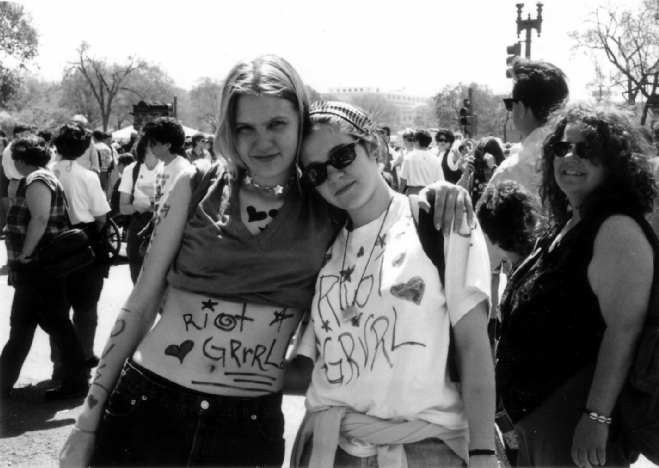
Leah Perry presents a feminist history of Riot Grrrl and Kathleen Hanna in order to explore the hope and the limits of an individualist revolution in the 1990s. Perry takes on the performance of shamelessness, embodied in Hanna’s songs as well as through bodywriting, sex work, zine production, and other aspects of the riot grrrl movement. Ultimately Perry exposes the position of these performances: they are alternative youth culture for certain subjects which both work against and from within the structures of neoliberalism. Perry concludes that shamelessness might remain a promising space for an urgent anti-racist, feminist politics, if it can work to destabilize power and center women from oppressed groups.
Introduction: In Search of Digital Feminisms
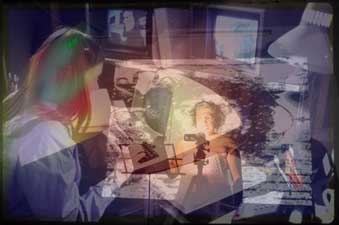
Edited by Katherine Behar and Silvia Ruzanka, In Search of Digital Feminisms includes five essays and the editors’ introduction that suggests we play with the shift from surfing to searching to what is fast becoming the offer, if not the intrusion, of piles of unrequested information. But In Search of Digital Feminisms is not an exercise in melancholia, longing for better digital days now past or for lost feminist horizons. It is a search, having already arrived at a destination, a before and an after all at once, the lost origin that always points to the work of an originary mediation or modulation, if not digitization. In other words, these are not anti-technology works; these are works seeking rather to find ways to creativity and multiplicity in identity and practice that can be an intervention into the contemporary scenes of feminisms and the digital. Although primarily offered as texts, the works that follow point to the need to make theoretical interventions a matter of practices, a matter of interactive mediation, a doing, if not a doing with others.
Ungoogleable: In Search of Digital Feminisms
We begin our search for digital feminisms with the following terms: an acknowledgment that “search” represents an ambition which must fail. Siri’s failed searches only scratch at the surface that Siri is.
BOT I
“BOT I” is a radical monologic mash-up of autobiographical material from Pilar’s childhood in a computing family and her passions for and against technology, cut in and through the texts of Samuel Beckett’s “Not I” and Isaac Asimov’s I Robot. This article includes the script of the performance Pilar presented at the Radical Philosophy Association Conference in Eugene, Oregon on November 13, 2010 and images from a 2011 performance. Ruthless in its refusal of all gentility and tact, and insistent in its feminist critique, Pilar’s script reveals the blind spots that capitalist techno-culture reserves for ethics and the body.
In Search of a www.analogfeminism.net: Starting with Three Contrarian Concepts via Mother-Daughter Machines to Come
Analog feminism (AF) and digital feminism (DF) are two sides of the same coin; or, multiple twin sisters joined at the hip. Skating from René Descartes to Kara Walker, she asks us “to go gray between zeroes and ones.” Reverting from the digital to its ancestral digit, a finger, Lee uses text and textuality to point out a multiplicity of directions, all of which refrain from a directive. In a series of “posts” negotiating, inheritance, reference, and influence, the daughter searching for the mother returns to sender. Whatever the case, we, or at least one of us, are here to focus on and fly with what’s left uncoordinated in—and connecting—all that’s (to be) digit-alled in the evolving idioms of feminist discourses.