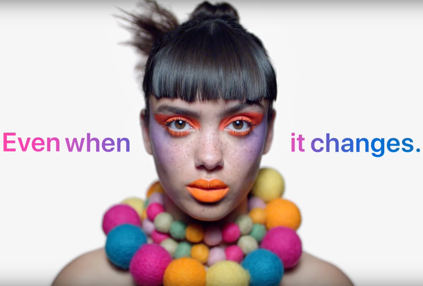
In September 2017, less than a year into Donald Trump’s first presidential term and just one month before the launch of iPhone X, Apple began releasing short commercials illustrating the phone’s signature features: infrared facial-recognition-based password authentication and payment services (Face ID), animated emojis capable of mimicking users’ facial expressions (Animojis), studio-quality camera effects for photography and video recording, augmented-reality gaming, wireless charging, and more—all powered by Apple’s A11 bionic system-on-chip, proprietary graphics unit, and neural engine. Throwbacks to the diversity campaigns of the mid-eighties and early nineties, the commercials featured attractive multiracial casts among whom non-white subjects received pride of place. Two ads for the Portrait Mode camera effect starred light-skinned Black women, while instructional videos presented a heavily freckled Asian woman and a young Middle Eastern woman dressed in a bright green hijab. A longer ad for Portrait Mode, set to Muhammad Ali’s recitation of his 1963 poem “I Am the Greatest,” scrolled through a Benetton-esque catalog before closing with the image of a Black woman wearing African tribal face paint and beads. Animoji commercials hyped music by popular Black artists Migos and Childish Gambino as well as South Korean indie pop band HYUKOH, each remade as an adorable emoji: Migos’ frontmen appeared as a beagle, a fox, and the infamous “poop” emoji; Childish Gambino assumed the guise of a glassy-eyed blue alien; and HYUKOH’s trio morphed into a brown bear, a chicken, and a dragon. While a handful of Face ID commercials were focalized by white characters—a blonde high-schooler able to unlock her locker and much else “with a look”; a young man whose growing beard was no foil for Face ID; and a middle-aged man relieved to discover that online banking no longer required him to remember a password—the first and lengthiest of Apple’s Face ID commercials, “Meet iPhone X,” featured a cast memorable not simply for its diversitarian composition but for its racial ambiguity. In contrast to the subtle essentialism of later commercials, which employed ethnic attributes—African tribal paint and beads, Itajime scarves, chonmaje hairstyles, and hijabs, not to mention the stereotypes conjured by aliens, dragons, and excrement—as a means of signaling diversity and locating subjects in relation to racial points of origin, “Meet iPhone X” repeatedly frustrated essentializing notions of racial identity. Presenting an array of mixed-race subjects whose hybridized morphologies and idiosyncratic styles of dress exceeded common visual markers for racial typification—a freckled face done up with orange lipstick and peony eyeshadow, those neon hues set off in turn by a rainbow garland of outsize felt beads—the commercial instead celebrated an intensified if deeply familiar neoliberal conception of racial individualism implicitly opposed to the coarse, impersonal racial rubrics presumed to operate across security’s bureaucratic institutions. Condensed by “the most unforgettable, magical password ever created: your face,” security, in iPhone X’s schema, emerged not as the controversial task of law enforcement but as the innate (read: magical) property of a given subject’s racial-identitarian uniqueness, a property whose protections obtained not from the state’s sometimes-overreaching vigilance but rather from the technical sophistication (read: magic) of Apple’s biometric sensor, able to sublimate that subject’s racial singularity into digital form.1
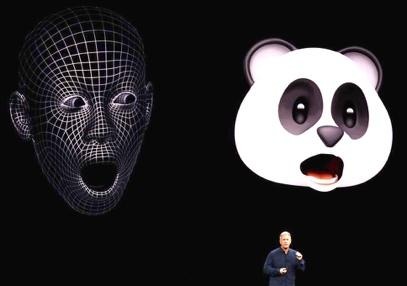
Significantly, Face ID’s enabling contradictions about personal security—that being hypervisible within corporatized spaces of mediatic simulation paradoxically renders one invisible or anonymous in the public spaces lying beyond them; that liberation from one’s body occurs by inhabiting it more fully; that a thoroughgoing racial individualism stands opposed to inevitably reductive race-based cultural politics—formulate themselves by way of tensions between essentialist and anti-essentialist, visual and anti-visual conceptions of racial identity institutionalized by neoliberalism’s ever-adapting rhetorics of colorblindness, multicultural diversity, and “post-racialism” (Figures 1 and 2). As Apple’s Face ID campaign suggests, and as this essay will explore, these tensions—between the affirmation and abolishment of racial identity categories; between choosing to recognize racial difference and choosing not to—assume new meaning in digital contexts where fantasies of racial individualization and unmarking collide, unfolding a logic of racial formation for a “post-race” era that, as critics Michelle Alexander, Eduardo Bonilla-Silva, David Goldberg, and Nikhil Singh suggest, continues to define race through idioms of positive agency and individual particularity the better to obscure its enduring status as a relation of economic domination realized by the global wage differential and reinforced by the operations of the carceral and national security state.2 Pictured alongside their Animoji counterparts, the ambiguously raced subjects of “Meet iPhone X” distill the terms of this logic, as they move between aspirationally mimetic spaces of identity confirmation and self-consciously artificial ones onto which racial essentialisms are silently offloaded between hyperindividualized, post-political sites of racial preference and customizability, and abject, posthuman ones where dragons encode Asianness and Black subjects get transmuted into excrement (Figure 3).

This essay pursues versions of that “post-racial” racializing logic in recent novels of ethnicity by Bharati Mukherjee, Mohsin Hamid, and Teju Cole. Trained on US contexts of tech-intensified neoliberal capitalism and ongoing national security projects condensed around the US-led war on terror, these novels, like Apple’s Face ID campaign, attune themselves to race’s “conceptual instability” in a “climate of ascendant postracialism” that, as Madhu Dubey writes, “promotes a dangerously muddled view of race as a biologically real but politically defunct category.”3 They consequently offer narratives in which protagonists’ racial identities will seem to disappear, mutate, and resurface as they move between shifting, differentiated zones of political inclusion and exclusion, within and across increasingly flexible national borders, and in and out of new technologies of algorithmic profiling and visual securitization. Unlike Apple’s iPhone X campaign, however, these novels do not fantasize about technology’s capacity to resolve contradictions between essentialist and anti-essentialist, realistic and artificial racial-representational regimes. Instead, by depicting in turn race’s obfuscation and its hypervisibility, its technical subsumption within neoliberal market logics of individual preference and its resurgence at the militarized borders of the nation, these texts highlight the complicities underlying these contradictions, showing how discourses of racial individualism counterbalance and sustain state security’s ethno-nationalistic yet nominally antiracist practices.
Primed as they are to tensions between agential or individualist forms of racial self-definition and involuntary or imposed acts of racial ascription, then, these novels, I’ll also argue, reframe mid-nineties debates over the politics of racial recognition initiated by Charles Taylor and Axel Honneth, and extended by a range of late twentieth- and early twenty-first-century critical race theorists. Proposing that esteem for marginalized groups’ authentic lived experience—recognition, that is, of their existential particularity—was a crucial prerequisite to these groups’ attainment of institutional equity, Taylor and Honneth prioritized culture in the pursuit of formal racial recognition.4 By contrast, Nancy Fraser proposed that questions of racial recognition were fundamentally paradigmatic and relational, rooted in a durable political economy of race whose renovation on the basis of culture risked “correcting inequitable outcomes of social arrangements without disturbing the underlying [capitalist] framework that generates them.”5 In place of a superficial politics that “deflect[ed] . . . questions of power and inequality into the relatively more malleable economy of cultural recognition”—recognition of the sort Apple cannily implicates in the preservation of real-world social and political protections—Fraser proposed the redress of historical racial injustices through “transformative remedies . . . aimed at correcting inequitable outcomes precisely by restructuring the underlying generative framework.”6 Rather than affirm race in cultural terms—an ambivalent recognitive gesture that, as Avery Gordon and Christopher Newfield argue, “attribute[s] a creative power to racial groups that lack . . . political and economic power” while neglecting the systems of social classification, dispossession, and management that sustain what Cedric Robinson terms “racial capitalism”—Fraser championed a fuller reckoning with the late-capitalist logics that continue to iterate racial inequality while representing neoliberalism’s free markets as inequality’s ultimate levelers.7
Recently, William Davies has sought to update Fraser’s recognitive-redistributive paradigm for the platform-capitalist age, asking how “transformations in the public sphere have led to a mutation in how recognition is demanded and supplied.”8 “The key condition for this,” Davies writes,
is the digital platform, which has ushered in a new era of public participation in which recognition of status is never adequately achieved by anyone, so injustice feels ubiquitous. In the attention economy of social media, public actors may long for recognition, but have to settle instead for varying quantities of ‘reputation,’ or simply the ‘reaction’ of immediate feedback.9
As platform capitalism increasingly organizes public life around “numerical standards of judgement and justification—surveys, ratings, scoring systems”—so too does it seek to convert identity into calculable data, yielding speculative “marketized recognitions” of individuals’ reputational merits as human capital in place of recognition itself. “The quest for recognition,” Davies concludes, “is more exacting and slower than that for reputation, and appreciating this distinction is the first step to seeing beyond the cultural limits of the platform, towards the broader political and economic obstacles that currently stand in the way of full and equal participation.”10 For Davies, the challenge for contemporary progressive movements lies in disentangling from platform capitalism the positive agencies and robust collectivities it would channel and circumscribe, replacing, as Hito Steyerl writes, “proprietary scheme[s] with . . . cooperative scheme[s],” “human capital” configurations with “humanity.”11
In what follows, I offer brief readings of Bharati Mukherjee’s Miss New India (2011) and Mohsin Hamid’s The Reluctant Fundamentalist (2007) before turning at length to Teju Cole’s Open City (2011) to elaborate a theory of “post-racial” recognition honed by the terms outlined above. Keyed to the evolving forms of agency and identity mediated by digital platforms, all of these novels narrate the breakdown of network-era fantasies of racial individualism while staging race’s categorical reassertion in a post-9/11 global security apparatus that, as Erica Edwards suggests, continues to collapse Black and Brown subjects under allegedly race-blind rubrics of threat, fear, and terror.12 Chronicling the fortunes of a Bangalorean call-center agent and a Pakistani-born US financial-industries wunderkind, Mukherjee and Hamid’s novels demonstrate the implication of economic and actual forms of terrorism performed by newly-technologized “third-world” entrants to the global neoliberal order. Mukherjee’s Anjali and Hamid’s Changez both indulge in fantasies of their labor’s de-racing via networking tech: Anjali crafts an elaborate persona as “Janey Busey,” an imaginary Illinoian operator whose regional accent she has been instructed to mimic, while Changez luxuriates in his assimilation to the honorarily white capital body of the elite Wall Street firm for which he values international businesses. Yet both are progressively drawn into racialized mechanisms of security, profiling, and capture that equate their Indian and Pakistani identities—if also their performance of outsourced technical and financial-speculative labor—with terrorist activity. Culminating in dramatic scenes of racial misrecognition, where Anjali and Changez are suddenly interpellated into the category of Muslim terrorist, Mukherjee and Hamid’s texts mark out a “post-racial” recognition paradigm that compels contemporary Black and Brown subjects to shuttle between digital platforms’ isolating yet putatively agential identities and the reductive orders of visual typification that underwrite post-9/11 counterterror practices of securitization.
Cole’s Open City significantly nuances and elaborates this paradigm. An extended allegory for race’s systemic drag in a “post-racial” climate of platform capitalism, the novel presents a series of literary and philosophical reflections issued in the antiquarian prose of its brooding protagonist Julius, a half-Nigerian, half-German psychiatry resident whom nearly all of the novel’s critics have identified as a modern-day flâneur. Over the course of its twenty-one short chapters, Open City tracks Julius as he “aimlessly wanders” about New York, meeting with a diverse catalogue of friends and encountering a number of African and African American strangers who invite him to identify with an objectified Blackness organized around a set of cultural stereotypes.13 The novel also recounts Julius’s brief trip to Brussels, where he goes in search of his German grandmother, as well as a handful of Julius’s seemingly random memories from his childhood in Nigeria. Alternating between scenes of technologically-mediated communion in which Julius conceives of himself as an unmarked cosmopolitan subject liberated from categories of identity made manifest at the level of physical appearance, and Fanonian scenes of visual recognition in which Julius is abruptly hailed as an “African” according to an expansive rubric of Blackness,Open City dramatizes race’s “conceptual instability” (to recall Dubey) as it moves between two vectors of “post-racial” racialization: tech-intensified neoliberal market logics that expand racial distinction to serve Julius’s increasingly individualistic conceptions of his identity, and militarized regimes of hypervisibility operative in the projects of US and global counterterrorism that conversely reduce Julius’s racial identity to coarse, embodied schemas of subalternity, culture, and color. Tracing out a literary protocol of “post-racial” recognition that belies these vectors’ opposition and foregrounds instead their mutual reinforcement of global white supremacy and US empire, the novel consequently compels a “post-racial” reading practice in which depth reading—reading for race’s ontological invalidity—paradoxically uncovers and renews its mimetic coordinates.
“Post-Racial” Infrastructures
Janey Busey of Rock City, Stephenson County, Illinois, rose from the ashes of Anjali Bose of Gauripur, Bihar, India. On the CCI computer she Google-Earthed the Rock City street map and even found “her” house; she memorized the population (only 315, she noted with horror; not even the poorest, most isolated Indian village was that insignificant); median age an elderly 33.5—and 99.7 percent non-Hispanic white, whatever that meant. Median family income, twenty-five thousand dollars, just a quarter-lakh; median house value under one lakh dollars.
Insofar as reality can be composed of raw data, Anjali had created Rock City. The rest of her virtual life was inspired by her own unbounded longings. Janey Busey had grown up in a cheerful, wholesome, Midwestern family of five, headed by a veterinarian father and nurtured by a gift-store-owning mother. She replaced [her own] sullen [sister] Sonali with two good-hearted, extroverted brothers, Fred and Hank. Fred worked in Rock City’s only bank and aspired to become a manager. Hank toiled in the office of the town’s only insurance firm, though he dreamed of building boats and sailing to Mexico. Puerto Vallarta, to be exact. [Anjali Bose’s] Vasco da Gama High School and College morphed into [Janey Busey’s] Lincoln High, where kids from Rock City had to hold their own against swaggerers from Chicopee and Davis. Then she got swept off her feet by her fantasies and invented sweet summer experiences of working weekdays in the big Wal-Mart in Freeport and flirting with a stock boy named Karl. She brought herself to tears just thinking of poor, slow, inept Karl shipping out to Iraq with hopes of returning with money enough for college.14
A lower-middle-caste Bengali girl from the semi-urban town of Gauripur, Anjali Bose reinvents herself in high-tech Bangalore as “Angie,” an Americanized alter-ego who surfs the Internet and sips iced coffee while savoring the designer saris borrowed from her rich Muslim friend Husseina, who later turns out to be a terrorist. Donning Husseina’s luxury clothes and attempting to pass for the upper-caste “Angie” by day, Anjali spends her nights as “Janey Busey,” a fictional Illinoian call-center agent whose American clients occasionally discern her Indian origins. “Where the hell y’all setting at right now?” one aggrieved client demands. “India? I used to be on y’all’s side, but when I get off the phone I’m fixing to call my congressman.” Moving between Bangalore’s increasingly caste-mobile social expanse and the supposedly deracializing affordances of digital platforms, both conceived by Anjali as fantasy spaces in which she might fashion an identity by means of what Mark Poster calls “performative self-constitution,” Anjali’s race and caste resurge in a climactic scene at Bengaluru airport where she is mistaken for Husseina, who has recently attempted to bomb Heathrow.15 Hailed as a Muslim terrorist, Anjali’s reracialization occurs in tandem with her renewed membership in the global precariat:
[The detective] wet his right index finger, opened the passport to its front page, and shoved it in Anjali’s face. She jerked her head back enough to make out a passport headshot of Husseina wearing the Panzer Delight T-shirt she had traded [for one of Husseina’s designer saris]. “You are seeing name of holder, isn’t it? Your good name but not face?”
How gullible she had been when she had given up her favorite T-shirt! “We could be sisters,” Husseina had gushed, and Anjali had been flattered. No wonder Husseina had asked her friendly questions about her birthday and place of birth.16
At this moment, Anjali’s racial identity, previously masked by complex digital platforms and abstracted within the networked division of labor at the Bangalorean IT firm, suddenly returns through crude war-on-terror rubrics that render her interchangeable with the terrorist, Husseina. Already implicated in a form of economic terrorism—a usurper of American jobs by dint of her employment in the offshore tech industry, no longer on the right “side” of American commerce—Anjali is further implicated in an act of terrorist violence on the basis of her visual likeness to a Muslim friend. Alert to the enduring priority of race’s visual epistemologies, then, Mukherjee’s novel begins to outline the capacious post-9/11 “security theater” that submits Black and Brown subjects to what Derek Gregory calls “militarized regime[s] of hypervisibility.”17 “Imagining levels of terror potential intertwined as fields of visible identity,” such regimes, Junaid Rana and Keith Feldman add, “collapse sartorial, physiognomic, and behavioral signifiers into a racial threat” by “deploy[ing] sight as the primary racial technology to lock . . . [the Muslim] subject in place and force its ontology into a terrifying relation to white supremacy.”18
Locked into Husseina’s identity as a Muslim terrorist, Anjali is consequently reduced to a version of the “crushing objecthood” Frantz Fanon associates with non-white subjects’ persistent racial non- and mis-recognition: their simultaneous invisibility and hypervisibility as objects of white-supremacist determination.19 Relegated to what Fanon describes as a “zone of nonbeing,” Anjali’s recognitive typification by the counterterror state thus emerges as the immediate consequence of white-supremacist discourses revived and intensified by the war on terror, if also as the far subtler artifact of a network-consolidated global labor regime whose mediating objects and infrastructures continue to be posited as levelers of racial difference.20 Delinked from visual epistemologies of biology and culture and recast according to digital platforms’ individualist logics of “performative self-constitution” that allow her to inhabit such placative identities as “Janey Busey,” Anjali’s race appears—if only temporarily—as the ambivalent property of platform capitalism’s supposedly neutral and abstracting labor formats, her seemingly expansive agency derived from altogether fluid racial coordinates. But it is perhaps more accurate to suggest that, in registering processes of racial formation occurring in tandem with that apparent fluidity, beneath the discourse of “post-racialism” and within the hidden technical registers of the networked global economy, Miss New India theorizes Anjali’s race as both the abstract correlate to economically motivated national borders maintained by the global wage differential and simultaneously the blunt, neo-colonial marker of disposable life. Inhabiting that contradiction, Anjali’s voluntary transformation into Janey Busey and subsequent, involuntary arrest as Husseina both work to convey the race concept’s extraordinary mutability in the twenty-first century: its categorical imbrication with tech-finance capitalism’s latest techniques of value creation, and its functional adaptation to what Allen Feldman describes as national sovereignty’s increasingly “flexible spatial pathogenesis” as it “moves from the exteriority of the transnational frontier into the core of the securocratic state.”21
Like Miss New India, Mohsin Hamid’s The Reluctant Fundamentalist meditates on race’s conceptual mutation in a period of global technocratic expansion and alongside the ongoing US-led war on terror. Specifically, the novel queries the relationship between pre-2008 regimes of deregulated finance and the proliferation of private-sector military and intelligence operations in what James Risen calls the post-9/11 US “homeland security-industrial complex.”22 Hamid’s novel centers on the pre- and post-9/11 experience of Changez, a Pakistani-born student and financial-industries wunderkind whose job at the elite Wall Street firm Underwood Samson involves applying financial “fundamentals” to the valuation of international businesses. Following the World Trade Center attacks, Changez, who has previously basked in New York City’s aspirational “post-racialism,” suffers a string of racial abuses at the hands of resentful white Americans. Disillusioned by the resurgence of his essential “Pakistaniness”—previously “invisible, cloaked by [his] suit, by [his Underwood Samson] expense account, and—most of all—by [his white American] companions”—Changez returns to Pakistan and begins to engage in “fundamentalist” anti-American activity at a local university, a rejection of neoliberalism’s hollow identitarian rhetoric if also a pointed rebuttal to its corollary ideology of “flexible citizenship.”23 He subsequently finds himself under surveillance by an American intelligence contractor sent either to capture or kill him. Narrating the emergence of a war-on-terror racial infrastructure, The Reluctant Fundamentalist shows how Changez’s racial identity, at first assimilated into the honorarily white capital body of Underwood Samson and free to cross national borders with impunity, gets drawn into racialized mechanisms of security, profiling, and capture that equate his Muslim identity—if also, significantly, his technical talents as a financier—with that of a terrorist. Allegorizing connections between one set of predictive models (the financial-speculative valuation work at which Changez excels) and another (the preemptive work of terrorist profiling to which Changez falls victim), Hamid, like Mukherjee, marks the collusion of economic and actual forms of terrorism as key to the terrorist’s “post-racial” reconceptualization: cannily recoding terrorism as the effect of technical competencies keyed not to the violent, material takedown of American civilians but rather the undermining of increasingly “immaterial,” translocalized sites of American commerce, Hamid locates the terrorist at the nexus of third-world precarity and tech-finance savvy, attributes that subtly rebind “terror” with “race.”
For Annie McClanahan, that rebinding implicates the actions of first-world financiers with third-world terrorists, revealing how “late capitalism creates the conditions of possibility for terrorism.”24 Noting the novel’s emphasis on Pakistan’s crushing foreign debt, The Reluctant Fundamentalist, she concludes, proposes that “the secular ‘fundamentalism’ of free market capitalism spreads precarity like a social contagion . . . [that] always threatens to return to the source in the form of ‘fundamentalist’ violence.”25 Read in tandem with Joseph Darda’s account of the novel’s “dialectic of finance and precarious life,” firms like Underwood Samson, John Macintosh writes, are shown to “exacerbate precarious conditions in the Global South” by way of their “seemingly mundane” workings—agents for the “less spectacular but very real violence occasioned by the daily functioning of global finance, the imperatives of shareholder value, and the international division of labor.”26 Enacting terrorism’s more manifest violence so as to lay bare the “degradation of labor enforced through a circuit between the Global South and the deindustrializing US,” Hamid thus offers a critique of the global devaluation of labor power wrought by systems of speculative and translocalized capital circulation that, as Jean and John Comaroff observe, promote the free flow of commodities and services while binding the workers who produce them ever more tightly to the national economies out of which their labor emanates.27 This binding of production to national markets, the Comaroffs suggest, is what generates labor’s lowest common denominator, giving rise to a global wage differential that effectively reracializes that labor, renewing divergences in wealth between the nations of the global North and South. Those divergences are in turn exacerbated by the “explosion of new monetary instruments and markets, aided by ever-more-sophisticated means of planetary coordination and space time compression, [which] have allowed the financial order to achieve a degree of autonomy from ‘real production,’ unmatched in the annals of modern political economy.”28 At a time when the nation and its borders are claimed to be obsolete, then, capital circulates with increasing virtuality, seemingly independent of material production. But the unseen laboring forces whose competencies capital exploits remain fatefully nation-bound to material sites of production, “reserve armies of spectral workers” whose relationship to the goods they manufacture is now “all but unfathomable, save in fantasy.”29
Just as Mukherjee underscores Anjali’s ultimate powerlessness to transcend her race and caste, the militarized borders of the nation marking her subjective limits, so too does Changez’s repatriation to Pakistan emblematize his labor’s reracing within with tech-finance capitalism’s increasingly “spectral” configurations of global wealth. Like Miss New India, The Reluctant Fundamentalist thus registers how, within platform capitalism’s increasingly spectral identity formations, race is nevertheless made to accord with accumulation’s continually recalibrating imperatives as those imperatives play out across US empire’s flexible “zones of being” and “nonbeing.” Like those invisible mechanisms that regulate Underwood Samson’s cryptic financial transactions, race, too, Hamid’s novel tells us, underwrites capitalism’s ever-adapting accumulative modes, an invisible social technology congealed beneath the surface of new forms of wealth.
The New Politics of Recognition
Set in late 2006 and into 2007, a period bookended by Facebook’s worldwide launch and the original iPhone’s US release, the twenty-one short chapters that comprise Teju Cole’s Open City are framed and roughly chronologized by the dozen or so “aimless walks” taken by its protagonist Julius, a half-Nigerian, half-German psychiatry resident whom nearly all of the novel’s critics have identified as a modern-day flâneur.30 Often detailed in conjunction with Julius’s accounts of the migration patterns of New York’s local birds, the walks also serve to focus Julius’s wide-ranging thoughts on art, music, literature, philosophy, politics, and history, as well as to relate conversations between Julius and the many racially diverse individuals he meets in New York and abroad. These interlocutors include Julius’s former professor, a Japanese-American internee; a Barbudan museum guard; a Liberian immigrant awaiting deportation in Queens; a Haitian bootblack; a Belgian cardiac surgeon; a Czech travel agent with whom Julius has a brief affair; an African American postal worker; and a Moroccan philosophy student who runs a cybercafé in Brussels. Chapters in which Julius converses with these and other characters take the form of biographical vignettes, often honed by the discussion of a work of literature or philosophy. These works range suggestively from Beowulf and Piers Plowman to Walter Benjamin’s “On the Concept of History,” Kwame’s Appiah’s Cosmopolitanism, and Benedict Anderson’s Imagined Communities. Interspersed with these conversation-driven chapters are a handful in which Julius relates memories of his childhood in Nigeria, including his flogging by a Nigerian Military School instructor, the death and burial of Julius’s father, and a scene of sexual awakening centered on Julius’s secret enjoyment of a Coca Cola. Throughout the novel, Julius reflects upon his racial identity as a Nigerian-German émigré and attempts to work through his relation to his immediate American surroundings, his distant African homeland, and his more distant German lineage. Repeatedly, Open City describes Julius’s refusal to identify with numerous African and African American strangers—and this despite his persistent feelings of isolation. The novel ends by recounting a traumatic incident suffered by Julius, and by revealing another perpetrated by him: Julius is mugged and beaten by a group of African American teenagers; soon afterward, a Nigerian schoolmate named Moji, also living in New York, alleges that Julius raped her at a party several years ago. Although the allegation goes unconfirmed, the incident lends the novel diegetic closure by furnishing a psychological explanation for Julius’s melancholy and his walking habit.
Moving between the city’s ethnic enclaves, from Chinatown and Harlem to racially unmarked yet implicitly whitened zones on the Upper West Side and the Financial District, Julius’s walks afford him time to ruminate on everything from the anatomy of the bedbug to the Ugandan and Rwandan genocides. These musings, Erica Edwards writes, work to connect New York’s neighborhoods to global sites of US imperialism and war, evincing an expansive post-9/11 racial-spatial regime in which the “geographic logics of segregation [have been transposed] onto the geographic practices of surveillance, policing, and invasion.”31 In this way, Edwards argues, Open City renders continuous the histories of US “domestic racial terror—the racial terror of slavery and Jim Crow, of lynching and the War on Drugs—[and] the imperatives of counterterrorism” in order to show how “new technologies of geopolitical control [have] intensified the existing cartographies of race.”32 In so doing, the novel describes a contemporary world reordered by policies of preemptive war, torture, incarceration while showing how this reordering comes to bear on post-9/11 literary forms of racial being and collective experience.
Building on Edwards’ claims, I’d like to suggest that Open City surveys race’s post-9/11 respatialization and elaborates the novel of ethnicity’s formal reckoning with new systems of anti-Blackness that conflate fears of “terror” with “Black criminality, gangs, prison culture and urban violence” by showing how Julius’s race coheres out of a type of subjective patterning that unfolds across the spatial and temporal contexts through which he moves.33 In this view, Open City depicts the intensification of existing racial cartographies while also positing Julius’s race as a peculiar cartographic effect, one that emerges out of the interplay between a highly particularized vector of “post-racial” individualism the novel associates with platform-intensified sites of capital mobility and mediation (located in Julius’s “aimless wandering” in and about New York’s Time Warner Center, Wall Street, and Financial District, and bound up with his voluntary affiliations with an elite, cosmopolitan class of artists and intellectuals) and a reductive, reracializing vector of monolithic Blackness (located at sites of economic precarity and containment such as the Queens Detention Facility and historically Black neighborhoods such as Harlem, and organized by Julius’s involuntary encounters with Black criminals, undocumented immigrants, and al-Qaeda sympathizers, avatars for those threatening, fearful, and terroristic populations disproportionately targeted for deportation, incarceration, torture, and extermination under what Simone Browne describes as post-9/11 “security theater.”)34
Attuned to that vectoral interplay, such a reading of the novel reframes critical preoccupation with Open City’s ambivalent cosmopolitanism, variously elaborated by Katherine Hallemeier, Alexander Hartwiger, Emily Johansen, Madhu Krishnan, Lily Saint, and Pieter Vermeulen. For these critics, the diversity of Julius’s cultural encounters belies their ethical and political impotence; it thereby signals Cole’s skepticism about cosmopolitan aesthetic practice’s capacities to motivate empathic cross-cultural connection or redress real-world injustice. By way of thickening these claims, my account of Open City’s “post-racial” vectorization scheme emphasizes the compensatory and prophylactic nature of Julius’s cosmopolitan self-fashioning, implicating that self-fashioning in discourses of racial and “post-racial” individualism intensified by platform capitalism and facilitated by its technical anatomization of the subject, while setting Julius’s supposed freedoms of identity and movement against the supranational backdrop of global securitization projects that continue to undermine cosmopolitanism’s multiply-allegiant subjects through the collapse of Black and Brown subjects under allegedly race-blind rubrics of threat, fear, and terror. In so doing, I argue for the entailment of Cole’s apparent skepticism about cosmopolitanism’s reparative virtues within his much subtler critique of a contemporary “post-race” moment that has come to view race as what Alexander Galloway terms an “affective predilection”—a matter of individual preference, aesthetic liberation, and technical customizability—rather than a historical-materialist category immanent to the workings of the capitalist world system.35 If, like Anjali and Changez, Julius luxuriates in platform capitalism’s capacious agencies and identifications across the first of these vectors, so too does he confront those identifications’ violent attenuation across the second, his struggle for individual recognition ossified into collective stigma.36
For much of Open City, Julius pursues an identity along the first vector, conceiving of himself not only as a “post-racial” subject but an entirely unmarked one, unbound by the body as a site of epidemiological definition or material limitation. As such a subject, Julius exceeds the flâneur’s privileged movement though space and assumes, instead, a curiously disembodied and non-identitarian perspective akin to that of the “virtual flâneur” theorized by Lev Manovich: the “prince who everywhere rejoices in his incognito.”37 Able to see and move beyond typical frames of reference, Julius never assumes that any city space is off limits to him, wandering with ease from the poorest neighborhoods in Harlem to luxury boutiques in Lower Manhattan, his “mobilized virtual gaze” peering down into the African Burial Grounds submerged beneath lower Manhattan, and rising up to the aerial viewpoint of migrating geese.38 Inhabiting a perspective Hamish Dalley describes as “global-local,” where “spatio-temporal locations can be constellated to create an ungrounded, non-teleological historical awareness,” Julius consequently fashions an identity bound by the parameters of culture and knowledge rather than those of the physical world, casting himself a lover of Mahler, Bach, and Fela Kuti, a student of Freud, Appiah, and Benjamin.39 After all, Julius declares, “Mahler’s music is not white, or black, not old or young, and whether it is even specifically human, rather than in accord with more universal vibrations, is open to question.”40 A counterpart to his conversations with an elite class of artists and intellectuals, Julius will commune with these universal vibrations while listening to the “disembodied voices” of German, French, and Dutch Internet radio personalities, reading aloud passages from Roland Barthes, Peter Altenberg, and Tahar Ben Jelloun.41 Suspending his actual body, and experiencing what Mark Hansen describes as the “paradox of disembodied embodiment,”42 Julius proceeds to imagine himself as neither Black nor white, but rather some other peculiar digital entity much like the audio data into which Mahler’s music has been converted, a thing capable of “mingl[ing]” with the fiber-optically-delivered “murmur of . . . the radio, or with the thin texture of violins.”43
I would sometimes listen to the radio. I generally avoided American stations, which had too many commercials for my taste—Beethoven followed by ski jackets, Wagner after artisanal cheese—instead tuning to Internet stations from Canada, Germany, or the Netherlands . . . . I liked the murmur of the announcers, the sounds of those voices speaking calmly from thousands of miles away. I turned the computer’s speakers low and looked outside, nestled in the comfort provided by those voices . . . . Those disembodied voices remain connected in my mind, even now, with the apparition of migrating geese. Not that I actually saw the migrations more than three or four times in all: most days all I saw was the colors of the sky at dusk, its powder blues, dirty blushes, and russets, all of which gradually gave way to deep shadow. When it became dark, I would pick up a book and read by the light of an old desk lamp . . . . Sometimes, I even spoke the words in the book out loud to myself, and doing so I noticed the odd way my voice mingled with the murmur of the French, German, or Dutch radio announcers, or with the thin texture of the violin strings of the orchestras, all of this intensified by the fact that whatever it was I was reading had likely been translated out of one of the European languages. 44
The “odd” feeling of “intensity” Julius experiences as a result of his voice’s “mingling” with those “disembodied” European voices delivered by the Internet belies its fundamental nonrelationality, a “sonic fugue” enacted in the echo-chamber of Julius’s “sparse apartment.”45 And yet, despite the fugue’s apparent difference from the face-to-face and one-on-one encounters that preoccupy Julius throughout Open City—dynamic exchanges rich in physical description and shared feeling—this thoroughly solitary interculturality offers Julius an “intense” and even totalizing format for individual expression predicated on the very mediation that renders it nonrelational: masked by the audio interface, Julius is free to enact a version of Apple’s prophylactic individualism, combining elements of his Nigerian and German heritage with French (Barthes), Austrian (Altenberg), and Moroccan (ben Jelloun) cultural personas to form a complex entity that is, to recall Julius’s account of Mahler’s music, neither white nor Black, not old nor young, nor even especially human. In this view, the “post-racial” and even “post-human” identity Julius performs, and the equally “post-racial” and “post-human” collective he imagines himself to join, both arise out of familiar utopian investments in digital networks’ putative ability to liberate identity into fuller expressive orders by transcending otherwise static categories of embodied difference—their capacity, that is, to facilitate hyperindividual identity performances unbeholden to normative racial scripts while recoding these solitary performances as intersubjective social acts.
Julius dwells on figures for the technical abstraction of embodied difference and interculturality’s networked “intensification” throughout Open City. Midway through the novel, he marvels at the silent “together[ness]” of a diverse group of patrons at a cybercafé in Brussels, struck by the fact “that such a small group of people really could be making calls to such a wide spectrum of places,” “liv[ing] together but still keep[ing] their own values intact.”46 Another scene sees Julius liken subway passengers to bits of information traveling along buried wire: “[t]he sight of large masses of people hurrying down into underground chambers was perpetually strange to me, and I felt that all of the human race were rushing . . . into movable catacombs . . . [where their] unacknowledged traumas [and] solitude[s] intensified.”47 Resonant with platform capitalism’s subterranean fiber optic networks, New York’s subway appears as a system wherein persons, like data, dart from one line to another, their private traumas “intensified” in an image of what Ruha Benjamin describes as digital systems’ subtle “codifying [of] existing social prejudices.”48
Cole develops these parallels between urban and digital infrastructures in the scene immediately following this one, where Julius meditates on the conceptual relation between the disembodied flow of data and the flow of money and labor in the global economy. Chancing upon New York’s Time Warner Center, onetime site of the historic merger between media conglomerate Time Warner and Internet provider AOL, Julius observes that the Center contains “apartments that include . . . the most expensive residence in the city.” The comment gestures subtly to the Center’s notoriety as a “safe[ty] deposit box” and laundering site for the fraudulently-acquired wealth of foreign investors hailing from Russia, India, Colombia, China, Kazakhstan, and Mexico—many of whom have been able to move their wealth abroad and keep it anonymous, thanks to Time Warner’s famously relaxed real estate policies.49 Figured forth by Time Warner’s anonymous buyers, and enacted within the Center’s opaque system of global investment, then, Julius’s brief visit to Time Warner intimates the difference between the types of laboring bodies that will seem to enjoy capital’s unrestricted freedom of movement (elite, de-raced bodies such as those of Time Warner’s investors, and also of the high-skill intellectual class whose exclusive company Julius maintains) and those other bodies that will remain confined by racial categories and national borders both (the highly raced, proletarian, and precarious laborers on the opposite end of an ever-widening gap between rich and poor, affiliation with whom Julius consistently rejects), between the fantasies of “capitalist individualization, accumulation, and legitimization” located at the rhetorical center of Internet utopianism, and race’s systemic drag within a putatively “post-racial” phase of accelerated capitalism.50 With varying degrees of explicitness, each of these scenes configures the Internet as a site for the “post-racial” imaginary, registering at once race’s obfuscation within the digital mode of production—its hiddenness beneath complex technical platforms and proxying by data infrastructures—and its simultaneous expansion according to market logics of individual preference, customizability, and qualitative specialness. Through Julius’s visions of racial unmarking and “performative self-constitution,” then, Open City outlines the first vector “post-racial” formation along which his race obtains: abstracted from his actual body, Julius’s race gets remade as an “affective predilection,” a fine-grained category of distinction wholly amenable to the digital platforms’ “new customized micropolitics of identity management.”51
Against these scenes of racial unmarking and customizability, Julius’s ostensibly aimless walks repeatedly lead him to encounter African persons and products in whose presence his race gets operationalized at the level of visual phenotype and through a stereotypical repertoire of Blackness: on the first and last of his wanderings, Julius takes arbitrary detours and winds up in Harlem, where he observes a diverse community of Africans and African Americans. In between, Julius’s walks yield chance encounters with an African-born cabdriver, a Haitian bootblack, and an African American postal worker. On another occasion, after he involuntarily fails to exit the subway at his neighborhood stop, Julius embarks on a spontaneous tour of Rector street and winds up in a restaurant just across from the World Trade Center disaster site. There, he speaks with a Barbudan security guard. Other outings lead Julius to confront a former classmate from Nigeria, a Guyanese repairman, a Liberian detainee, a Congolese bartender, and an African American World War II veteran. Julius’s final walk through Harlem ends in a confrontation with three African American teenagers, who beat Julius and steal his wallet and cellphone. Other encounters feel similarly engineered, as though generated by a predictive algorithm: a conversation on the German occupation of Brussels ends with the suggestion that Julius listen to the late works of Art Blakey and Cannonball Adderley. A citation from Elizabeth Costello inexplicably leads Julius to consider the history of the New York slave trade. After viewing The Last King of Scotland, Julius encounters two children who make strange hand gestures at him and ask if he’s “a gangster.”52 Later, Julius’s memory of a recently-ended relationship shifts into his contemplation of the Haitian revolution. Finally, after visiting a Jamaican restaurant, Julius bumps into a subway passenger reading Octavia Butler’s Kindred.
With the exception of Julius’s assault by the Harlem teens, each of these encounters unfolds similarly: a gesture of racial kinship is extended by the interlocutor, and subsequently rebuffed by Julius. The African cabdriver, for instance, feels slighted when Julius fails to greet him upon entering his car. “Not good, not good at all, you know,” the driver chides, “the way you came into my car without saying hello, that was bad. Hey, I’m African just like you, why you do this?”53 Although Julius apologizes for his behavior, he is irritated by the driver’s presumption. “I said, I’m so sorry about it, my mind was elsewhere, don’t be offended, ehn, my brother, how are you doing? . . . [But] I wasn’t sorry at all. I was in no mood for people who tried to lay claims on me.”54 Throughout Open City, “claims” of this sort are continually laid upon Julius, and continually refused. Kenneth, the Barbudan museum guard, attempts to discern Julius’s racial background before delivering a monologue on his love of African culture: “[Kenneth] asked where I was from, what I did. He spoke fast, chattily. One of my housemates, once, in Colorado, he said, was a Nigerian. He was called Yemi. Yoruba, I think he was, and I’m really interested in African culture anyway. Are you Yoruba?”55 Soon afterwards, Julius notices “that [Kenneth’s] eyes were asking a question: a sexual question. I explained to him that I had to meet a friend. I apologized for not having a business card with me, and said something about visiting the museum again soon.”56 Later, an African American World War II veteran is moved to tell Julius how proud he is to come to Julius’s psychiatry office and “see a young black man . . . in that white coat, because things haven’t ever been easy for us, and no one has ever given us nothing without a struggle.”57 In the most dramatic of these “claims,” a postal worker gushingly labels Julius a “visionary.”
Say, brother, where are you from? Cause, see, I could tell you were from the Motherland. And you brothers have something that is vital, you understand me. You have something that is vital for the health of those of us raised on this side of the ocean. Let me tell you something: I am raising my daughters as Africans.58
Captured in each exchange is a process of racialization that works to interpellate Julius into a vast yet tenuous web of Black transnationalism, where each interlocutor appears as a point or node upon that web, and each racial signifier—black, brother, Motherland, Africa—a keyword for its activation. Cued by Julius’s skin color, functioning as an automatic index of cultural homophily, the encounters lock Julius into a mimetic economy of racial representation, convinced, as his African and African American interlocutors are, that Julius’s appearance conveys not just his biological origins but also his inner being or essence—a special African “vision,” and authentic cultural “vitality.” In so doing, the encounters not only seize on the “racial epidermal schema” famously problematized by Fanon, in which skin color is taken to index the ontological truth of racial difference, but also instantiate a logic of visual knowability immanent to technologies of US counterterror and homeland securitization—digitized mapping, drone imagery, facial recognition—that, in Keith Feldman’s words, “invest the visual with a heightened truth-[value] meant to extract the purported core identity of its racial object.”59 In this view, Julius’s repeated hailing by African and African American strangers eager to solicit his identification with an objectified Blackness organized around a set of racial keywords and stereotypical images subtly formalizes the types of racial-interpellative mechanisms for “strategic characterization” and “pattern of life” profiling common to the preemptive targeting of suspected terrorists abroad, while also anticipating those mechanisms’ increased deployment at home, adumbrating a range of anti-Black surveillance systems that will emerge in response to such decentralized movements as Black Lives Matter. Experienced by Julius as acts of racial misrecognition—distorted and demeaning assertions of his Africanness that undermine Julius’s deeply cultivated “post-racialism”—the encounters consequently outline the second vector along which Julius’s race coheres: hypervisual regimes of difference that render him, in John Cheney-Lippold’s phrase, a broadly “measurable type” analyzable according to his “quotidian social patterns and minute divergences from those patterns.”60
In its subtle exfoliation of what Herman Gray names the “regulatory role of race and difference” at the “peculiar confluence between . . . discourses of postracialism and security,” then, Open City, like Miss New India and The Reluctant Fundamentalist, suggests the race concept’s contradictory operation at the turn of the twenty-first century, negotiating tensions between abstract and embodied, individualized and collective racial-recognitive mandates.61 But if Mukherjee and Hamid’s novels appear somewhat more adept at that negotiation, narrating the vectoral collapse of “post-racial” individuals into racialized types, Cole’s might be understood to resist, at least in part, that collapse’s determinant tidiness and formal stability—a goad, instead, to the preservation and deepening of race’s constitutive aporias and ideological contradictions more so than confirmation of those contradictions’ ever-adapting homology with capitalism’s own.62 Perhaps this is why Open City closes with Moji’s accusation that Julius raped her some years ago—a “reveal” that, many critics note, does not so much grant the novel epistemological closure so much as compel readers to reexamine Julius’s epistemological control of its narrative details. Syncing Moji’s violation to Julius’s own, experienced at the hands of the Harlem muggers but also by the string of African and African American “claimants” unwilling to concede Julius’s distinction from a stereotypical Blackness, the “reveal” of Moji’s rape appears yet another instance of racial misrecognition: not simply the absorption of Julius’s identity into a stereotypical Blackness but the excavation of some malignant ontology that would seem to confirm that stereotype from within.63 Puncturing Julius’s meticulously crafted “post-racial” individualism, Moji’s accusation effectively sunders Julius’s attachments to an unmarked, elite class of artists and intellectuals and groups him, instead, with those stereotypically precarious and fearful Black and Brown populations affiliation with whom Julius has studiously avoided. But even as this gesture reiterates the mechanism of “post-racial” racialization in the manner of Miss New India and The Reluctant Fundamentalist, exposing Julius’s positive agency as an ideological fiction intensified by platform capitalism’s fundamental abstractions, an idealized, “post-racial” self-regard hallucinated by Julius as compensation for the real world that, like those racist children on the New York subway, continues to perceive him as a “gangster,” so does Cole’s novel finally refuse racial ontology’s submission to stereotype. As Cole himself notes, “[the ‘reveal’ of Moji’s rape] is not ‘the thing at the end.’ It’s been there all along, in the same way that [the social relations enabling rape are] around us all the time.” “Readers,” Dena Fehrenbach elaborates, “should have seen these social relations,” and it’s precisely their “sympathetic identification with [Julius’s] monstrous fantasy” that Cole subsequently indicts. The novel, Fehrenbach concludes, “stages its own self-contradiction and ethical failure as a warning. There is no expedient way ‘out’ of Open City and the constraints it magnifies.” So too, Cole might add, there’s no expedient way ‘out’ of the contradictions that define race in the twenty-first century, even as those contradictions might yet undermine the capitalist world- systems whose interests they serve.
Acknowledgments
Sincerest thanks to Elaine Venter, Reed Van Schenck, and Lateral’s anonymous reviewers for their discerning comments on this essay’s earlier drafts.
Notes
- Transcribed from “Meet iPhone X.” All promotional videos for iPhone X are available at Apple’s YouTube page: https://www.youtube.com/watch?v=hS18Zxpd6E0. ↩
- For these theorists “post-racialism” denotes not the end of race but rather the perpetuation of regimes of racial domination by state policies and institutions no longer permitted to invoke racial criteria explicitly. See Michelle Alexander, The New Jim Crow: Mass Incarceration in the Age of Colorblindness (New Press, 2012); Eduardo Bonilla-Silva, Racism without Racists (Rowman & Littlefield, 2003); David Goldberg, Are We All Postracial Yet? (Polity Press, 2015); Nikhil Singh, “Racial Formation in an Age of Permanent War” in Racial Formation in the Twenty-First Century, ed. D. M. HoSang et al. (University of California Press, 2012), 276–301. ↩
- Madhu Dubey, “Racecraft in American Fiction,” Novel: A Forum on Fiction, 50, 3 (2018): 367, https://doi.org/10.1215/00295132-4194968. ↩
- See Charles Taylor, “The Politics of Recognition,” in Multiculturalism: Examining the Politics of Recognition, ed. Amy Gutmann (Princeton University Press, 1994), 25–74; and Axel Honneth, The Struggle for Recognition: The Moral Grammar of Social Conflicts (Polity Press, 1995). ↩
- Nancy Fraser, “From Redistribution to Recognition? Dilemmas of Justice in a ‘Post-Socialist’ Age,” New Left Review 212 (1995): 82, https://doi.org/10.64590/4rl. ↩
- Fraser, “From Redistribution,” 84. ↩
- See Avery Gordon and Christopher Newfield, Mapping Multiculturalism (University of Minnesota Press, 1997), 3; and Cedric Robinson, Black Marxism: The Making of the Black Radical Tradition (University of North Carolina Press, 1983). ↩
- William Davies, “The Politics of Recognition in the Age of Social Media,” New Left Review 128 (2021): 83, https://doi.org/10.64590/3dh. ↩
- Davies, “Politics of Recognition,” 83. ↩
- Davies, “Politics of Recognition,” 99. ↩
- Hito Steyerl, “Common Sensing?” New Left Review 144 (2023): 12, https://doi.org/10.64590/ua2. ↩
- Erica Edwards, “The New Black Novel and the Long War on Terror,” American Literary History 29, no. 4 (2017): 664–681, https://doi.org/10.1093/alh/ajx025. ↩
- Teju Cole, Open City (Random House, 2011), 3. ↩
- Bharati Mukherjee, Miss New India (Harper Perennial, 2011), 236. ↩
- Mark Poster, What’s the Matter with the Internet (University of Minnesota Press, 2001), 75. ↩
- Mukherjee, Miss New India, 256. ↩
- The concept is Simone Browne’s. See Dark Matters: On the Surveillance of Blackness (Duke University Press, 2015); and Derek Gregory, “From a View to a Kill,” Theory, Culture & Society 28, no. 7–8 (2011): 193, http://doi.org.10.1177/0263276411423027. ↩
- Junaid Rana, Terrifying Muslims: Race and Labor in the South Asian Diaspora (Duke University Press, 2011), 54; and Keith Feldman, “Empire’s Verticality: the Af/Pak Frontier, Visual Culture, and Racialization from Above,” Comparative American Studies 9, no. 4 (2011): 334, https://doi.org/10.1179/147757011X13045212814529. ↩
- Frantz Fanon, Black Skin, White Masks. Trans. Richard Philcox (New York: Grove Press, 2008), 82. ↩
- Frantz Fanon, Black Skin, White Masks, trans. Charles Lam Markmann (Pluto Press, 2008), xii. ↩
- Allen Feldman, “Securocratic Wars of Public Safety: Globalized Policing as Scopic Regime,” Interventions: International Journal of Postcolonial Studies 6, no. 3 (2004): 336, https://doi.org/10.1080/1369801042000280005. ↩
- See Mark Karlin, “James Risen: The Post-9/11 Homeland Security Industrial Complex Profiteers and Endless War,” November 16, 2014, https://truthout.org/articles/james-risen-the-post-9-11-homeland-security-industrial-complex-profiteers-and-endless-war. ↩
- Mohsin Hamid, The Reluctant Fundamentalist (Harcourt Mifflin, 2007), 71. “Flexible citizenship” is a concept coined by Aihwa Ong, and refers to the primacy of economic determinants in the construction of contemporary citizens. See Flexible Citizenship: The Cultural Logics of Transnationality (Duke UP, 1999). ↩
- Annie McClanahan, “Salto Mortale: Narrative, Speculation, and the Chance of the Future” (UC Berkeley Electronic Theses and Dissertations, 2010), 186. ↩
- McClanahan, “Salto Mortale,” 186. ↩
- See Joseph Darda, “Precarious World: Rethinking Global Fiction in Mohsin Hamid’s The Reluctant Fundamentalist,” Mosaic: A Journal for the Interdisciplinary Study of Literature 47, no. 3 (2014): 113. See also John Macintosh, “‘We Just Value’: Narration and Financial Valuation in Mohsin Hamid’s The Reluctant Fundamentalist,” Contemporary Literature 63, no. 1 (2022): 73. ↩
- The phrase is Macintosh’s. Macintosh, “We Just Value,” 65. ↩
- Jean Comaroff and John L. Comaroff, “Alien-Nation: Zombies, Immigrants, and Millennial Capitalism,” The South Atlantic Quarterly 101, no. 4 (2002): 784, https://muse.jhu.edu/article/39105. ↩
- Comaroff and Comaroff, “Alien-Nation,” 784. ↩
- See James Wood, “The Arrival of Enigmas,” New Yorker, February 20, 201, https://www.newyorker.com/magazine/2011/02/28/the-arrival-of-enigmas; andGiles Foden, “Open City by Teju Cole – review,” Guardian, August 17, 2011, https://www.theguardian.com/books/2011/aug/17/open-city-teju-cole-review; and Claire Messud, “The Secret Sharer,” New York Review of Books, July 14, 2011,https://www.nybooks.com/articles/2011/07/14/secret-sharer; and Pieter Vermeulen, “Flights of Memory: Teju Cole’s Open City and the Limits of Aesthetic Cosmopolitanism,” Journal of Modern Literature 37, no. 1 (2014): 40–57; and Katherine Hallemeier, “Literary Cosmopolitanisms in Teju Cole’s Every Day is for the Thief and Open City,” ariel: A Review of International English Literature 44, no. 2–3 (2013): 239–252; and Stephen Miller, Walking New York: Reflections of American Writers from Walt Whitman to Teju Cole (Fordham University Press, 2015). ↩
- Edwards, “New Black Novel,” 667. ↩
- Edwards, “New Black Novel,” 667. ↩
- The phrase is Sohail Dalautzai’s. See “Protect Ya Neck: Muslims and the Carceral Imagination in the Age of Guantanamo,” Souls: A Critical Journal of Black Politics, Culture, and Society 9, no. 2 (2007): 136. ↩
- See Browne, Dark Matters. ↩
- Alexander Galloway, The Interface Effect (Polity Press, 2012), 140. ↩
- For an account of ethnicity’s hardening into race, see Loic Wacquant, “Resolving the Trouble with Race,” New Left Review 133/134 (2022). ↩
- Lev Manovich, The Language of New Media (MIT Press, 2001), 274. ↩
- The phrase is Anne Friedberg’s See Window Shopping: Cinema and the Postmodern (University of California Press, 1994), 4. ↩
- Hamish Dalley, “The Idea of ‘Third Generation Nigerian Literature’: Conceptualizing Historical Change and Territorial Affiliation in the Contemporary Nigerian Novel,” Research in African Literatures 44, no. 4 (2013): 31. ↩
- Cole, Open City, 252. ↩
- Cole, Open City, 5. ↩
- Mark Hansen, Bodies in Coe: Interfaces with Digital Media (Routledge, 2006), 91. ↩
- Cole, Open City, 5. ↩
- Cole, Open City, 5. ↩
- Cole, Open City, 5. ↩
- Cole, Open City, 112. ↩
- Cole, Open City, 7. ↩
- Ruha Benjamin, Race After Technology: Abolitionist Tools for the New Jim Code (Polity, 2019), 96. ↩
- Cole, Open City, 8. ↩
- The phrase is Christian Fuchs’s. See “Information and Communication Technologies and Society: A Contribution to the Critique of the Political Economy of the Internet,” European Journal of Communication 24, no. 1 (2009): 84. ↩
- Galloway, Interface Effect, 140, 142. ↩
- Cole, Open City, 30. ↩
- Cole, Open City, 40. ↩
- Cole, Open City, 40. ↩
- Cole, Open City, 53. ↩
- Cole, Open City, 54. ↩
- Cole, Open City, 210. ↩
- Cole, Open City, 186. ↩
- Feldman, “Empire’s Verticality,” 334. ↩
- See John Cheney-Lippold, We are Data: Algorithms and the Making of Our Digital Selves (New York University Press, 2017), 50. The second phrase is Neal Curtis’s. See “The Explication of the Social: Algorithms, Drones and (Counter)Terror” Journal of Sociology 52, no. 3 (2016): 523. ↩
- Herman Gray, “Subject(ed) to Recognition,” American Quarterly 65, no. 4 (2013): 774. ↩
- Those contradictions are key to what Fernand Braudel terms capitalism’s “infinite adaptability.” Quoted in Evgency Morozov, “Critique of Techno-Feudal Reason,” New Left Review 133/134 (2022): 126. ↩
- Moji’s name, it’s worth noting, pointedly evokes the Animojis and Emojis with which this essay began, a curious figuring for affect’s flattening. ↩
