
Delores Phillips and Cultural Studies Association’s Crip Cultures/Critical Disability Studies Working Group Co-Host Theodora Danylevich discuss crip silences, crip futurities, and crip joy with authors Alyson Patsavas (University of Illinois, Chicago), Alyson K. Spurgas (Trinity College), and Jess Whatcott (San Diego State University). This podcast is accompanied by a scholarly commentary by Angela Carter.
Articles by Jess Whatcott
Jess Whatcott studies and teaches critical disability studies and critical carceral studies in the US-Mexico borderlands, occupied Kumeyaay territory. They are Associate Professor of Women’s, Gender, and Sexuality studies at San Diego State University. Whatcott is the author of Menace to the Future: A Disability and Queer History of Carceral Eugenics (2024).
Crip Collectivity Beyond Neoliberalism in Octavia Butler’s Parable of the Sower
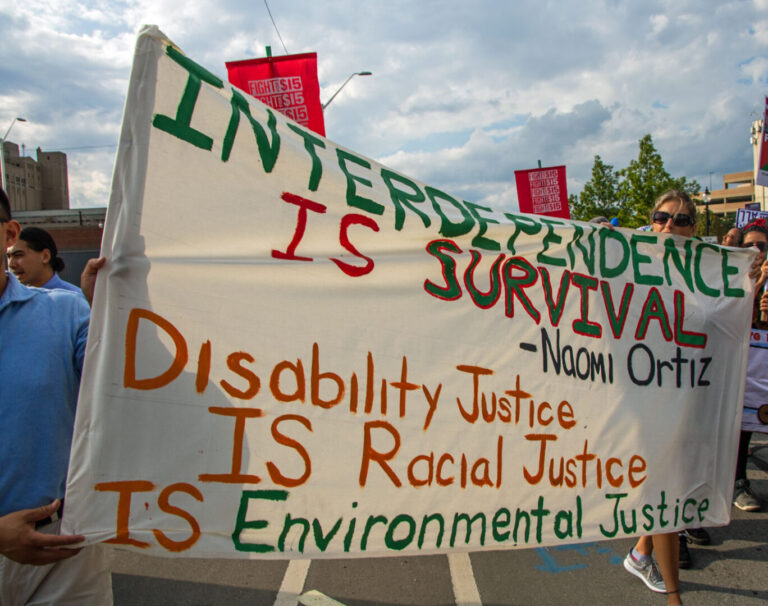
The importance of Octavia Butler’s 1993 novel Parable of the Sower continues to crystalize, as Butler’s prescient imagining of urban California torn apart by neoliberal divestment comes to fruition. Following in the space opened up by Black feminist scholarship on Butler, the present essay examines her relevance beyond literary and cultural studies. I argue that Parable is a Black feminist crip theorization of political economy that diagnoses the disabling conditions of precarity under neoliberalism and also prescribes collectivity for crip and mad survival. Neoliberalism describes a global stage of advanced capitalism wherein governments are both incentivized and disciplined into enforcing economic policies that include privatization, deregulation, and market liberalization. As Jodi Melamed defines it, neoliberalism requires a certain kind of political governance, that puts the interests of business over the well-being of people (2011). Neoliberal governance engenders what I call “disabling contradictions,” yet the blame for conditions of precarity is deflected onto bodyminds themselves. In Parable of the Sower, Butler theorizes these disabling contradictions of neoliberal governance under advanced capitalism, drawing into focus the political economic systems that cause suffering. Parable also depicts strategies for crip and mad survival that are made possible through the conscious creation of community and networks of solidarity that counter the neoliberal state’s devaluation of bodyminds. Gathering to read and discuss the novel, rather than a distraction from the crises, furthers the emergence of crip and mad collectivities. As such, it is an urgent and timely practice for building futures for crip and mad people.