Introducing The Amplification Project
Since 2019, I have collaborated with an international group of artists and curators, including Biba Sheikh, Vukašin Nedeljković, Lisa Shoshany Anderson, and Pinar Öğrenci, on The Amplification Project: Digital Archive for Forced Migration, Contemporary Art, and Action (hereafter, The Amplification Project), a participatory, community-led digital archive that documents, preserves, and shares art and cultural productions related to forced displacement and refugeedom.1 Independent, activist, and open to all (within the limits of digital devices and internet connectivity), the archive offers artists and cultural producers a platform to preserve and share work related to displacement, and a space for people to encounter and engage with their creations. The Amplification Project’s operations are sustained by shared decision-making and collection development, with all logistics and ongoing stewardship coordinated from New York City, including support from graduate assistants and alumni of Pratt Institute’s School of Information. Its US base situates the work within a contemporary representational regime in which refugees2 remain underrepresented and misrepresented in many institutional archives and are routinely framed through crisis and dehumanizing rhetoric that travels across news media, platformed discourse, and policy—a regime that motivated the archive’s founding.
In what follows, I trace the founding and evolution of The Amplification Project through my experiences as a co-founder, director, and archivist of—and researcher on—the project. These roles inform the article’s voice, shifting between a practitioner engaged in day-to-day operations and a critical archival scholar analyzing the workings of this archive as cultural infrastructure that fosters community while documenting, preserving, and sharing art and cultural productions related to forced migration. I introduce and frame my discussion through the concept of “collective interventionist archiving”: a participatory, collaborative digital archival praxis that animates The Amplification Project’s approach. This praxis involves archivists working with existing communities—or those that organically form around an archiving project—to leverage digital archives (spaces, materials, platforms, and networks) to raise awareness about, disrupt, and contest injustice within specific communities or across broader social fields.
After situating my positionality, I sketch a US and European representational regime across institutional archives, media, and political discourse, and the art world’s growing attention to displacement and refugeedom that engendered the project. I then detail the project’s socio-technical design and collaborative labor as a model of collective interventionist archiving, before turning to two artworks as analytic tests of what The Amplification Project enables and where it still meets limits when works travel into differently constituted publics.
Positionality
As a white, cisgender woman, a US citizen without refugee experience, and a critical archival studies professor with a background in performing art practices, I acknowledge the limitations and privileges that shape my perspective. My racial, cultural, social, educational, and experiential background undoubtedly influences my approach to this work. I continually seek feedback from my professional community, including refugee advisors and Amplification Project community members, such as sharing presentations and paper drafts before presenting or publishing to ensure accurate representation, addressing potential gaps in understanding, and challenging assumptions arising from my privileges. Further, as refugee experiences are diverse and evolve across time and space, this work necessitates ongoing learning and critical reflection on power, representation, ethical responsibility, and the complex dynamics of documenting and disseminating refugee experiences. Additionally, I understand The Amplification Project and my role within it as one of confronting and transforming power imbalances and limitations in archives and online spaces, rather than as “empowering agency” or “giving voice” to refugees. In line with Saidiya Hartman, the project embodies “a struggle within and against the constraints and silences imposed by the nature of the archive”3 to challenge the erasure of refugee experiences from social memory.
The Driving Forces Behind The Amplification Project
My work with the Refugee Rights in Records (R3) Initiative at the University of California, Los Angeles (UCLA) during the latter part of the 2010s laid the foundation for The Amplification Project. That research surfaced two linked dynamics: persistent problems in the representation of refugees across institutional archives, media, and political discourse in the US and Europe, and the global, growing prominence of artistic and curatorial practices about displacement and refugeedom. The archive emerged as an attempt to think through those dynamics together, asking what kinds of collective, archival practices and systems might support artists and cultural producers responding to displacement—especially those outside mainstream art circuits—while also attending to the constraints that shape how such archival work circulates and is taken up.
Refugee Representation in Institutional Archives
Institutional archives contain a preponderance of records about refugees rather than by refugees. These records—ranging from administrative files and policy documents on relocation and settlement to NGO field reports and other bureaucratic materials—predominantly capture the perspectives, decisions, and actions of the people and institutions with whom refugees interact rather than reflecting refugees as narrating subjects.4 These materials frequently reduce people to statistics and categories in their interactions with the state, judicial systems, or NGOs, failing to recognize the day-to-day realities and experiences of displacement. This asymmetry is one reason art and cultural productions related to refugeedom, along with participatory community archival practices that preserve and circulate them, have become critical sites for contesting how displacement is narrated, remembered, and shared, since they can help register voices and perspectives beyond bureaucratic practices and categories.
This research raised two questions that continue to animate my work: What kinds of collective archival practices, systems, and technologies can archivists use to raise awareness of refugee experiences? How can archivists collaborate with refugee communities and their allies to build more inclusive and representative archives of refugee experiences and perspectives?
Media, Governance, and Platforms
A parallel representational pattern appears in US and European news coverage, which often prioritizes politicians and bureaucratic discussions about refugees rather than refugees’ own voices,5 and frequently represents refugees as statistics or through dehumanizing metaphors like “floods” or “waves.”6 These representations extend beyond language; they are also reproduced through images, shaping how refugees are perceived. As Kathy Burrell and Kathrin Hörschelmann write, contemporary refugee discourse operates as a very “visual ‘crisis’” in which “the story of refugees is being told in highly gendered and racialised images” that script refugee bodies through familiar tropes of vulnerability and threat, intensifying processes of othering.7 Moreover, a recurring problem in coverage is categorical slippage: news and political discourse often collapse refugees, asylum seekers, and undocumented migrants into a single undifferentiated figure of “the migrant.” This obscures the legal rights and state obligations specific to each status—such as the right to asylum or protections under international refugee law—making it easier for restrictionist rhetoric to treat legally distinct populations as equivalent and harder for legal, policy, and humanitarian advocates to invoke those frameworks in response.
In political discourse over the past decade, anti-refugee rhetoric has increasingly framed refugees through degrading tropes—framings that can move from speech into governance. In the US, this movement from speech into governance was visible during President Donald J. Trump’s first term through his “zero-tolerance policy” that led to family separations at the US–Mexico border, and entry bans for people from Muslim-majority countries.8 During the 2024 US election cycle, President-elect Trump and other Republican candidates repeatedly characterized migrants crossing the US–Mexico border as “animals”9 and their movement as an “invasion.”10 In 2025, Trump codified this rhetoric into policy through an executive order stating that “an invasion is ongoing at the southern border,”11 and this framing quickly translated into concrete enforcement directives, including expedited removal of individuals from the US without a court hearing. Media framings and political discourse are increasingly shaped by platformed dissemination, with far-right actors using social media to spread anti-refugee misinformation and conspiracy theories. Recent reporting links this online misinformation to anti-refugee mobilization and violence, including protests and arson attacks targeting properties linked to asylum seekers in the UK as well as attacks on asylum seekers and migrants in Portugal.12
These dynamics also spill into artistic spheres: during the 2018 Liverpool Biennial, Banu Cennetoğlu’s The List, a public work memorializing refugees who have died at or within the borders of Europe since 1993, was vandalized.13 Read alongside “invasion” rhetoric, the defacement underscores how cultural forms that memorialize or reframe forced displacement can become flashpoints in polarized, hostile discursive environments.
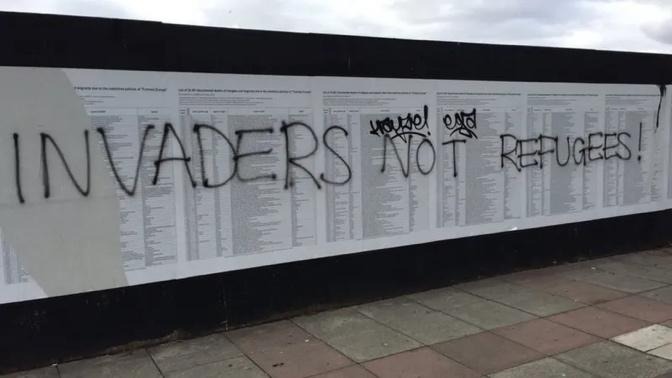
This led me to ask: in an era of widespread anti-refugee sentiment and xenophobic rhetoric, how might archivists leverage digital archives to challenge dehumanizing narratives, counter misinformation, and shift the terms through which refugee lives are represented in the media and public discourse?
For The Amplification Project, these challenges are inseparable from circulation. As a web-based, public archive, it enters the same antagonistic discursive environments it seeks to interrupt, aiming to introduce different, more humanizing and affective materials, contexts, and interpretive possibilities—yet remains vulnerable to being ignored, misunderstood, or absorbed without altering the scripts of crisis, threat, invasion, and other anti-refugee sentiment that circulate around it.
Art, Displacement, and the Politics of Representation
Since the so-called “refugee crisis” of 2015, artists have been telling stories about why people are forced to flee and what home, displacement, and refugeehood look like to them, with a significant cohort of visual artists transforming their practices into what Anne Ring Peterson calls “critical modalities of thinking about migration”—interrogating prevailing beliefs and offering different perspectives on the circumstances surrounding and processes of migration in a globalized world.14 In this context, Peterson argues that art exceeds its traditional role as an object or representation, becoming a “politically charged action” that engages artists and viewers in critical reflection.15
Art can also reconfigure what becomes perceptible and sayable about forced migration and refugeedom. It can “creatively recalibrate representational conditions,”16 writes T.J. Demos, by rendering visible displacement experiences overlooked or oversimplified in other spaces, such as archives and the media, thereby “transform[ing] the visual field of politics.”17 For instance, large-scale, high-profile art interventions—most visibly Ai Weiwei’s installations at the Biennale of Sydney (2018) and Berlin’s Konzerthaus (2016)—made the material traces of refugee journeys central. In Berlin, Weiwei covered the pillars of the building in 14,000 orange life jackets used by refugees arriving in Lesbos, commemorating those who drowned while attempting the journey to Europe.18 Such works draw attention to how objects of refugee movement (life vests, rafts, clothing, emergency blankets) become affectively and politically charged sites of encounter, what Kaya Barry terms an emerging “aesthetics of mobilities,”19 through which refugee movement is made publicly perceptible and narratable.20 At the same time, however, the political promise of this work is not automatic. Even as art can open new ways of seeing and thinking about forced migration, it can also be absorbed into familiar representational conventions, circulating as a humanitarian spectacle without substantially shifting the underlying systems through which displacement is encountered and interpreted.21
For Jacques Rancière, the question is not simply whether an artwork “raises awareness” but whether it reconfigures the “distribution of the sensible”: the perceptual and practical ordering that defines what is shared, how roles and positions are allocated, and who can participate in a common world.22 In this framework, politics centers “around what is seen and what can be said about it, around who has the ability to see and the talent to speak, around the properties of spaces and the possibilities of time.”23 Rancière calls a break in this ordering “dissensus”: a rupture that unsettles established frameworks of “perception, thought, and action.”24 Building on this, Arek Dakessian and Liliana Riga argue that art related to displacement can sometimes instantiate this kind of dissensus by staging new “scenes of relationality,” opening a momentary “rift” in ordinary ways of seeing refugeedom and enabling “a different epistemic access” to forced displacement than activist, political, or humanitarian representations allow.25
Whether such rifts endure often depends on the systems of circulation and interpretation through which artworks travel—the curatorial settings, descriptive conventions, and publicity channels that shape who encounters a work and under what terms. These limits are compounded when works move primarily within bounded publics and established Western art-world circuits—especially European and US biennial, museum, and festival circuits—where gatekeeping, the often-invisible networks of power and influence that shape who is recognized as an artist and which works are deemed to matter, continues to condition how (and by whom) displacement is encountered.
The tension between art’s capacity to interrupt dominant frames and the constraints that shape its circulation opens space for The Amplification Project as an archival intervention: not only preserving works but also creating a setting for their ongoing relational encounter and recirculation beyond the spatiotemporal limits and frequently restricted publics of exhibitions and performances. The project also works against Western art-world gatekeeping by mobilizing crowdsourced collecting, creating alternative pathways through which artists and works can travel and accrue new relations and meanings, and inviting different publics into contact with the artworks. These tensions raise a set of questions for archival practice:
- How can archivists and artists collaborate to preserve and amplify stories of displacement?
- How can archives provide lasting platforms for artists’ work on displacement, without reproducing art-world gatekeeping logics?
- How can participatory digital archives move beyond recognition or “awareness” to disrupt the dominant frames through which displacement often becomes legible?
Wanting to explore these questions through a collaborative archival project, I reached out via email to Sheikh, Öğrenci, Nedeljković, and Shoshany Anderson—whose work on displacement I admired and had been following—to ask whether, in their experiences and networks, such a project is needed and whether they would want to build it together. All four said yes, and together we co-founded the archive and began developing its mission, scope, and workflows.
Positioning The Amplification Project
As a participatory, community-led digital archive preserving and sharing art and cultural production related to forced displacement across borders, The Amplification Project draws on and contributes to participatory archives, community archives, and socially engaged art practice and thought. Participatory archives approaches centrally inform the project’s design. These varied forms of archives seek to expand access to—and diversify—archival collections while also shifting curatorial authority and reconfiguring power relations between archives and their users. Often, though not exclusively, digital, they operate from the premise that “multiple parties have rights, responsibilities, needs and perspectives with regard to the record,” making the archive a negotiated space of shared stewardship “created by, for and with multiple communities” that respects “community values, practices, beliefs, and needs.”26 In this model of archiving, diverse stakeholders contribute to and shape both archival processes and the archive itself—to varying degrees—through activities such as uploading personal materials, describing, tagging, annotating, translating, and transcribing content.
Community archives are grassroots, independent memory organizations created and stewarded by members of the community being documented, frequently “emerging from and coalescing around vulnerable communities, past and present.”27 They are often activist projects in which communities tell, protect, and share their own histories on their own terms.28 The Amplification Project aligns with many of these structures and commitments but diverges in two ways: not all members of its community have personal displacement experiences or identify as refugees, and the community did not pre-exist the archive but continues to form through the ongoing work of developing, stewarding, and using it. This dynamic represents an evolving model of community archiving—one that builds its community as the archive grows.
A third framework, socially engaged art, shapes the project’s collaborative and activist orientation. Socially engaged art—variously termed interventionist, social practice, or relational art—is a field in which artists prioritize public engagement, dialogue, and relationship-building, often working with specific communities (or those that form through an art-making process) to foster collective action on shared social and political issues. As Gregory Sholette, Chloë Bass, and the Social Practice Queens observe, many such projects aim to realize “a real-world instance of progressive justice, community building, and transformation.”29 Although The Amplification Project is not an artwork in itself, it draws on this orientation through the collective work of its co-founders and community members, advancing its mission to foster solidarity and community, counter anti-refugee rhetoric, and amplify art and cultural productions related to forced displacement.
Connecting, Collaborating, and Creating: Forming Community
…be[ing] in the place of the here and now, work[ing] with others in simultaneous and concrete practice, see[ing] the realization of work in the experience of connection.30
…through an archival project, action and change can become a reality.31
Over six months in 2019, Sheikh, Öğrenci, Nedeljković, Shoshany Anderson, and I—scattered across three countries and initially strangers to one another—worked across geographic distance, time zones, and diverse backgrounds to lay the project’s foundations. Through email, shared online documents, and video calls, we negotiated ideas, values, and interests to develop the archive’s mission, goals, technical aspects, content scope, and curatorial decisions while also building relationships with one another. We practiced (and continue to practice) consensus-based decision-making across all archival matters, from idea generation to implementation. Our efforts and conversations created a workable blueprint for the archive, built solidarity among us, and revealed an activist, interventionist vision for the project.
This vision surfaced repeatedly in our discussions. For instance, Sheikh, Shoshany Anderson, and I emphasized mobilizing the archive to raise awareness of global displacement and to counter negative media narratives about refugees; Shoshany Anderson further articulated educational and public-facing ambitions through a series of questions:
The most important goal for this archive is to be able to use it to introduce people to these global issues, to educate people, to preserve and document the artworks and materials refugee and asylum seekers are creating, but to keep the goal in mind. Are we trying to change people’s minds? Are we trying to further educate people? Are we trying to reach as broad an audience as possible? Are we simply trying to preserve precious materials and artwork in an accessible way? Or all of the above?32
Sheikh also framed the archive as a counter-discursive space—one that challenges the demonization of refugees and displaced people across media platforms:
A counterpoint to other platforms and media that demonize refugees, displaced people, and victims of war and violence. People require an eye-opening and heart-opening experience. People need certainty that they have nothing to fear about other cultures and that refugees are similar to them.33
Nedeljković emphasized the need to present digital works in a sustainable and compelling way:
We need to establish a clear vision for documenting and collecting digital works as they relate to refugees and asylum seekers, and for presenting them in an effective, sustainable, and most importantly, impactful format.34
Collectively, these conversations crystallized The Amplification Project’s aims: to preserve and circulate displacement-related art and cultural productions; to increase the presence of refugee narratives in archives; to intervene in anti-refugee and xenophobic rhetoric; to disrupt dehumanizing portrayals of refugees in the media and on digital platforms; to provide diverse, global perspectives about the ways people experience displacement; and to build solidarities. These goals may seem idealistic, and this project alone cannot achieve them. However, we pursue them with the belief that small, situated gestures—made possible by participatory digital archiving—can foster meaningful social ties and solidarities that, over time, shift understanding of forced migration and refugee representation.
Growing Community, Growing the Archive
Because The Amplification Project’s community did not pre-exist the archive, it is best understood as an expanding set of relations—concentric, overlapping, and widening circles rather than a bounded group. At its core are the co-founders, who collectively shape the archive through shared decision-making about daily operations and long-term direction. The community expands outward to include content contributors; people who provide expertise, skills, and connections to make the archive legible and sustainable (e.g., lawyers, web developers, graduate student assistants, volunteers, and colleagues); and visitors who engage with and recirculate the archive’s content, including students, educators, and curators who use it as a resource for experience-based learning and programming. This structure reflects the project’s dynamic nature: an evolving network of relationships and shared interests. Yet “community” here can be an externally imposed and contested label, one that may obscure uneven labor, ownership, or identification since not all participants may identify with it in lived experience.
The archive’s collection development strategy is grounded in a grassroots approach: we hold one-on-one conversations with artists and cultural producers who may be interested in contributing work, using these meetings to learn about their practice and to share the archive’s mission and how we support and amplify contributors’ work. These exchanges often generate additional introductions to other artists, creating a network effect that organically increases the project’s reach. Nedeljković frames this as “slow activism” (after Wallace Heim), which emphasizes the power of deliberate, person-to-person communication in which the “locus of change is one person at a time, in a process of communication which is dependent on finding enough common meaning between the two people to sustain a dialogue,”35 and in which the “activist potential for change develops in the time it takes to speak about something, and for it to be ‘listened’ into existence.”36 This framing resonates with Kim Christen and Jane Anderson’s account of “slow archives,” which makes space in archival workflows, structures, and practices to emphasize how “knowledge is produced, circulated, and exchanged through a series of relationships,”37 foregrounding “listening carefully and acting ethically” through long-term, reciprocal archival relationships.38
In practice, The Amplification Project prioritizes relationship-building with contributors, often extending beyond the immediate goal of content acquisition. For instance, a referral contact from a 2020 outreach effort evolved into an ongoing conversation and relationship with artist Lilli Müller, who has since contributed a substantial body of work, collaborated with us on the curatorial display of her work on our site, and participated in a “Spotlight Interview” in the archive’s newsletter. This form of archival growth is measured by depth, trust, and contextual richness—building relationships with contributors—as much as by item counts. More recently, this relationship-based outreach has led to ongoing Zoom and email conversations with three Palestinian artists living in Balata Camp in the West Bank, introduced to the project by Sheikh. Their current contributions underscore how slow archiving and slow activism can foster new participation across cultures, across time, and across contexts.
Alongside relationship-based collection development, the archive also supports low-barrier, self-directed participation: anyone can upload text, images, audio, and video through a submission form on the archive’s website. Regardless of how materials enter the archive, contributors retain full rights to their work and maintain authority over description and contextualization. To preserve contributors’ voices, understanding, and perspectives, we do not substantively edit their descriptions (except to correct typos), and contributors can assign tags to improve discoverability and thematic organization.
Reciprocity is also central to our approach: when someone contributes work, we aim not only to preserve it but also to amplify it in as many ways as possible, which currently includes featuring new contributions on our homepage, social media, and in our quarterly newsletter (launched in 2024). The newsletter highlights items from the archive, features “Spotlight Interviews” with contributing artists and cultural producers, and invites subscribers to share news and updates, positioning the project as an ongoing site of exchange and recognition.
Sustaining The Amplification Project is collective and labor-intensive. As mentioned, the co-founders conduct one-on-one outreach and intake conversations with potential and returning contributors, seek grants, manage day-to-day archival operations, and develop public programming. Pratt Institute School of Information graduate assistants and alumni volunteers extend this work by supporting web development and design, managing our social media presence, designing and publishing our newsletter, coordinating and assisting contributors with the submission process, implementing outreach activities, and helping ensure that attribution and context accompany archival items as they circulate.
Although public and web-based, the archive’s readership is only partially visible to the project team, which limits what can be empirically claimed about its reception at scale. To address this constraint, we have implemented web analytics to better understand who visits the website (e.g., location), how visitors find it (e.g., search or social media), and how they engage with it (e.g., time spent and actions taken). While a systematic analysis of this data remains a future step, what is currently visible is how the archive accumulates impact through uptake—especially pedagogical and curatorial activations that move works across contexts and publics, generating new interpretive encounters with the materials. These traces of uptake reveal how the archive extends the capacity of art and cultural production by enabling what might be called “cascading encounters”—moments when archival materials are reactivated, remediated, and introduced to people, groups, and communities who might never visit the archive directly.
For instance, when Pratt graduate assistants on The Amplification Project designed and produced a zine featuring ten images from the archive for InfoShow25 at the Pratt Manhattan campus, they translated digital materials into print for an audience of several hundred attendees, including information scholars, professionals, and students. This remediation served dual purposes: it introduced displacement narratives to attendees—and particularly to current and future archivists and information workers who will shape how such materials circulate—and it also demonstrated participatory, community-led archiving as a model for graduate student experiential learning and professional practice. Similarly, the Center for Curatorial Studies (CCS) at Bard College invited the author to lead a year-long curatorial module focused on creating “other curatorial experiences” beyond traditional exhibitions in which graduate students are engaging The Amplification Project as a framework for rethinking curatorial practice. The CCS invitation, extended specifically because of The Amplification Project, stages the archive as infrastructure for curatorial pedagogy—a model that travels beyond archival and information contexts into art education and curatorial training.
Yet, these activations also reveal the partial and mediated nature of circulation: works travel as carefully selected fragments rather than comprehensive documentation, raising questions about what context is lost or transformed in remediation. The InfoShow25 zine, for example, presented images with artists’ names and work titles only, omitting the descriptions and tags contributors had provided. The success of such uptake initiatives remains uncertain and challenging to measure—we can trace that encounters occur, but not always what understanding they generate or whether they shift perception or understanding about refugeedom in the ways the archive intends.
In the Archive
The Amplification Project currently stewards 350 items—photographs, images of visual artwork, photo and illustrated narratives, videos, and blogs—from twenty-four contributors residing in or originating from Bahrain, Lebanon, Jordan, Ireland, the UK, Palestine, the US, Italy, Egypt, and Albania. Dating from the late 1980s to 2025, these works document uprisings and revolutions, war, confinement, the search for asylum and its associated vulnerabilities, and the textures of daily life under displacement across distinct geopolitical settings. The following two cases serve as analytic stress-tests—showing how the archive’s work can intensify relational encounters in some settings, while in others, the ethics of representation require refusal and withdrawal from spectacle.
Sheikh and Nedeljković were the first to contribute to the archive. Sheikh—curator of the ongoing exhibition Mitli Mitlak (Like You, Like Me)—contributed nearly fifty images of works from the exhibition. Mitli Mitlak showcases Sheikh’s collaborations with thirteen artists from the Mediterranean and Arab world, many of whom are refugees. Together, they have created a body of work that blends her poetic theater scripts, shared immigrant stories, and community testimonies into visual art. The exhibition features paintings, drawings, videos, and photographs by artists from occupied territories and refugee camps. Some works, like Sinan Hussein’s “Just a Concert,” radiate joyful celebration, while others, such as Wael Darweish’s “Burning Bodies,” confront violence. Although their mediums and tones vary, all pieces in the archive from Mitli Mitlak are connected by a common theme: responding to Sheikh’s poetic theater texts about Ruba, a character influenced by war and forced migration.
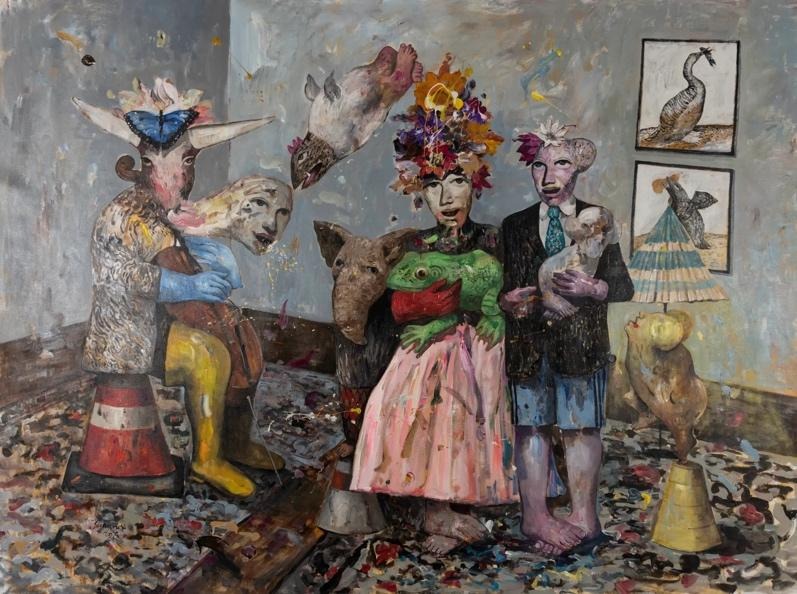
Sheikh describes the exhibition’s title as deeply rooted in wartime rhetoric, yet also naming an ethical claim about human relations that insists on shared humanity against the logics of othering that structure anti-refugee rhetoric:
In the context of struggle, Mitli Mitlak means ‘Like You, Like Me…whether you die or whether I die is not the matter, we are the same; and if I have to die for you, I will’. We are more alike than we are different; we are all human. I am you. WE are part of the Oneness.39
Mitli Mitlak was exhibited at the Miller Art Museum in Sturgeon Bay, Wisconsin (March 2–April 15, 2019) and later at the Scarab Club in Detroit, Michigan (July 1–31, 2024), where Sheikh performed amid fifteen artworks hung on the walls. Through movement and monologue in an intimate atmosphere, Sheikh transformed the exhibition into a multisensory encounter. By immersing viewers in a tapestry of movement, storytelling, color, shape, and texture, Sheikh forged a visceral connection between the stories in her text and those embedded in the artworks, illuminating intricate emotions and experiences surrounding war, displacement, and resilience. Approximately twenty-five people attended the show, many staying for a post-performance conversation and Middle Eastern desserts and pastries—an informal yet highly engaged mode of encounter that connected attendees with the work and with one another. Read through Rancière, this kind of encounter matters not simply as audience response but as a reconfiguration of the sensible: it stages a scene in which refugeedom is encountered through shared attention, embodied narration, and conversation rather than through the distancing scripts of crisis or humanitarian spectacle. In this sense, the work does politics by reordering the terms under which displacement becomes thinkable and felt as a matter of common concern.
Through The Amplification Project, the Mitli Mitlak artworks circulate under conditions different from those of the intimate, twenty-five-person Detroit performance. Visitors encounter them as digital thumbnails in the archive’s grid, accompanied by contributor-provided descriptions and tags, without Sheikh’s embodied presence, monologue, or the sensory atmosphere of the exhibition space. Yet this shift from performance to archive also extends Mitli Mitlak’s temporal and spatial reach: the performance lasted one evening; the archived images remain available for ongoing encounter, accumulating new contexts as users discover or use them in new publications, such as the zine created for InfoShow25.
If Sheikh’s contributions work through relation, narration, and embodied encounter, one of Nedeljković’s contributions to the archive works through refusal—documenting the material conditions of confinement while withholding the image of the refugee subject that circulates so easily as spectacle. Nedeljković contributed sixteen images from their Asylum Archive (2007–), an art, activist, and academic online platform that documents and critiques Ireland’s Direct Provision system for asylum seekers.40 Asylum Archive features more than 10,000 photographs documenting Direct Provision centers and their surrounding localities, alongside exhibitions, academic research, publications, and a second edition (2021) of Nedeljković’s eponymous book (which they also contributed to The Amplification Project). About the Direct Provision system, Nedeljković writes:
Introduced in November 1999, the Direct Provision system provides asylum seekers with accommodation, access to medical care and a small living allowance; it also provides children with access to mainstream schooling. Well, that is the official version. The reality is that, as I have written elsewhere, the more than 200 centres are located outside cities—in former convents, army barracks, and hotels—on the periphery of society . . . Residents live in dirty, cramped conditions, with families often forced to share small rooms. Managers control every aspect of their lives: meals, mobility, access to bed linen, and cleaning supplies.41
Nedeljković’s experience of living in a Direct Provision center from April 2007 to November 2009, while seeking asylum, profoundly shaped their work. As they explain,
As an artist, I kept myself intact by capturing and communicating with the environment through photographs and videos. This creative process helped me to overcome confinement and incarceration. Originally started as a coping mechanism, Asylum Archive is directly concerned with the reality and trauma of life for asylum seekers.42
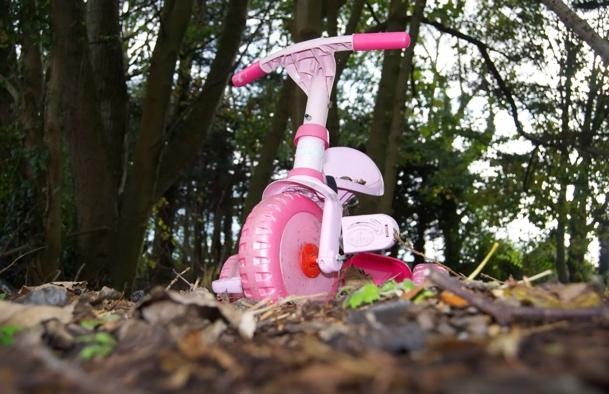
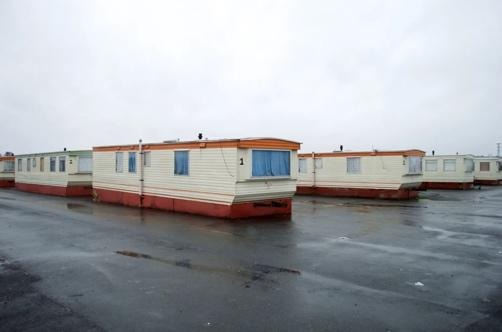
Nedeljković’s photos of Direct Provision spaces, architectures, and artifacts left behind offer a spectral glimpse into these sites without showing a single person. Their focus on the “material architectures of containment”43 deliberately avoids depicting asylum seekers, foregrounding instead the institutional environments and objects through which confinement is organized and lived. In a 2024 interview for The Amplification Project’s newsletter, Nedeljković commented, “What I am interested in are traces, the remnants or the ghosts of the people that used to be there.” They continue:
The decision not to have the people is an ethical one. It is twofold. One is this notion of representing people, especially when it comes to refugees. We are seeing the suffering, even now, with the biggest, horrible genocide in Gaza. We see the human bodies. We see them suffering, being murdered, and slaughtered under the rubble. I was posing this question: Do we really need to see the human bodies to be able to empathize, right? Also, when I am in this process of taking the photograph of a person, that photograph can be manipulated or certainly interpreted in so many various ways through different mediums and formats. I did not want to take this responsibility, especially at the beginning, because my own image had been misinterpreted and misrepresented.44
Nedeljković’s Asylum Archive and their recent project, Fortress Europe,45 which documents immigrant detention camps across Europe, shed light on the often-overlooked realities, systemic injustices, and inhumane conditions faced by those seeking international protection, and offer visual accounts with a level of detail and subjectivity often absent from administrative records.
In The Amplification Project, Nedeljković’s refusal to depict asylum seekers takes on additional significance. The archive’s tagging system connects their photographs of Direct Provision spaces to other works tagged “confinement,” “asylum seekers,” or “Ireland,” creating thematic networks that situate these images within broader displacement narratives. A visitor searching for ‘refugees’ or browsing by contributor encounters these spectral traces alongside other artists’ more figurative representations, generating comparative moments that Nedeljković might not have intended but that the archive’s structure enables.
While differing in approach, Sheikh’s Mitli Mitlak and Nedeljković’s Asylum Archive contribute to the goals of The Amplification Project. Together, they challenge dehumanizing portrayals of refugees and refugeedom by staging encounters that refuse spectacle and dehumanizing tropes while insisting on complexity—through performance and narration on the one hand, and through traces and withheld portraiture on the other. Circulating these works through the archive’s practices extends their capacity to be encountered and engaged with beyond the temporal, spatial, and gatekeeping limits that often shape whose stories travel. This networked circulation means the archive’s materials are never fixed but continually reconstituted through their relationships to other materials, both within and outside the archive, and to the diverse contexts visitors bring to their encounters.
Conclusion
The Amplification Project demonstrates how a participatory, community-led digital archive can serve as cultural infrastructure for refugee-related art and cultural productions—a shared space for interaction and dialogue that preserves and shares works that counter bureaucratic, media, and political framings of displacement while also fostering conditions for their ongoing encounter across time and space. Recalling Rancière, its intervention is representational and aesthetic-political as the archive and its practices help re-stage what can be seen, said, and perceived about refugeedom by assembling different fields of attention—classrooms, newsletters, curatorial programming, and networked recirculation—that exceed the fleeting temporalities of exhibitions, performances, and news cycles.
Ismail Einashe’s call to “use art to look and think again”46 points to the limits of media frames and the need for alternative ways of apprehending forced displacement—ways that do not reduce refugee experiences to spectacle, statistics, or xenophobic rhetoric. The Amplification Project advances this possibility so that encounters with displacement and refugeedom can take place on terms other than crisis news or platformed outrage. In this sense, the archive’s work aligns with Roland Bleiker’s argument that aesthetics act like an “amplifier,” adding a “different dimension to our understanding of the political and, by consequence, to the ethical discourses that are central to waging political debate.”47
Yet, the project also clarifies the limits of archival and artistic intervention: works may still circulate within bounded publics; hostile discursive environments can distort or foreclose reception; and unequal digital access constrains who can contribute and who can encounter the archive. As a result, “impact” is best understood here not as immediate change but as the slow accumulation of relational encounters among people, the archive’s materials, and the archive itself, which, over time, can interrupt representational regimes and widen the settings under which refugee narratives are recognized as complex, situated, and contextualized on their own terms. In Caswell’s terms, it is a mode of activating archival “traces in the now for resistance and activism against oppressive power structures in the present.”48
Two interconnected research threads will further develop understanding of The Amplification Project—one yet to be undertaken and one already underway. First, developing and implementing qualitative methodologies to trace how the use of the archive generates understanding beyond metrics by examining uptake—including how educators integrate materials into pedagogy, how curators and artists activate works in new contexts, and how visitors make meaning from their encounters with the archive and its materials, particularly when those encounters occur in antagonistic discursive environments. Second, I am conducting ongoing ethnographic research with The Amplification Project’s graduate assistants and alumni volunteers, which aims to document and theorize how sustained participation with the archive blurs the line between learning about archival activism and actively practicing it — examining how participants describe their labor, what they report learning and experiencing, and how they navigate connections between their own goals as students or volunteers and the archive’s activist mission and community needs. Such scholarship would advance theoretical understanding of archives as sites of intervention while illuminating how sustained student and volunteer engagement functions as a pedagogical and social model, a strategy for advancing activist archival work, and a means of building community.
As the archive grows, it will continually (re)shape what can be seen, perceived, and expressed about displacement and refugeedom. While social media and other online platforms can amplify xenophobic voices, The Amplification Project engages these same systems of recirculation to cultivate a shifting constellation of refugee narratives. In doing so, it sustains connections in which people, art, activism, and social memory-keeping can be in common across borders and boundaries. As a model of collective interventionist archiving, The Amplification Project offers one way in which participatory, community-led digital archives can serve as sites of resistance, solidarity, and community-building in the face of global displacements.
Acknowledgement
My sincere thanks to Jamie Lee for their support and to James Lowry for insightful feedback and invaluable suggestions on an earlier draft. I am also grateful to the two anonymous reviewers for their helpful and discerning comments.
Notes
- Following Peter Gatrell, “refugeedom” denotes the condition and lived realities of being a refugee, encompassing the social, political, legal, and bureaucratic dimensions of displacement, the representation of these experiences in the media and social discourse, and the agency and subjectivities of refugees as they navigate and respond to their circumstances. Peter Gatrell, “Refugees—What’s Wrong with History?,” Journal of Refugee Studies 30, no. 2 (2017): 170–89, https://doi.org/10.1093/jrs/few013. ↩
- In this paper, I use the term ‘refugee’ as an umbrella shorthand for people experiencing displacement across a range of legal and social positions (e.g., asylum seeker, asylee, internally displaced person, undocumented), while acknowledging important distinctions among these categories. I also follow Critical Refugee Studies in treating “refugee” as an expansive analytic category that exceeds formal legal recognition and includes people forcibly displaced by persecution, conflict, war, conquest, settler/colonialism, militarism, occupation, empire, and environmental and climate-related disasters, regardless of legal status. Critical Refugee Studies Collective: Critical Research, Teaching, and Public Initiatives on Refugees, “Critical Vocabularies,” https://criticalrefugeestudies.com/teaching/critical-vocabularies. ↩
- Saidiya V. Hartman, Scenes of Subjection: Terror, Slavery and Self-Making in Nineteenth-Century America (Oxford University Press, 1997), 11. ↩
- Dima Saber and Paul Long,“Refugee Writing, Refugee History: Locating the Refugee Archive in the Making of a History of the Syrian War,” in Refugee Imaginaries: Research Across the Humanities, ed. Emma Cox, Sam Durrant, David Farrier, et al. (Edinburgh University Press, 2020); Rachel Ibreck, Peter Rees, and Martina Tazzioli, “Counter-Archiving Migration: Tracing the Records of Protests against UNHCR,” International Political Sociology 18, no. 4 (2024): 4, https://doi.org/10.1093/ips/olae035; Lauren Banko, Katarzyna Nowak, and Peter Gatrell, “What Is Refugee History, Now?,” Journal of Global History 17, no. 1 (2022): 15, https://doi.org/10.1017/S1740022821000243. ↩
- Glenda Cooper, Lindsey Blumell, and Mel Bunce, “Beyond the ‘Refugee Crisis’: How the UK News Media Represent Asylum Seekers across National Boundaries:,” International Communication Gazette, 83, no. 3 (2021): 195–216, https://doi.org/10.1177/1748048520913230; Lilie Chouliaraki and Rafal Zaborowski, “Voice and Community in the 2015 Refugee Crisis: A Content Analysis of News Coverage in Eight European Countries,” International Communication Gazette 79, no. 6–7 (2017): 613–35, https://doi.org/10.1177/1748048517727173; Christine Ogan, Rosemary Pennington, Olesya Venger, et al., “Who Drove the Discourse? News Coverage and Policy Framing of Immigrants and Refugees in the 2016 U.S. Presidential Election,” Communications 43, no. 3 (2018): 357–78, https://doi.org/10.1515/commun-2018-0014. ↩
- Costas Gabrielatos and Paul Baker, “Fleeing, Sneaking, Flooding: A Corpus Analysis of Discursive Constructions of Refugees and Asylum Seekers in the UK Press, 1996-2005,” Journal of English Linguistics 36, no. 1 (2008): 5–38, https://doi.org/10.1177/0075424207311247; Cooper et al., “Beyond the ‘Refugee Crisis.’” ↩
- Kathy Burrell and Kathrin Hörschelmann, “Perilous Journeys: Visualising the Racialised ‘Refugee Crisis’,” Antipode 51, no. 1 (2019): 47–48, 133850546, https://doi.org/10.1111/anti.12429. ↩
- Banu Gökarıksel, “The Body Politics of Trump’s ‘Muslim Ban,’” Journal of Middle East Women’s Studies 13, no. 3 (2017): 469–71, https://doi.org/10.1215/15525864-4179133; Adela C. Licona and Eithne Luibhéid, “The Regime of Destruction: Separating Families and Caging Children,” Feminist Formations 30, no. 3 (2018): 45–62, https://doi.org/10.1353/ff.2018.0037. ↩
- Anjali Huynh and Michael Gold, “Trump Says Some Migrants Are ‘Not People’ and Predicts a ‘Blood Bath’ If He Loses,” U.S., The New York Times, March 17, 2024, https://www.nytimes.com/2024/03/16/us/politics/trump-speech-ohio.html. ↩
- Eric Cortellessa, “Read the Full Transcripts of Donald Trump’s Interviews with TIME,” TIME, April 30, 2024, https://time.com/6972022/donald-trump-transcript-2024-election; Jazmine Ulloa, Meg Felling, and Claire Hogan, “Video: Republicans Target Migrants at the Border as an ‘Invasion,’” U.S., The New York Times, April 26, 2024, https://www.nytimes.com/video/us/politics/100000009411247/republicans-label-migrants-invasion.html; John Fritze, “Trump Used Words like ‘invasion’ and ‘Killer’ to Discuss Immigrants at Rallies 500 Times: USA TODAY Analysis,” USA TODAY, August 8, 2019, https://www.usatoday.com/story/news/politics/elections/2019/08/08/trump-immigrants-rhetoric-criticized-el-paso-dayton-shootings/1936742001. ↩
- Donald J. Trump, Executive Order No. 14159, “Protecting the American People Against Invasion,” Federal Register Doc 2025-02006, vol. 90, no. 18, January 29, 2025. ↩
- Danica Kirka, “What’s behind the Anti-Immigrant Violence That Has Exploded across Britain? Here’s a Look,” AP News, August 5, 2024, https://apnews.com/article/britain-riots-unrest-social-media-misinformation-attack-5824d3136675e10d6a25c9e17287c994; Steven Lee Myers, Adam Satariano, Leo Dominguez, et al., “How Online Hatred Toward Migrants Spurs Real-World Violence,” The New York Times, August 9, 2024, https://www.nytimes.com/interactive/2024/08/09/technology/migrants-racism-social-media-violence.html; Lauren Boland, Muiris O’Cearbhaill, Jane Moore, et al., “How Arson Attacks on Properties Linked to Asylum Seekers Have Escalated over the Last Six Years,” The Journal, July 16, 2024, https://www.thejournal.ie/arson-attacks-fire-asylum-seeker-accommodation-6252984-Jul2024. ↩
- Tom Emery, “Why Liverpool’s Twice-Vandalized Memorial to Dead Migrants Stands as a Monument to Shame,” Frieze, August 21, 2018, https://www.frieze.com/article/why-liverpools-twice-vandalized-memorial-dead-migrants-stands-monument-shame. ↩
- Anne Ring Peterson, Migration into Art: Transcultural Identities and Art-Making in a Globalised World, (Manchester University Press, 2017), 7–8. {italics in original} ↩
- Peterson, Migration into Art, 8. {italics in original} ↩
- T. J. Demos, The Migrant Image: The Art and Politics of Documentary During Global Crisis (Duke University Press, 2013), 31. ↩
- Demos, The Migrant Image, 31. ↩
- Anny Shaw, “Ai Weiwei Wraps Berlin Landmark in Lifejackets in Memory of Drowned Refugees,” The Art Newspaper, February 15, 2016, https://www.theartnewspaper.com/2016/02/15/ai-weiwei-wraps-berlin-landmark-in-lifejackets-in-memory-of-drowned-refugees. ↩
- Kaya Barry, “Art and Materiality in the Global Refugee Crisis: Ai Weiwei’s Artworks and the Emerging Aesthetics of Mobilities,” Mobilities 14, no. 2 (2019): 204–17, https://doi.org/10.1080/17450101.2018.1533683. See also Abby Peterson, “Ai Weiwei and JR – Political Artists and Artist Activists,” Journal of Mediterranean Knowledge 4, no. 2 (2019): 183–202, https://doi.org/10.26409/2019jmk4.2.12; Eleana Yalouri, “‘Difficult’ Representations. Visual Art Engaging with the Refugee Crisis,” Visual Studies 34, no. 3 (2019): 1–16, https://doi.org/10.1080/1472586X.2019.1653788. ↩
- Barry, “Art and Materiality in the Global Refugee Crisis,” 205. ↩
- Juan Pablo Aris Escarcena, “Ceuta: The Humanitarian and the Fortress EUrope,” Antipode 54, no. 1 (2022): 64–85, https://doi.org/10.1111/anti.12758; Lilie Chouliaraki and Tijana Stolic, “Rethinking Media Responsibility in the Refugee ‘Crisis’: A Visual Typology of European News,” Media, Culture & Society 39, no. 8 (2017): 1162–77, https://doi.org/10.1177/0163443717726163. ↩
- Jacques Rancière, The Politics of Aesthetics: The Distribution of the Sensible, trans. Gabriel Rockhill (Continuum, 2004), 12. ↩
- Rancière, The Politics of Aesthetics, 13. ↩
- Rancière, The Politics of Aesthetics, 85. ↩
- Arek Dakessian and Liliana Riga, “Art, Refugeedom and the Aesthetic Encounter,” Journal of Ethnic and Migration Studies 50, no. 12 (2024): 3127, https://doi.org/10.1080/1369183X.2023.2290990. {italics in original} ↩
- Anne J. Gilliland and Sue McKemmish, “The Role of Participatory Archives in Furthering Human Rights, Reconciliation and Recovery,” Atlanti 24, no. 1 (2014): 20, https://escholarship.org/uc/item/346521tf. See also: Gregory Rolan, “Agency in the Archive: A Model for Participatory Recordkeeping,” Archival Science 17, no. 3 (2017): 195–225, https://doi.org/10.1007/s10502-016-9267-7, Edward Benoit III and Alexandra Eveleigh, eds., Participatory Archives: Theory and Practice, 1st ed. (Cambridge University Press, 2019), https://doi.org/10.29085/9781783303588. ↩
- Michelle Caswell and Anna Robinson-Sweet, “‘We Bounce Off Each Other’s Vibe’: The Importance of Symmetrical Intersubjectivity between Interviewer and Narrator,” The Oral History Review 51, no. 1 (2024): 8, https://doi.org/10.1080/00940798.2024.2316904. ↩
- Andrew Flinn, “Independent Community Archives and Community-Generated Content ‘Writing, Saving and Sharing Our Histories,’” Convergence: The International Journal of Research into New Media Technologies 16, no. 1 (2010): 39–51, https://doi.org/10.1177/1354856509347707; Andrew Flinn, Mary Stevens, and Elizabeth Shepherd, “Whose Memories, Whose Archives? Independent Community Archives, Autonomy and the Mainstream,” Archival Science 9, no. 1 (2009): 71–86, https://doi.org/10.1007/s10502-009-9105-2; Marika Cifor, Michelle Caswell, Alda Allina Migoni, et al., “‘What We Do Crosses over to Activism’: The Politics and Practice of Community Archives,” The Public Historian 40, no. 2 (2018): 69–95, https://doi.org/10.1525/tph.2018.40.2.69; Michelle Caswell, Urgent Archives: Enacting Liberatory Memory Work, (Routledge, 2021). ↩
- Gregory Sholette, Chloë Bass, and Social Practice Queens, “Art as Social Action (a Preface),” in Art as Social Action: An Introduction to the Principles and Practices of Teaching Social Practice Art, ed. Gregory Sholette, Chloë Bass, and Social Practice Queens (Allworth Press, 2018), xiii. For more on socially engaged art, see Pablo Helguera, Education for Socially Engaged Art: A Materials and Techniques Handbook (Jorge Pinto Books, 2011); Miwon Kwon, One Place After Another: Site-Specific Art and Locational Identity (The MIT Press, 2004). ↩
- Nikos Papastergiadis, “Spatial Aesthetics: Rethinking the Contemporary,” in Antinomies of Art and Culture: Modernity, Postmodernity, Contemporaneity, ed. Terry Smith, Okwui Enwezor, and Nancy Condee (Duke University Press, 2008), 363. ↩
- Biba Sheikh, personal conversation with the author, September 19, 2019. ↩
- Elizabeth Shoshany Anderson, Google Doc shared with the author, July 3, 2019. ↩
- Biba Sheikh, Google Doc shared with the author, July 3, 2019. ↩
- Vukasin Nedeljkovic, Google Doc shared with the author, July 3, 2019. ↩
- Wallace Heim, “Slow Activism: Homelands, Love and the Lightbulb,” The Sociological Review 51, no. 2_suppl (2003): 187, https://doi.org/10.1111/j.1467-954X.2004.00458.x. ↩
- Heim, “Slow Activism,” 187. ↩
- Kimberly Christen and Jane Anderson, “Toward Slow Archives,” Archival Science 19 (2019): 90, https://doi.org/10.1007/s10502-019-09307-x. ↩
- Christen and Anderson, “Toward Slow Archives,” 90. ↩
- Biba Sheikh, “Mitli Mitlak (Like You, Like Me),” The Mediterranean Fire Project, https://www.mediterraneanfire.com/mitli-miltalk/collection. ↩
- Asylum Archive, https://www.asylumarchive.com ↩
- Vukasin Nedeljković, “Reiterating Asylum Archive: Documenting Direct Provision in Ireland,” Research in Drama Education: The Journal of Applied Theatre and Performance 23, no. 2 (May 2018): 289, https://doi.org/10.1080/13569783.2018.1440202. ↩
- Vukasin Nedeljković, email correspondence with the author, September 5, 2019. ↩
- Aida Rosende-Pérez, “Resisting Ireland’s Necropolitics of Asylum: Refugee Voices in Irish Literature and the Arts,” Anglia 142, no. 2 (2024): 306, https://doi.org/10.1515/ang-2024-0023. ↩
- Terry Parris Jr., “Documenting Ghosts with an Olympus Camera: In Conversation with Vukašin Nedeljković about Asylum Archive,” The Amplification Project Newsletter, April 2024 https://mailchi.mp/db8fc02e7818/the-amplification-project-newsletter-is-live-6362899?e=75488d1ba3. ↩
- Fortress Europe, https://www.fortresseu.com. ↩
- Ismail Einashe, Strangers (Tate Publishing, 2023), 45. ↩
- Roland Bleiker, Aesthetics and World Politics (Palgrave Macmillan UK, 2009), 11, https://doi.org/10.1057/9780230244375. ↩
- Caswell, Urgent Archives, 38. {emphasis in original} ↩
