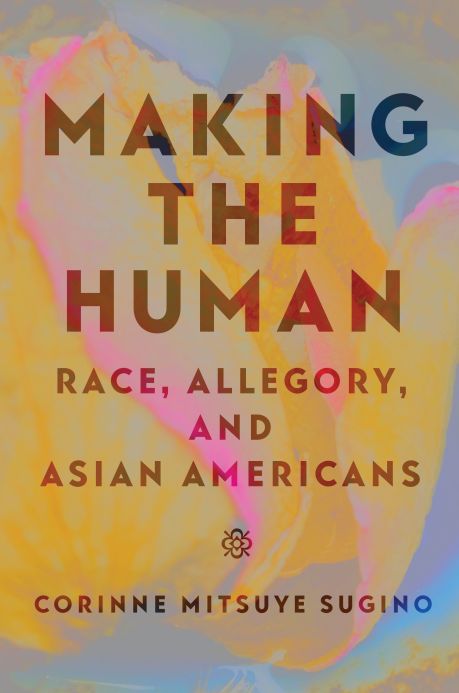
Corinne Mitsuye Sugino’s Making the Human: Race, Allegory, and Asian Americans theorizes how Asian Americans are constructed and made legible through cultural narratives to shore up normative European colonial whiteness, or what Sugino calls “Western Man.” This process happens through “racial allegory,” or discourses that narrativize racial difference, often by making distinctions between the human/inhuman or “in/animacies”; these allegories in turn work to reproduce power. Further, because Western Man is founded on anti-Blackness, Sugino demonstrates how Asian American racialization is intimately tied to anti-Black violence. By focusing on the process of Asian American legibilization itself, Sugino sidesteps portraying an accurate or “authentic” Asian America; instead, Making the Human takes up the relationship between discourse and materiality, centering the question of what narratives around Asian Americans do, create, and enact. Making the Human offers to scholars across multiple fields a significant and novel theory to understand Asian American racialization and its imbrication in complex vectors of power.
Keyword: communication
Review of Make America Meme Again: The Rhetoric of the Alt-Right by Heather Suzanne Woods & Leslie A. Hahner (Peter Lang)

In Make America Meme Again, Heather Suzanne Woods and Leslie Hahner highlight the central role that memes play in the contemporary political landscape. Specifically, the authors show the ways in which members of the Alt-right have deftly used memes to forward their political agenda, to recruit new members, and to move the so-called “Overton window” rightward to expand the acceptable field of political discourse. In their schema, memes are not simply distractions from important political issues; rather, they function rhetorically and work to constitute the political field. The authors trace the origins of the Alt-right to the murky depths of the internet and show how discourses that emerged from these shadowy depths were able to appeal to a wider audience and cohere around mainstream political discourse. The authors carefully outline the ways that memes circulate, the rhetorical strategies that the Alt-right uses to deploy them, and the ways they work to disavow any charges of racism or extremism that critics might level against them. For Woods and Hahner, memes are the dominant mechanism through which the Alt-right is able to secure and enact its discursive power. Aware of the bleakness of this particular historical moment, Make America Meme Again provides a cogent argument for the ways the Alt-right has been able harness memetic power while also offering a blueprint through which future scholars and activists might reconfigure the present conjuncture so that the Alt-right does not have a stranglehold over the discursive power of memes in the future.
Language is a Public Thing
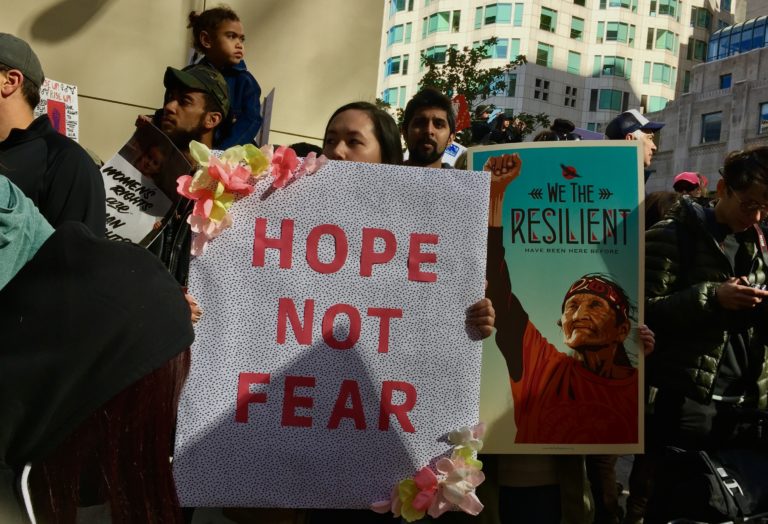
Manifestos have resurfaced as fuel for firing political imaginations and calling people to action in a threatening time. But what can they really accomplish? A rethinking of the limitations of manifestos—their panic-driven contexts, their emphasis on collectivities rather than individuals, the vagueness and combativeness of their language—suggests that there may be other more fruitful ways of instilling care of and for language in everyday life and politics. With due deference to Orwell for his focus on the political dangers of not caring for language, we posit that his prescriptions can also inhibit our abilities to communicate in productive ways, across disparate communities that might stand to gain from breaking out of strictures on political language and expression. Inspired by Arendt’s call to “think what we are doing,” we propose as a starting point a language charter that will make language everyone’s business.