
In its depiction of interracial, international marriage, the reality television show 90 Day Fiancé has become an object of morbid fascination to US and global audiences alike. Featured prevalently in the series, couples consisting of white US men and Filipina women constitute a recurring motif through which 90 Day Fiancé solidifies the institution of marriage as a locus for creating and enforcing politics of global capital, heteronormative gender, racialization, and imperialism. This article focuses on the depiction of a couple, Larry and Jenny, as one example of how the series restages the abusive colonial relation between the US and the Philippines through the marriage institution. Further, the figure of the Filipina is rendered along a spectrum of uncivilized animalism vs. nationalist caregiving—that which the US white male subject defines himself against. Following scholarship in Filipinx studies, visual culture, and postcolonial studies, I argue that 90 Day Fiancé extends occupation- and Cold War-era rhetorics of sentimentality and nationalism into the current globalized moment. Thus, I offer unsentimental decoding as a method of reading, viewing, and interpreting Western media that resists the recuperative logics of neoliberalism, (neo)colonialism, and historical erasure.
Keyword: postcolonial
Minor Miracles: Toward A Theory of Novelty in Aya of Yopougon
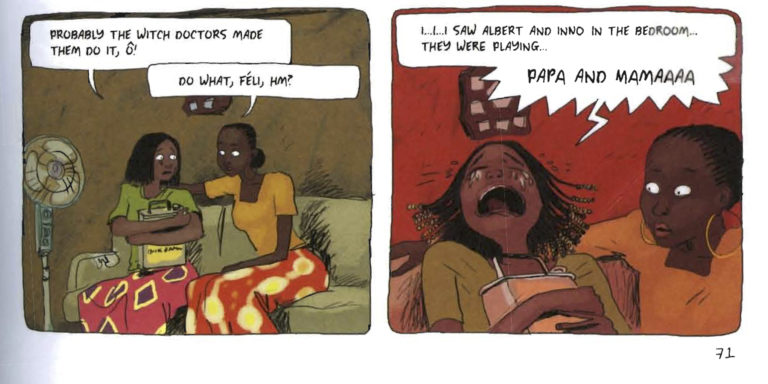
This essay undertakes a reparative reading of Aya of Yopougon, a multivolume graphic novel by Marguerite Abouet and Clément Oubrerie. Setting Aya alongside other African comics and prevailing interpretations of African and Diasporic literatures, this interpretation coins the term “novelty” to describe the unique mode of representing subjects, space, and time in the text. This “novelty” situates Aya at the intersection of tendencies in African, European, and North American comics art, and it juxtaposes subtle renditions of everyday life with overdetermined representations of African societies and Africans in Diaspora. The essay also articulates the relevance of novelty for feminist, queer, and postcolonial theories, comics scholarship, and Diaspora Studies.