I graduated from my PhD program in 2020. My dissertation defense was the only one of my cohort held face-to-face, and none of us were able to wear our regalia and walk to receive the degrees that we had dedicated so much of ourselves to. Pre-pandemic, I remember having a conversation with a friend who was an international student in my program, during which we discussed the political climate at the time and hope. I recall saying that I thought taking away someone’s hope is the worst thing you can do to a person. My friend laughed and said that was “such an American thing to say” and that “people from India don’t have such sensibilities” but he added that my making that statement revived some of the love he felt for people from the US and their culture, which had been challenged at the onset of the Trump administration. My love for the United States and its culture was similarly challenged by my positionality as a neurodivergent woman of lower socioeconomic status—all facets of identity that felt targeted through politics—and I found myself holding on to any hope I could find. Granted my situatedness in US culture differed greatly from my friend who was experiencing racism and xenophobia semi-regularly, we both experienced and felt palpably the divisiveness and fear of that historical moment in different ways. And when the pandemic hit, I doubled down on my feelings about hope in the face of a time where many people felt hopeless.
In March of 2020, my hope was high. I was on the job market and receiving interview requests, which created a sense of balance against things like major academic conferences being canceled, and my summer income opportunity getting placed on hold until there would be more information available about the pandemic. During this time, I joined a Facebook group called “Baking in Uncertain Times” created by Jody Shipka1 with many participants from English Departments in universities nationwide. Each week, Shipka created a different baking challenge, and participants would plan, bake, and post their creations for the challenge on the weekend. The tasks and structure helped to build community among participants and people interested in what the group was doing, and filled a social need that many people were seeking. Even virtually, the group offered a sense of respite from the COVID-19 crisis and allowed people to feel connected through creativity. The challenges invited conversations about why people chose to make specific recipes, limitations with obtaining ingredients, substitutions, and also share recipes for other members to try.
This paper is framed through a year of amateur baking with the virtual group, which involved being vulnerable, taking risks, experiencing failure, and finding resilience. In doing so, I suggest the act of baking can transfer into teaching and academic research to foster community-based learning that focuses on process rather than product, along with experimentation in academic research. I contend that this approach encourages us to rethink cultural concepts in new ways, such as literacy, collaboration, embodiment, memory, and community. Additionally, I highlight some of the processes by which my then-partner and I devised responses to the weekly baking challenges and provide pictures of a few completed challenges. Further, I detail how the group ended up functioning as a model for divergent composition pedagogy, by highlighting the importance of community, curiosity, creativity, and shared goals. Divergent thinking is attributed to psychologist J. P. Guilford2 and is described as “the ability to ask questions, recognize opportunities, and identify alternatives.”3 Divergent thinking is perhaps more currently known through Sir Ken Robinson’s work on changing education paradigms,4 which echoes the tensions between social constructionism and expressivism discussed later. His TedTalk titled “Do Schools Kill Creativity?”5 is among the top 25 most popular TedTalks of all time, as of this writing. Divergent approaches are considered an alternative to convergent thinking, or, “the ability to provide a definitive answer . . . without requiring creativity.”6 From these frames, divergent pedagogy encourages students to engage assignments in exploratory ways, from multiple perspectives, while considering numerous possibilities. This is a valuable concept that destabilizes the common misperception that there is one correct answer or way of completing a task. In other words, divergent pedagogy creates a space for students to explore processes of learning, rather than fear or anxiety about whether or not they have found the perceived one way of doing an assignment right.
Throughout this paper, I position baking as being synonymous with cooking (in spite of the obvious differences) to engage a deliberate application of Peter Elbow’s “process of writing-cooking” wherein he describes growing and evolving as a larger process, and cooking as a smaller process that “drives the engine that makes growing happen.”7 Further, he posits “cooking” as a transformative act of “one piece of material being seen through the lens of another, being dragged through the guts of another, being reoriented or recognized in terms of the other, being mapped onto the other.”8 I have come to understand the baking group through this frame: tasks interpreted and shared through multiple lenses, capable of being recreated, consumed, and tasted while members were dragged through the guts of the pandemic; reorienting many aspects of daily life, and reorienting recipes to accommodate lack of access to ingredients or dietary needs; having a space to recognize contributions made to a group including people both familiar and strange to us; guided by “mapped out” challenges compiling the spine of a collective memory within a historical moment, enacted through transformations of ingredients, and people.
I outline a year of the pandemic primarily through three challenges from the baking group, one at the beginning, one from the middle, and one from the end, and further situate them within Elbow’s third chapter of Writing Without Teachers,“The Process of Writing–Cooking.”9 Further, I connect the experiences to my personal and professional life, and discuss the subsequent impacts on my pedagogy. In particular, I discuss how the baking group experiences helped engender a pedagogy toward divergent classroom communities geared toward encouraging engagement, rather than focusing on grades.
Baking Group Challenge 1: Cookies (March 2020)

I frame the onset of the baking group within Elbow’s concept of cooking as interaction between ideas.10 During grad school, my partner and I were in the same program and same year. Pre-pandemic, we made sure to carve out some time each weekend for a date night or social outing to take needed breaks from what felt like non-stop work. During lockdown, we utilized the baking group as a way to reorient our work breaks. Our process usually started with brainstorming ideas for each challenge once they were announced and he would sift through ideas with me. Elbow says this part of the process works because there is a continual restructuring that gets you somewhere.11 Then, my partner would come up with a drink to pair with the selections and play music as our DJ while I baked and we sampled versions of the drinks. And we came to view the baking challenges as creative projects that replaced our date nights and much of our social lives.
The first bake I shared with the group was in March 2020 for the cookie challenge. My inspiration came through recipes attributed to “fat Elvis,” specifically the peanut butter and banana sandwiches he became known for eating when at a heavier weight. I created a dish consisting of a chocolate chip cookie crust and top that housed peanut butter fudge, with homemade banana marshmallow fluff and candied bacon crumbles. I was nervous to make my post initially because I felt vulnerable and worried that my contribution might not be well-received or criticized. I believe my fears arose due to the nature of the group being peers in my field, and I experienced similar feelings of impostor syndrome with scholarship, especially being in my last year of graduate school. But I took inventory of the work I put into my creation and reconciled my fears by reminding myself that participation is what the group was about, and posting the results was the point.
This part of my process reminded me of a grad school experience where the former director of composition tasked graduate teaching associates with doing the major assignments we were teaching in our first-year writing courses to better understand pedagogical approaches to teaching the projects. As graduate students collectively followed the first set of instructions with audience and purpose in mind, I remember the fear of assessment, particularly the fear of not doing something “right” that presumably should be in my skill set. This caused me to hyper-focus on what I thought I needed to do to feel the validation of “doing the assignment right.” Unfortunately, my fear additionally led me to overlook the opportunity to complete the assignment by doing something creative, or at the very least, interesting. And the notion that fear of critique can squash an exploratory attitude has stuck with me. Post-lockdown, I taught at a STEM-focused school, and the majority of my students were in engineering fields. The bulk of my slated courses were public speaking and professional communication, and my classes were some of the very few places where students had an opportunity to talk to other students and see themselves as part of a group, focused on participation, with their contributions being the point or part of the overall end goal. In Public Speaking, the first major task I asked of my students was a short speech to introduce themselves to the class and share a little about who they are. One of the reasons I assigned this was because it helped students and their classmates to better understand audience analysis. However, it was very common for students to focus on talking about their major, and not themselves.
So, I learned to draw from my fat Elvis cookie post to encourage students to dig deeper into sharing what they are doing, outside of their academics, and to approach the first speech as possibly the easiest “hard” thing they might do all semester. I additionally incorporate my first experience of making a public presence to the baking group as a means of positioning the classroom as its own community, and an empowering space where students focus on being constructive, not destructive, of the contributions made by members of the group. Doing so led to students sharing interesting things they have done like skydiving or preparing food for a large dinner party for the first time. Their stories sparked lively conversations and additionally helped other students to feel more comfortable sharing their speeches and work with the class, because they became invested in being part of the group, instead of checking off a box for a required class.
Baking Group Challenge 12: Extra AF (June 2020)
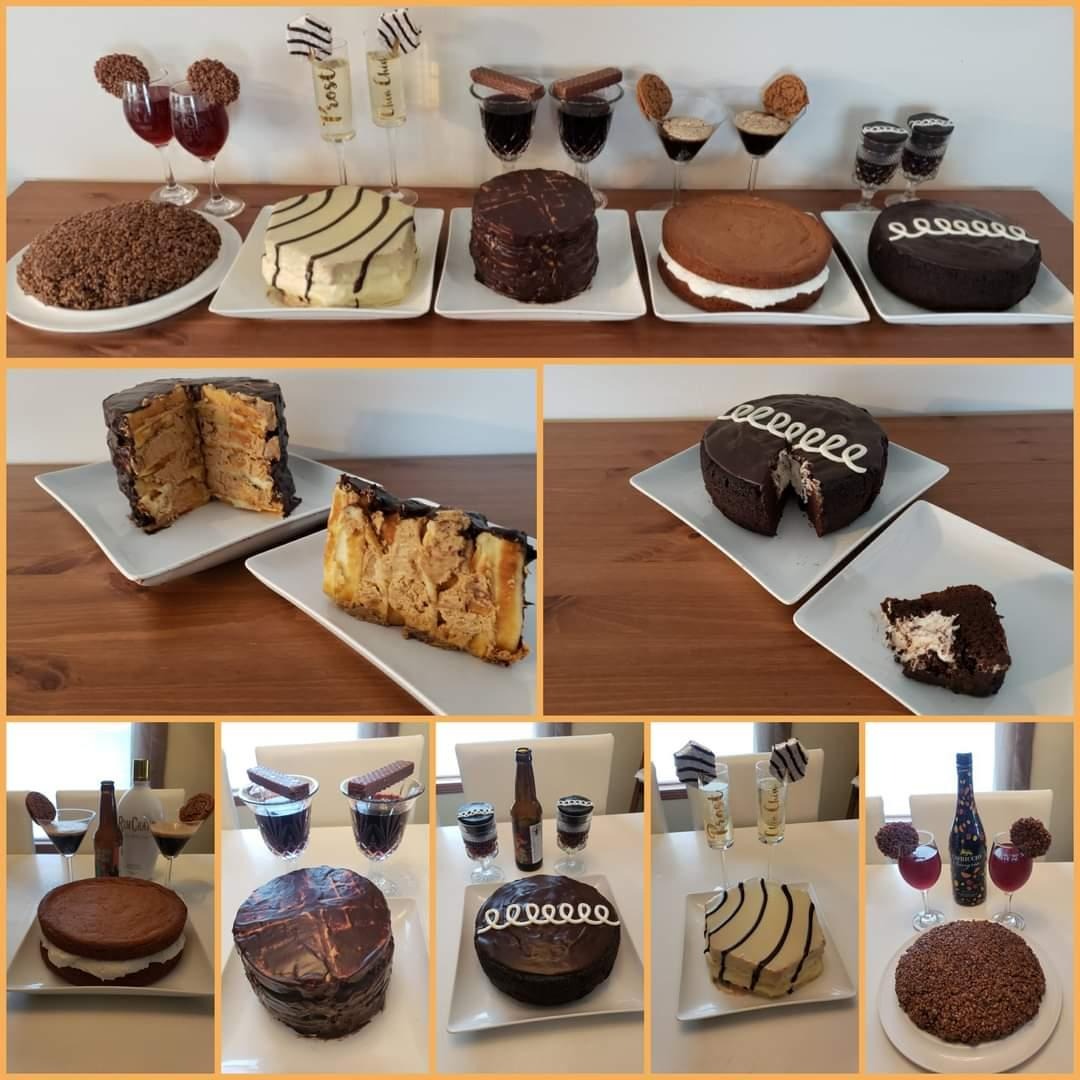
I frame the middle baking challenge within Elbow’s concept of cooking as interaction between words and ideas, between immersion and perspective.12 In June 2020, after nearly every job prospect on my list had been cancelled or placed on hold due to pandemic-related freezes, my hope was still high, and I accepted a post-doc position. This also meant that I needed to start preparing for a number of big, inevitable life changes over the next couple months, including moving across the country during lockdown, and the end of my relationship with my then-partner. For context, we entered our relationship in grad school, knowing it was temporary. We wanted different things in life, and understood that realistically, we would be getting jobs in different parts of the country and pursuing our goals made us incompatible to remain a couple. As a result, we found ourselves simultaneously celebrating successes and realizing that we were reaching our “expiration date” as a couple.
During this time, the baking group posted its twelfth of the twenty-four weekly challenges. As my partner and I really began to wrap our heads around knowing we would not have many more baking dates, we took the week’s aptly titled “Extra AF”13 challenge to our version of a fun extreme. We began talking about the idea of “going big with Little Debbie,” starting with making a giant Zebra cake, and we kept strategizing ways to make bigger versions of other Little Debbie snack cakes. Eventually, we got invested to the point that we decided to just make all of the large-scale cakes we envisioned while brainstorming for the bake. Elbow describes working in ideas as providing “perspective, structure, and clarity” and working in words to gain “fecundity, novelty, [and] richness”14 and states that “it’s the interaction between the two that yields both clarity and richness.”15 Throughout the baking challenge and coming to terms with my upcoming life changes, I paralleled Elbow’s working in words and Annemarie Mol’s doing.16 And by doing the Extra AF Big Little Debbie cakes, the combination of ideas and doing provided both a sense of clarity and richness of the state of our relationship. My feelings of vulnerability shifted to the uncertainty of uprooting myself during a global pandemic, and baking was the only thing I felt I could do with certainty. This led me to realize the growth I had achieved over the first eleven baking challenges, and how I had done a complete turnaround from a timid cookie post to a full-blown baking extravaganza. My partner and I ate every bite of the cakes. Perhaps we didn’t want to throw away the joy we found in the baking challenges, or maybe giving up on eating the cakes was symbolic of giving up on our relationship, but as we gained clarity, we savored the richness.
When the Fall 2020 semester began, despite teaching online, I carried the importance of combining working in ideas and working in words into my classroom to encourage joy and divergent thinking. And I continue this practice as a now naturalized part of my pedagogy. Unfortunately, some students may fall into adopting a generally apathetic attitude toward a number of college courses, and anxiety to pass courses they may not be fully invested in, or even interested in. This in turn, shifts their focus to passing and checking off assignment requirements rather than engaging with the material. My classroom activities are generally structured in two parts: interactive lecture to discuss and “work with ideas,” and application activities of “doing” or loosely “working with words” to yield clarity and richness of course concepts and goals. Part of this structure includes taking pressure off students to give them space to strategize and “think big AF” without the fear of assessment. I have learned that when students think in terms of “points” they panic, but when they think in terms of possibilities, they progress.
Decades of traditional grading practices have conditioned students to complete work with their teacher’s response in mind, often at the cost of creativity and taking an exploratory attitude toward education. Joyce Olweski Inman and Rebecca A. Powell note that students commonly understand their academic identities in terms of being an A or a C student, etc., and that it is hard to move away from traditional systems of grading and the ingrained associations of letter grades. They claim, “These affects, gained from years of cultural conditioning, bear further exploration because it is affect that colors experience, motivation, and dispositions.”17 Further, Jane Danielewicz and Elbow claim standard grading “induce[s] student compliance by obscuring analogous structures of unfairness.”18 These structures perpetuate the notion that obtaining the right marks is more important than engaging in the process of higher learning. Because of this, many students have thrived on what Catherine Fox calls “the race to truth” or when students “seem to equate critical thinking with figuring out what [the instructor’s] opinion is and then reproduc[ing] it in their papers and class comments.”19 Many students have come to believe this is how to get an A. The heavy focus on assessment makes me wonder: What if we could reimagine assessment as not measurable by awarding grades? And, what if students could see the classroom as a space to explore without the fear of judgment?
I draw from the baking group to reframe the stronghold ideas of completing tasks to please others, or what we perceive might please others, to instead find joy in what we can try to accomplish or learn. When the structural impedance of grading becomes deemphasized, it enables students to feel less pressure to comply and provides more room for critical reflection and self-actualization. Moreover, the shift from emphasizing outcome to focusing on engagement enables opportunities for students to have conversations about things they don’t understand, or may be misinformed about, without feeling like speaking up might result in judgment, or a potentially bad grade. To alleviate some of the panic and pressure, I secure a non-formal agreement with my students that we will not have quizzes or homework reading accountability assignments as long as students participate in discussions. I also make a second agreement that we will not have minor graded tasks as long as everyone participates the best they can in classroom activities, and illustrate that they are understanding the intended concepts or goals. When faced with the option of doing something either graded or ungraded—(with a mandatory attendance policy) my students unanimously select the ungraded option, every time. However, with these informal agreements, I make it known that I reserve the right to add accountability assignments back into the course if students do not hold up their end of the deal. This increases students’ sense of classroom community, because they hold each other accountable and also do not want to be responsible for increased graded assignments.
As part of my self-evaluation process, I often ask students what was challenging about a particular activity, along with what was easy about it. In answer to the latter, I consistently hear that not being graded made the tasks easier, which in turn made the major assignments feel less daunting. I have noticed a tendency where students feel that they need to know the course material prior to learning it, and that the fear of not knowing the content being covered before or as it is presented in class can make them feel insecure. Reflecting on my experience in graduate school of completing an essay assigned in my own class, encourages me to attempt to help students unlearn those notions and instead become curious about the assignments. And I openly discuss my participation in the baking group as being similar to the research and writing process by additionally comparing their work to baking. Doing so normalizes the idea that sometimes, even when you follow the instructions, things don’t go as planned, but that does not mean all is lost. Getting creative with a flopped dessert is an opportunity to try to transform it into something else, which might turn out even better than the original plan. But also that failure is okay, and sometimes it happens. I reinforce the idea that it is okay to fail and learn from mistakes by allowing students to revise and resubmit assignments that might not meet the outlined goals. Students reported being more inclined to tap into their creativity without the fear that taking creative risks or challenging themselves beyond trying to get an A the easiest way might result in failure. Setting the expectation that everyone should participate as part of being a member of “the group” along with activities and assignments designed to encourage students to get to know their classmates additionally increased their sense of community, divergent curiosity, and understanding of the classroom as a space of uncertainty, and a place to learn. Students state that knowing everyone was in the same boat additionally made them feel more confident about participating in class, and they were more willing to put themselves out there, and try to have fun with the activities. A mantra that I offer my students is “If you can’t get out of it, get into it” and much like not being able to “get out of” lockdown, the baking challenges became a means to “get into it” with enhancing my baking and teaching literacies.
Baking Group Challenge 24: Hello There Pumpkin Spice (September 2020)
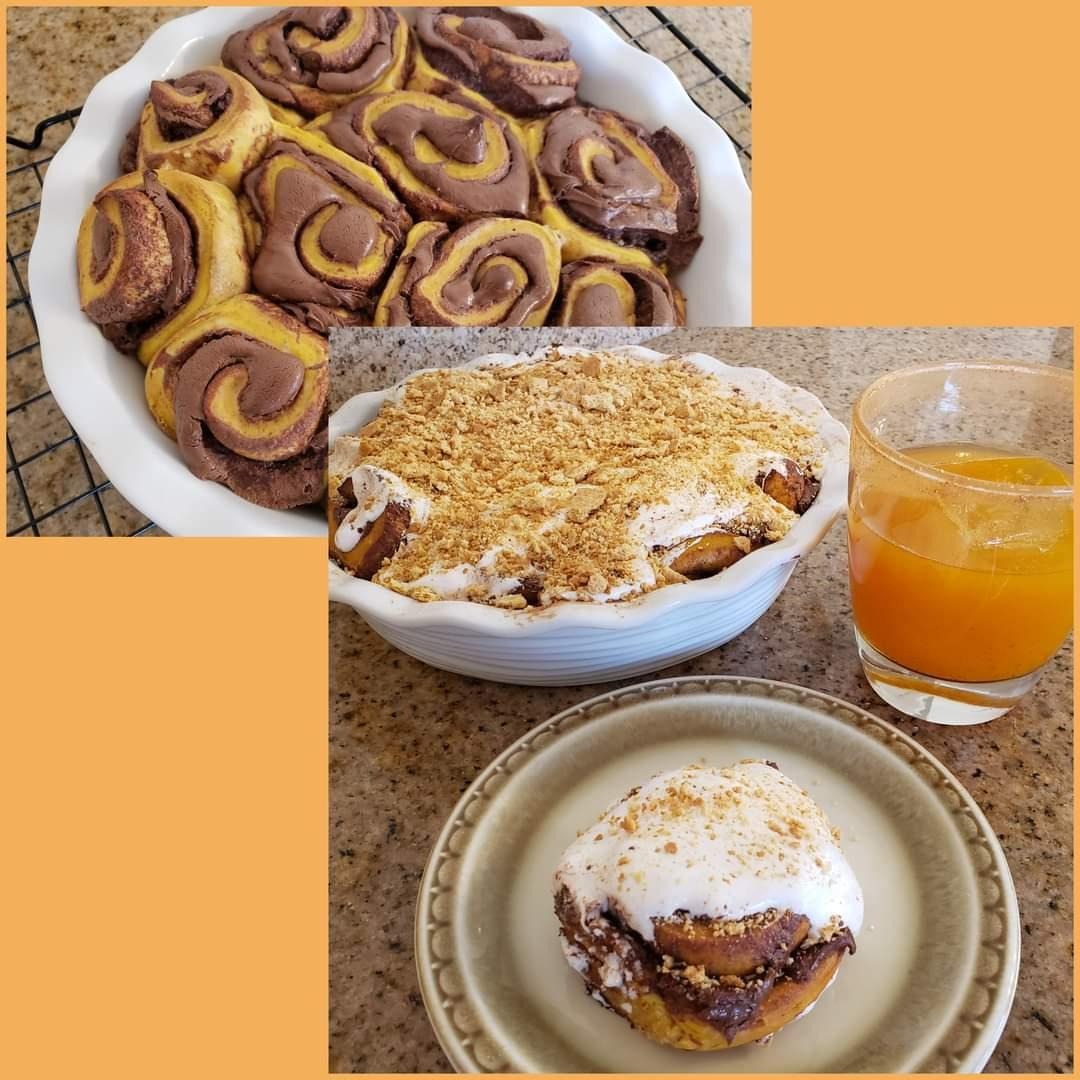
I frame the final baking challenge in Elbow’s claim that “the goal is cooking.”20 By September 2020, I was back on the job market which was still looking a little bleak because of COVID, particularly with uncertainties about pandemic enrollments declining. I was living alone, about two full days of driving away from anyone in my support system, and teaching remotely. I was still afraid of the coronavirus, anxious about finding gainful employment, and worried about moving again. The weekly bakes provided comfort and something to look forward to. So, I had reoriented my Saturdays to focus on anything that brought me joy. This usually included baking in the morning, an afternoon of watching trash TV, and an indulgent dinner. I now see my focus on reveling in things that brought me joy as a form of “doing hope,” and approach to self-care. This is an important framing device for divergent pedagogy because doing hope engages interest and inquiry while self-care often replicates more traditional, established practices.
For Challenge 24, I made pumpkin spice s’mores rolls with a Nutella swirl, topped with marshmallow fluff and graham cracker crumbs. And to keep with tradition, I paired them with a “pumpkin spicy” margarita. Elbow further breaks down the “cooking” metaphor to make a distinction between external cooking and internal cooking, stating that desperation writing is something that can seem magic, because it gets you going after feeling stuck, whereas internal cooking is like a wholly inner “magic writing” which he likens to a symphony.21 Over the remainder of lockdown, I felt I had no choice but to remain hopeful, and to believe that even though it often seemed like the sky was falling, things were falling into place. Baking served as the thing that seemed like magic writing, because it got me out of feeling stuck. The challenges then helped me to continue to “do hope” and fueled my internal “magic writing.”
Though this was the last official challenge of the baking group, the online page stayed active, instead of structured tasks, members posted anything they were baking and shared general comments and conversations. And I continued my tradition of Saturday bakes. Moreover, the confidence I gained from trusting my creative instincts additionally filtered into my research and scholarship. I began to see more potential with my research areas and started to feel less constrained by impostor syndrome. Allowing myself to adopt a divergent, creative approach to scholarly pursuits has helped alleviate pressures that I believe were holding me back, and I became more willing to take risks, accept failure, learn, and keep trying.
March 2021
As the general population transitioned from lockdown to a masked society, to a semi-vaccinated public, and eventually to seeing more unmasked than masked people, my hopefulness manifested in securing my next job. I moved back across the country and began working at the previously mentioned STEM-focused school in what was then their department of Communication, Media & Design. This was the first face-to-face engagement I had with students since lockdown, and I was eager to bring the enthusiasm I gained from the baking group into the classroom. And just as the final challenge from the baking group reinforced my hope and helped me carry confidence and creativity forward, I wanted the semester to end in a similar fashion for my students. So, I structured a final task for my Public Speaking classes that embodies Elbow’s idea that the goal is cooking. The assignment was completed by all students on the last day of class and took the shape of an impromptu speech, where students opened a random fortune cookie, read the fortune aloud, and spoke about the fortune off-the-cuff for sixty seconds, while trying not to use filler words like um’s or uh’s. Though the speech was graded, I took pressure off students and encouraged creativity by adding another informal agreement that as long as everyone showed up and did their best, everyone would earn an A on the assignment. In this instance, the promise of an A is the thing that seems magic, but it actually gets students to tap into their inner “magic writing” (or speaking) and helps build their confidence by knowing that they can get through any awkward situation after finishing that impromptu speech.
Negotiating Convergent and Divergent Pedagogical Practices
Structuring the impromptu speeches in a way that empowered students to tap into their natural creativity is just one approach that distinguishes divergent approaches from more traditional convergent pedagogical practices. Moreover, it provides a foundation that could prove helpful with the resurgence of canonical memory through the current increase in verbal presentations amidst the rise of generative AI, in a way that builds confidence and compassion. Traditionally, many academic tasks are framed in rubrics with strict guidelines to ensure students are showing proficiency with course outcome goals. Additionally, students may complete “skill and drill” styles of teaching and testing, accountability quizzes or papers that emphasize correctness over creative thinking, and largely measure student success by their ability to follow instructions and repeat information.
Calls to reshape these structures are not new. There is a long-standing ideological dichotomy in writing studies between social constructionism and expressivism.22 Social constructionism holds ideas that the correct standards of writing have been set by all of the writing that has preceded students’ own.23 Conversely, expressivism, such as Elbow’s, encourages student writing that voices their own ideas and thinking, as opposed to reproducing previous thoughts of others. I contend that these structures are not unique to writing studies, and the tension between ideologies that encourage student creativity often clash with more traditional expectations for things to be done by the book, or as they have been previously expected, is common in many academic spaces. To mitigate these tensions, Sherrie Gradin sought to merge the two through “social expressivism”24 And shortly thereafter, Anis Bawarshi called to move composition pedagogy toward a theory of divergence by opening a conversation encouraging “a more sophisticated and satisfying notion of agency,” which, nearly thirty years later, is still ongoing.25 And while I agree that students do need to illustrate an understanding of course learning outcome goals, they often reinforce social constructionist structures. As such, I acknowledge social expressivism as a successful starting point, and argue the need for more theories of divergence remains. Further, working within the constraints of traditional genres while encouraging intellectual creativity requires a literal application of pedagogy that inspires divergent thinking, experimentation, and cultivating a culture of curiosity, without the fear of penalty. Simply put, social expressivism and more expressivist practices enable students to incorporate their experiences and facets of identity into their work, which humanizes academic writing and helps them find their voice. Divergent pedagogy on the other hand, tasks students with exploring assignments in non-linear ways that encourage difference or different perspectives as a method for completing assignments that resist the notion that there is one “correct” outcome.
Connecting Divergent Pedagogy to the Baking Group – A Model of Divergent Pedagogical Practice
Because students by-and-large have come to conceptualize education through primarily social constructionist perspectives that encourage them to find the quickest way to an “A” as highlighted previously through Inman and Powell, Danielewicz and Elbow, and Fox, my participation in the baking group helped me understand that divergent pedagogy belongs in conventional writing classrooms. In the same way that students can follow the traditional conventions of writing and complete an assignment, I could have merely followed a recipe and replicated someone else’s work. The outcome in both scenarios would likely result in a decent product, but perhaps a joyless process that minimizes Mol’s concept of doing, and therefore reduces the likelihood of making the work meaningful. Experimenting with conventional recipes, through divergent practices of taking risks, finding creative substitutes, combining new ingredients, or looking at standard artifacts (e.g., mass-produced snack cakes) from multiple constructive perspectives brought joy and intrigue to the labor of completing a task. And I believe that joy and intrigue should be incorporated into pedagogical practices and academic research.
Assessment
Many scholars are working toward more progressive, alternative means of assessment, such as contract, process-based, and labor-based grading, all of which have benefits and challenges. And as educators negotiate systems that are perhaps too individualistic (or conversely too prescriptive), it is worth considering that the outcome goals are the same as cooking, which is essentially a communal act. The internal tension and inconsistency with teaching writing between social constructionism and expressivism can potentially be worked out by engaging in the skills gained from understanding how to bake. Exploring creative modes of baking as a way to better understand the need for specific literacies or conventions (recipes/traditional outcomes goals) and motivation to bring joy, interest, and creativity (taking expressive risks) to “do hope” can empower a spectacular outcome, or an understanding of failure as a tool for learning. Finding ways to mitigate student fears of failure, or worries of not getting high scores if they explore joy in academic work, is a critical part of rethinking assessment. This might take the form of incorporating more low-stakes assignments that reward participation and engagement, or policies that allow students to take creative risks, knowing they could revise and resubmit an assignment if it falls short of instructional criteria. A shift such as this will enable students to understand systems of knowledge as part of memory, while still teaching traditional and necessary concepts of writing, such as paragraphing, argument, persuasion, credible source evaluation and incorporation, audience analysis, and structure. Though divergent tasks and modes of assessment increase opportunities for students to become active members of their education, rather than passive consumers of it. And perhaps more importantly, my experiences with the baking challenges have informed my teaching to see classes as being similar to the baking group: a number of people brought together by shared goals, working on a series of tasks, in a supportive environment, resulting in some level of transformation that is transferable to other areas of their lives.
Currently, I am working to incorporate the joy of the baking group into a food-themed writing class that is framed in the wicked question: How can food help define American culture, or does food only make it more complicated?” This question derives from the concept of wicked problems, which originated with city planning.26 The resulting wicked questions do not have an easy answer or resolution. They transfer to writing studies as they prompt students to be critical and creative in seeking to understand what more they can learn about an issue, rather than rushing to find an answer, or reporting information. Further, I am in the process of organizing a way for students to engage Mol’s concept of doing through participating in a “Composition Cake Showcase”27 where they will have the opportunity to decorate cakes that represent their class projects, which will serve as a visual aid to discuss their research. In addition to helping students sharpen their presentation skills, my goals for this event are to open conversations for students who have not yet taken the university-required course, so they can learn more about the class and what to expect, while also building community across departments, programs, and employees on campus—through food. And students are relieved of the pressure to feel that they have to “perform” during the event, because it is not graded—it is just the class activity for the day. Essentially, my hope is that in “doing hope,” students will help demystify fears surrounding the research and writing process for other students coming into the class after them, while relaying that it is okay to take risks to see what they can learn, rather than what they can merely report, and show how writing can literally be a piece of cake!
Rethinking Traditional Concepts Toward Divergent Pedagogical Practices
In addition to self-evaluation, in shaping classroom activities and course assignments, I approach teaching and learning by rethinking cultural concepts in new ways, such as: literacy, collaboration, embodiment, memory, and community. For each of these concepts, I offer a suggestion to reframe them, along with a pedagogical practice and how the baking group informed it.
Literacy, challenging students to think beyond assessment and draw on their creativity to think and learn in divergent ways can take shape in classroom activities and assignments that de-emphasize points or grade values to encourage participation. This shift is beneficial in considering how the fear of not getting the correct answer or doing something “right” can disempower curiosity, creativity, and the process of learning. The baking group reinforced the importance of focusing on engagement and how working through my initial fear helped me develop a more exploratory attitude toward the challenges. Collaboration, when students work together in groups it allows them to share their strengths, navigate conflict productively, accomplish shared goals, and build camaraderie. Pedagogically, group projects can be positioned as a way to network with peers and view them as resources to find how many directions they can take their research, and what more they can learn. For me, this is inspired by having students share their work in ways that are similar to seeing what everyone did differently with the same weekly baking challenge.
Additionally, embodiment encourages students to understand themselves in academia beyond their major and what letter grade of student they have come to believe they are. Incorporating low-stakes activities throughout the semester can empower students to take risks, discover resilience, engage compassion, and help them learn more about themselves as part of the classroom experience. As the baking group taught me to see myself beyond a scholar among scholars in my field through creative challenges, I continually reshape course assignments and activities by asking, “How can I add value and joy to this?” And I believe students gain valuable skills through learning how to seek joy, rather than potentially feeling lost or less visible among a sea of faces in classes or on campus.
Memory, understanding multiplicity in systems of knowledge, values, ideas, beliefs, and discourse. Students decorating and using a cake instead of a poster or PowerPoint to discuss their research beyond the classroom provides nuanced interest to standard academic conventions. Alternatives for courses that do not involve food might include things like, various crafts, legos, artifacts/objects, photographs, or failed research attempt collages (leading to their outcome). The cake event is an easy connection to the baking group, but creative, divergent approaches to presenting information stemmed from the baking group through understanding the value of connection, especially during trying times, continuing conversations through shared interests, and inspiring creativity.
This leads to community. Empowering students to see themselves as not only being a member of a group, but also having a willingness to learn about multiple perspectives and how student contributions can be a resource that strengthens our understanding of cultures helps to build meaningful connections. This can be modeled through rethinking each class as its own community, while engaging with the greater campus community through facilitating events to showcase their work, like a cake event, colloquium, or activities encouraging activism. With the baking group, knowing I was doing something each week, with the same goal as a group of people, and sharing the end result helped me to understand the need for students to share their work, and not have it as something that remains largely between the student and instructor. While there might be some fear involved, there is also the potential for bonding over interesting ideas that may otherwise traditionally go undiscussed.
I measure my success in achieving these goals in part through feedback from my students. Near the end of the first face-to-face semester after lockdown, a student came to me and said “I know you say ‘we are all in this together’ and I just want to tell you how true that is.” She told me that she had been going through a tough time, and that she felt she needed our class. She explained that she didn’t mean just having the class as a place to go and something to do, but that she was referring to our specific class, and the people in it. She added that she had shared something she was struggling with to a classmate, and that person made a point to check in on her every day. She told me it meant a lot to her to not feel alone during a difficult time. I wondered if she would have had a similar experience in another communication-based class, or if she may have felt more isolated had she only taken larger lecture classes that semester. Regardless, I am grateful she shared her experience with me, and I think if one of the takeaways my students get from my classroom is an understanding of the importance of being a member of a community, and a supportive one at that, then I should probably keep baking on Saturdays.
Changing Views and Getting Through 2020
Overall, my year of baking changed my understanding of 2020 in two primary ways: First, it shifted my view of compassion from general care and concern to better understanding the need for connection, community, and validation. Second, it forced me to work against traditional standards, which is perhaps ironically hard for me as a neurodivergent person. But I am grateful for the joy I found in becoming a more divergent thinker and active participant in my life. These frames continue to shape my pedagogy as I approach courses, assignments, and activities by incorporating course outcome goals while asking myself how I can add value and joy to each task, and how my classroom can encourage students to do hope and build their own community. Additionally, these values have transferred into my research and scholarship as I better understand that I am sharing ideas and research among a community of scholars, whose contributions, much like baking, might start messy, follow or resist traditions, and may feel under- or overdone. But, they evolve nonetheless, and start or keep valuable conversations going. Moreover, quite possibly the most important concept that 2020 taught me is how to do hope, and keep hope, especially in uncertain times.
Notes
- Jody Skipka, Ashley Margaret Beardsley, and E. Vivian Leigh, “Together in the (re)Making: Rethinking Key Terms and Practices through a Food Lens,” College Composition & Communication Conference, 2026. ↩
- J. P. Guilford, “Creative Abilities in the Arts,” Psychological Review 64, no. 2 (1957): 110–18, https://doi.org/10.1037/h0048280. ↩
- Antonios D. Livieratos, Petros Kosmas, Hristo Andreev, Athanasios Dimas, and Anastasios Magoutas. “Fostering Divergent Thinking in Management Education: A Five-Stage Model of Student Case Writing,” Management Learning, 2026, https://doi.org/10.1177/13505076261428295. ↩
- Sir Ken Robinson, “RSA ANIMATE: Changing Education Paradigms.” YouTube, October 14, 2010, https://www.youtube.com/watch?v=zDZFcDGpL4U. ↩
- Sir Ken Robinson, “Do Schools Kill Creativity?” TED Talk, February 2006, https://www.ted.com/talks/sir_ken_robinson_do_schools_kill_creativity. ↩
- Livieratos, et. al., “Fostering Divergent Thinking in Management Education.” ↩
- Peter Elbow, Writing Without Teachers (Oxford University Press, 2023), 48. ↩
- Elbow, Writing Without Teachers, 49. ↩
- Elbow, Writing Without Teachers, 48–75. ↩
- Elbow, Writing Without Teachers, 50. ↩
- Elbow, Writing Without Teachers, 49. ↩
- Elbow, Writing Without Teachers, 51. ↩
- “AF” is a colloquial abbreviation that is an intensifier for a preceding adjective and stands for “as fuck.” ↩
- Elbow, Writing Without Teachers, 51. ↩
- Elbow, Writing Without Teachers, 52. ↩
- Annemarie Mol, Eating in Theory, Duke University Press, 2021, 88. ↩
- Joyce Olewski Inman and Rebecca A. Powell, “In the Absence of Grades: Dissonance and Desire in Course-Contract Classrooms,” College Composition & Communication 70, no. 1 (2018): 35, https://doi.org/10.58680/ccc201829783. ↩
- Jane Danielewicz and Peter Elbow, “A Unilateral Grading Contract to Improve Learning and Teaching,” College Composition & Communication 61, no. 2 (2009): 248, https://doi.org/10.58680/ccc20099471. ↩
- Catherine Fox, “The Race to Truth: Disarticulating Critical Thinking from Whiteliness,” Pedagogy 2, no. 2 (2002): 200, https://doi.org/10.1215/15314200-2-2-197. ↩
- Elbow, Writing Without Teachers, 64. ↩
- Elbow, Writing Without Teachers, 64. ↩
- Anis Bawarshi, “Toward a Theory of Divergence in Composition Studies,” JAC 17 (1997): 69, https://www.jstor.org/stable/20866111. ↩
- David Bartholomae, “Writing with Teachers: A Conversation with Peter Elbow,” Composition and Communication 46 (1995): 64, https://doi.org/10.2307/358870. ↩
- Gradin, Sherrie L., Romanticizing Rhetorics: Social Expressivist Perspectives on the Teaching of Writing, Heinemann, 1995. ↩
- Bawarshi, “Toward a Theory of Divergence in Composition Studies,” JAC 17 (1997): 81. More recent scholarship continuing conversations on the expressivism/social constructionism dichotomy, components therein, and divergent pedagogical practices includes Ira J. Allen, “Composition Is the Ethical Negotiation of Fantastical Selves,” College Composition and Communication 70, no. 2 (2018): 169–94, https://doi.org/10.58680/ccc201829923; Hilary Selznick, “Performing a Metis Pedagogy in the Rhetoric and Writing Studies Classroom,” Disability Studies Quarterly 40, no. 1 (2020), https://doi.org/10.18061/dsq.v40i1.7225; Jordan C. V. Taylor, “Adopting Affective Science in Composition Studies: A Literature Review,” Emotion Review 14. no. 1 (2022): 43–54, https://doi.org/10.1177/17540739211071027; Alexis McGee, “Toward a Black Rhetoric of Voicing,” College Composition and Communication 75, no. 2 (2023): 333–59, https://doi.org/10.58680/ccc2023752333; Qianqian Zhang-Wu, “Rethinking Translingualism in College Composition Classrooms: A Digital Ethnographic Study of Multilingual Students’ Written Communication Across Contexts,” Written Communication 40, no. 1 (2023): 145–74, https://doi.org/10.1177/07410883221127208; Shenika Hankerson, “‘The World Has to Stop Discriminating Against African American Language’ (AAL): Exploring the Language Ideologies of AAL-Speaking Students in College Writing,” Written Communication 40, no. 2 (2023). Los Angeles, CA: SAGE Publications: 587–619, http://doi.org/10.1177/07410883221146484; and Jialei Jiang, “Composing to Enact Affective Agency: Engaging Multimodal Antiracist Pedagogy in the First-Year Writing Classroom,” College Composition and Communication 75, no. 3 (2024): 534–57, https://doi.org/10.58680/ccc2024753534. ↩
- More information about wicked problems can be found in Isaac Record, “Critical Making to Solve Wicked Problems,” YouTube, July 7, 2023, https://www.youtube.com/watch?v=0KFSfOG2QNw. ↩
- Inspired by Kelli R. Gill’s craftivism at Montana State University on October 16, 2025. ↩