Using the management of Black athlete protest (e.g., Colin Kaepernick, Naomi Osaka, LeBron James, Brittney Griner) in the post-Ferguson era as a foil, Fred Moten, Roberto Sirvent, and Charles Athanasopoulos engage in a critical conversation surrounding Black sociality which has bearing on the arenas of sports, art, and the academy. The discussants ponder the appropriate terms for considering how Black athletes themselves may have their own investments in the logics which reduce them to countable units: perversity, codependency, co-option, complicity, ambivalence, do words even go there? How do such terms come each with their own assumptive and diagnostic logics? How do we relinquish our search for purity (of an arena, person, community, object of study) as concomitant with Black liberation? Moten also comments on how the logics of individuation come to bear on academics in thinking about the meaning of “fellowship” in the university. Such commentary dovetails with Moten’s critical inversion of Allen Iverson’s infamous line on “practice” as a way of thinking about Black sociality beyond the “game.” The conversation thus ends with a reflection on how scholars, students, and activists can “see through” the individuating logics of recognition or purity by refocusing on the “practice” and “fellowship” of Black study/activism.
Articles by Charles Athanasopoulos
Charles Athanasopoulos is Assistant Professor of Black Rhetoric & Popular Culture at The Ohio State University. Utilizing rhetorical and cultural methods of analysis, his research operates at the intersection of Black study, Caribbean studies, and critical Romani studies. He is the author of the multi-award-winning Black Iconoclasm: Public Symbols, Racial Progress and Post/Ferguson America (Palgrave Macmillan, 2024).
“A Program of Complete Disorder”: The Black Iconoclasm Within Fanonian Thought
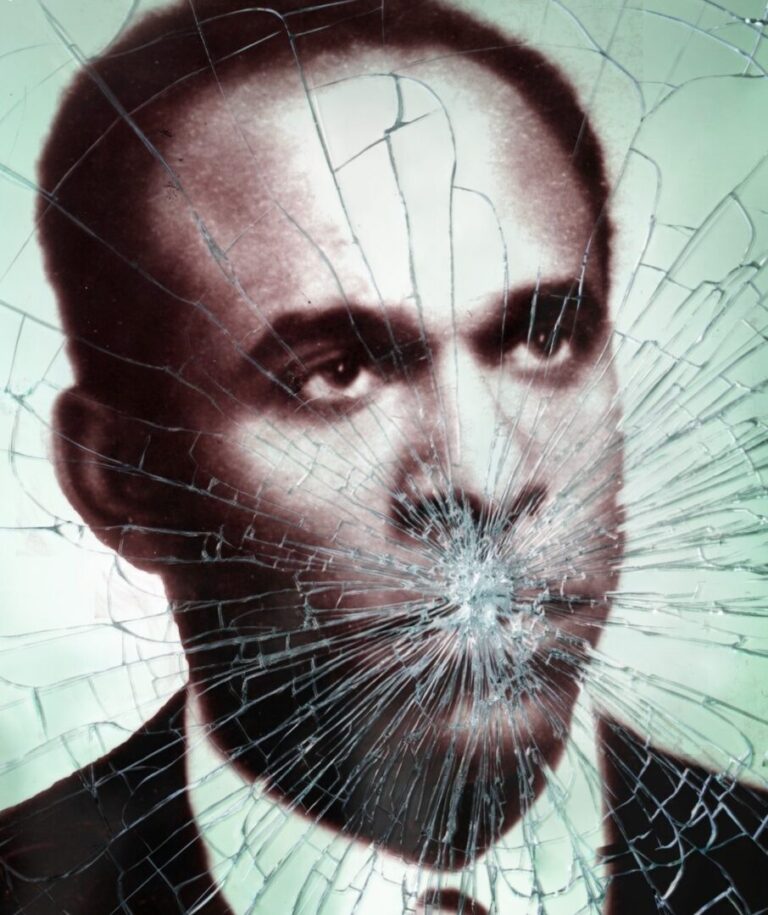
This essay examines the scholarship of revolutionary theorist Frantz Fanon and the debate surrounding his conception of decolonization and “new humanism.” Across a multitude of fields, Black and cultural studies among them, Fanon has been heralded as an iconic thinker who offers us a path toward an alternative humanity. Working against the grain of this popular form of Fanonism, I suggest that there is a Black iconoclasm—a deep desire to unsettle the very rendering of a systematic path toward decolonization—that pervades Fanonian thought. Accordingly, the essay examines and unsettles various forms of Fanonism by suggesting that their teleological narratives of redemption ultimately end up serving anti-Fanonian pursuits. Through an extended meditation on Fanon’s claim that decolonization is “a program of complete disorder,” I explore what it might mean to embrace a Black iconoclastic approach to Fanon and the pursuit of Black liberation.
Review of Iconoclasm: The Breaking and Making of Images edited by Rachel F. Stapleton and Antonio Viselli (McGill-Queen University Press)
Using an eclectic mix of artifacts (e.g. romance novels, historical sites, religious texts, literary texts), Iconoclasm highlights the cyclical nature of iconoclastic gestures and iconolatry. For the authors in this edited collection, iconoclasts re-energize iconophiles’ investments in a particular object through its shattering. In taking a Nietzschean perspective on destruction, they also gesture toward the ways in which iconoclastic acts contain the seeds of a new form of idol worship. Highlighting what they call the “Taussigian principle,” this text compels the reader to consider whether iconoclasm unwittingly reproduces the dialectical relationships it attempts to escape.