
Delores Phillips and Cultural Studies Association’s New Media & Digital Cultures Working Group Cochairs Reed Van Schenck and Elaine Venter discuss their special section entitled Digital Platforms and Agency, which appeared in Lateral 14.2 (Fall 2025), with additional content from three of the included authors: Kelsey Cummings (Christopher Newport University), Nina Medvedeva (Winona State University), and Nathalie Schäfer (Bauhaus-Universität Weimar) This podcast is accompanied by a scholarly commentary by Chris Alen Sula.
Keyword: cultural studies
Digital Platforms and Agency
Delores Phillips and Cultural Studies Association’s New Media & Digital Cultures Working Group Co-Hosts Reed Van Schenck and Elaine Venter discuss their special section entitled Digital Platforms and Agency, which appeared in Lateral 14.2 (Fall 2025), with additional content from three of the included authors: Kelsey Cummings (Christopher Newport University), Nina Medvedeva (Winona State University), and Nathalie Schäfer (Bauhaus-Universität Weimar) This podcast is accompanied by a scholarly commentary by Chris Alen Sula.
Editors’ Introduction: The Long 2025

Observing rather than drawing conclusions about the moment, in this introduction the editors discuss dynamics that contextualize a collection of cultural productions—news, music, state communication, group chats on encrypted messaging apps, Wikipedia pages, experiences in crowds, and art—that we center around the winter of 2025–2026 in the US cities Minneapolis/St. Paul, in the state of Minnesota. This work, a kind of cultural studies in practice, is informed by our positionalities and experiences, in a range that includes on-the-ground actions and national reflections. This issue features three articles, an interview, and the new work in the Years section.
Introduction: A Reflection on Years
As an introduction to the Years section of Lateral, this essay suggests that the present-day “culture war” offers an opportunity for cultural studies to reflect upon the narration of time, especially through the invocation of important years in history.
Editors’ Introduction

Reflecting on editorial labor, this introduction considers how the work of cultural studies can be furthered through community, amplification, and world-building. Advancing a curatorial, developmental model in contrast to a gatekeeping one, we consider what a horizontal approach to editing looks like in practice.
Editors’ Introduction: The View from US Cultural Studies Today
Reflecting on this moment of “crisis”—an inadequate word to capture the scope, the cost, and the history of the present violences—we consider what “building something small” might look like, thinking complexly about the immediacy of people and our needs.
Baldwin’s Balls: Sensuality, Profanity, and the Testicular Fortitude to Reckon with Race

Both sensuality and profanity dwell within love’s truthful self-expression. James Baldwin’s oeuvre reads race relations in the United States, revealing a skewed balance between sensuality and profanity rectified through authentic sensual connections across racial lines. This essay introduces Baldwin’s work as an exemplar of world reading, an ingredient of cultural literacy, to argue that sensuality prevents society from dismissing negative emotions as merely symptomatic of race or class resentment. Centering on profanity, the argument relies on how Baldwin deftly constructs sensuality as an inversive emotional balm for healing the US race problem through the feminine energeia found in his pervasive testicular discourse.
Review of Marx for Cats by Leigh Claire La Berge (Duke University Press)

Leigh Claire La Berge’s Marx for Cats reimagines the history of capitalism by analyzing archival documentation about felines. By updating bestiaries to include contemporary criticism of capitalism, La Berge positions cats as the key to an economic revolution. While the title and cover suggest a playful, possibly unserious analysis, La Berge carefully constructs a detailed history from feudalism to capitalism to point readers toward an animal-friendly future that reconsiders power structures and dares to imagine a world beyond capitalism.
Editors’ Introduction: Imaginary Futures

This issue introduction reflects on the upcoming 2025 Cultural Studies Association Annual Conference theme, “Imaginary Futures,” and cultural studies futures. This issue contains several articles that address the “presencing” of possible futures, whether through Black popular culture; digital laborers, tech workers and online sex workers; cannabis commodity aesthetics and working-class Black and Latinx life in contemporary California; or racialization of the K-pop band BTS. This issue also features several articles in the special section, “Political Economy and the Arts,” edited by Katerina Paramana, contributions to “Aporias,” edited by Joshua Falek, and the Positions podcast, and six book reviews.
Editors’ Introduction

This issue of Lateral introduces new features and significant original scholarship, including the Feeding the Civic Imagination forum, the debut of Aporias, new additions to Years in Cultural Studies and Positions, three original articles, and several book reviews.
Introduction

This special section provides snapshots of the field of cultural studies, querying theoretical lapses, overlaps, and contentions between and within competing texts. In these short pieces, emerging scholars enter contemporary or historic academic debates to complicate the canon without a desire for resolution.
Editors’ Introduction: Cultural Studies toward a Free Palestine
Responding to Palestinian organizers’ calls to use our voice, continue to engage in conversations, and to speak out, this statement articulates what we see as the abolitionist and anti-colonial way forward—the only way we can commit to a free Palestine. Imagining and building alternatives is the future, the horizon of possibility, that Lateral, as part of the intellectual and activist project of cultural studies, is imperfectly but consistently striving toward. Here, we highlight work in this issue, including the Towards Third Worlding forum, articles, book reviews, and the second installment of the Positions podcast. We continue to welcome authors to join in this work of pushing the field of cultural studies further, towards its promise of critical inquiry matched by political engagement.
Review of Against Marginalization: Convergences in Black and Latinx Literatures by Jose O. Fernandez (The Ohio State University Press)
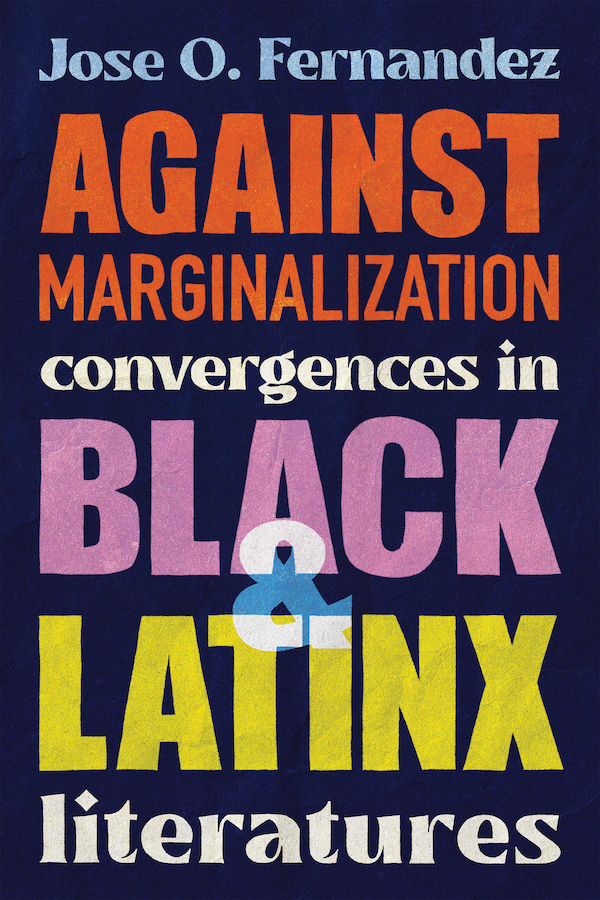
Jose O. Fernandez’s Against Marginalization: Convergences in Black and Latinx Literatures is an innovative project that takes conversations about literary and cultural history in a new direction. Recognizing the efforts of Black and Latinx scholars in crafting distinct literary traditions and histories, Fernandez uses his book to argue for cross-ethnic literary studies and identify similarities between Black and Latinx traditions. This endeavor revolutionizes conversations about literary history of the United States and challenges narratives of exclusion and silencing. This book serves to show the importance of knowing the names of authors and artists, and the communities that fought for them, because they make up the fabric of US history. To learn those names next to Faulkner, Twain, Hemingway, Steinbeck, and Fitzgerald not only makes them part of American literary tradition but also spotlights their absence and exclusion in a way that expands the boundaries of “literary tradition.” This review takes seriously Fernandez’s project, which opens exciting avenues for cross-ethnic historic study while also examining opportunities for future study.
Editors’ Introduction: Lateral Changes

This issue marks the addition of a new co-editor and several special projects, including Lateral‘s first podcast, Positions. This issue presents two important sections of work, both building on conversations in the field and across publications: “The Black Shoals Dossier,” curated by Beenash Jafri, and the second part of “Crip Pandemic Life,” edited by Alyson Patsavas and Theodora Danylevich. In addition to these impressive sections, the issue features three research articles and ten book reviews.
Review of Fates of the Performative: From the Linguistic Turn to the New Materialism by Jeffrey T. Nealon (University of Minnesota Press)
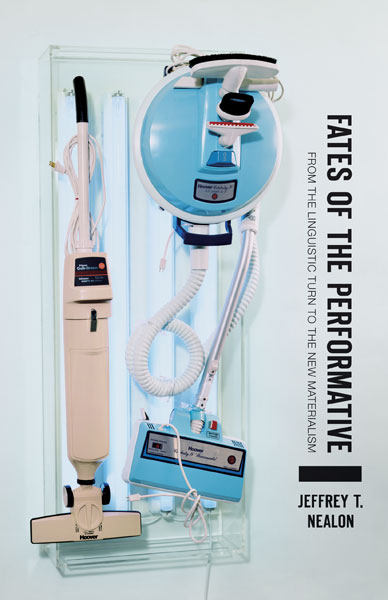
Jeffrey T. Nealon’s Fates of the Performative: From the Linguistic Turn to the New Materialism crafts a history of performativity within contemporary theoretical thought. Through the structure of a genealogy, Nealon examines the nascence of performativity and its intersection with biopolitics and neoliberalism to predict not only the future of the performative, but also to imagine new avenues of criticism within the humanities.