Here, Katerina Paramana introduces the articles in the “Political Economy and the Arts” special section of this issue. In the current climate of geopolitical upheaval (from Ukraine, to Gaza, Iran, Venezuela, and Greenland), the articles illuminate what arts do to produce resistance at a micro level by re-writing problematic narratives, visibilizing marginalized communities, imagining alternative models and futures, and working towards equitable space-making.
Keyword: political economy
The Indigenous Turn, or the Spectacle of Otherness: Cultural Political Economies of the 60th Venice Biennale, Foreigners Everywhere
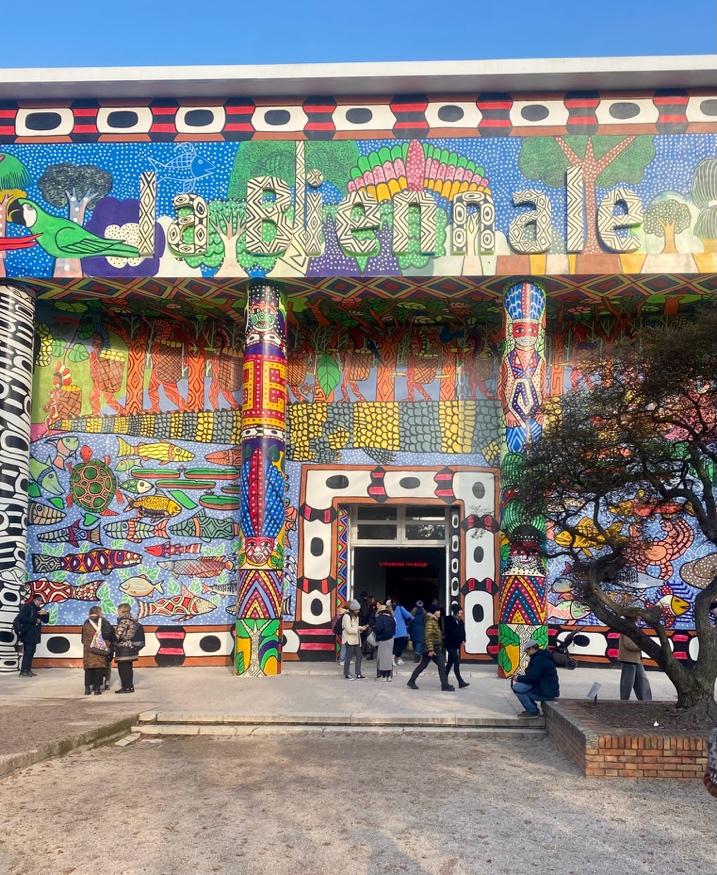
The 60th Venice Biennale, Foreigners Everywhere, placed the figure of the foreigner at its center, drawing on Adriano Pedrosa’s curatorial idea that foreignness is a pervasive condition of human existence. Within a broad spectrum of “minoritarian foreigners,” the “Indigenous” emerged as a particularly charged symbolic figure. This article situates the Biennale as a global institution whose strategies of expansion and rarefication sustain its symbolic power, examining four “framing moments” of Indigenous representation in the 60th edition: cosmologies, objects, alternative modernisms, and memory. These framings variously spiritualize, aestheticize, historicize, and politicize Indigeneity, producing visibility around Indigenous cultures in an exclusive environment where viewership is characterized by cultures of speed. The article argues that the institutional framing of Indigenous artists’ biographies and traditions simultaneously validates and commodifies identity, with “authenticity” serving as symbolic and economic capital. While such visibility can create opportunities for recognition and market access, it also may fetishize and flatten heterogeneous Indigenous histories into a universalized category of “the Indigenous.” The article explores how the Biennale’s pursuit of global relevance depends on the spectacular inclusion of difference, a process in which otherness—and, here, Indigeneity—is made visible but also subject to institutional power and gatekeeping logics. Reading the Indigenous not only through the lens of representation but also as a symbolic actor within the exhibition’s cultural-political economy, the article concludes by reflecting on whether alternative curatorial strategies—slower, more focused, and territorially specific—can create space for Indigenous representation beyond spectacle, enabling forms of knowledge production that better acknowledge the diversity and historicity of Indigenous peoples.
Unsettling Political Economies: Instituting, Blurring, and Monstrous Space-Making
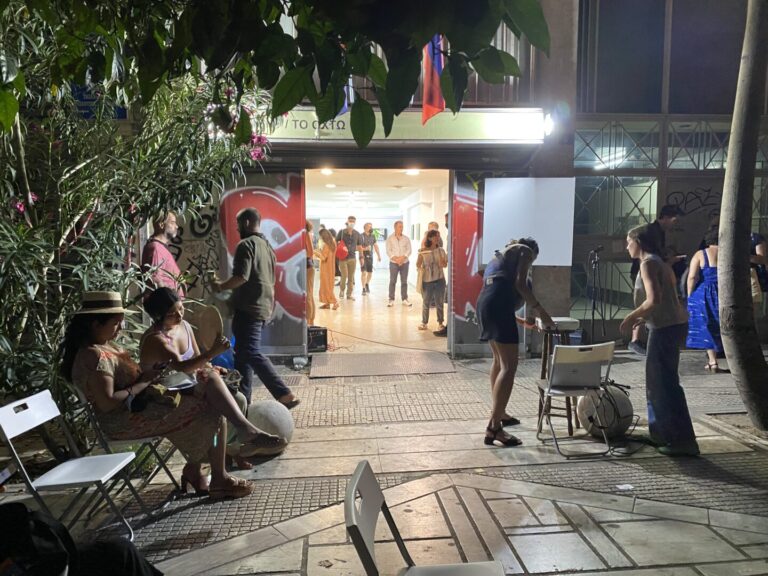
This article explores the ways in which emergent cultural space-making practices—particularly practices of “instituting,” “blurring,” and “monstrous space-making”—challenge and ephemerally unsettle political and economic systems. It focuses on the history of the cultural space, EIGHT Critical Institute for Arts and Politics, in Athens, Greece. The concept of “instituting” is discussed as a form of space-making that refuses structuralization, while “blurring” signifies a process of dissolving boundaries and categories to create fluid, unpredictable spaces that resist fixed identities. The notion of “monstrous space-making” is introduced as a method of excess and refusal, capable of disrupting dominant political economies. The article argues that these practices, rooted in modes of “militant curating” and critical spatial interventions, operate as performative acts of reconfiguration—offering ways to produce new relations, economies, and imaginaries within contested landscapes. It suggests modes of continuous, open-ended spatial interventions that do not seek to fix existing systems but to deform and reimagine them from within.
Introduction – Performance and Political Economy: Bodies, Politics, and Well-Being
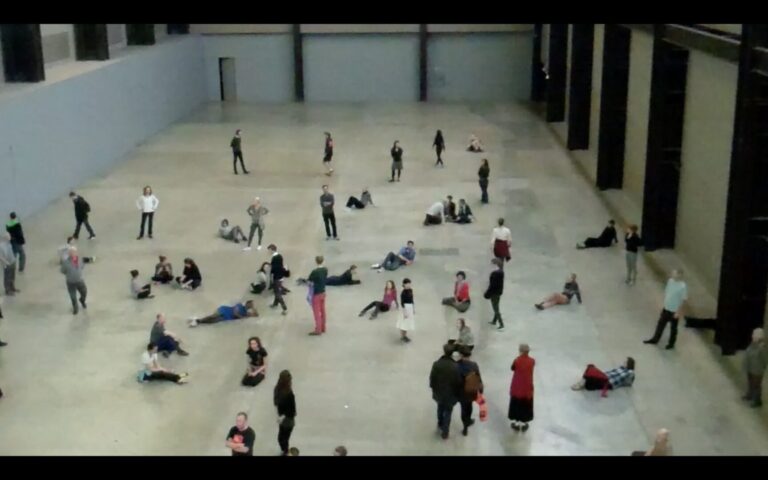
In this article, Katerina Paramana introduces Lateral’s special section, “Political Economy and the Arts,” and its first set of articles, “Performance and Political Economy: Bodies, Politics, and Well-Being,” and provides the rationale and context for this section’s topic. In the face of a multiplicity of world-wide problems and suffering, this special section aims at a reinvestment in desire for change in order to resuscitate and reinvest in hope. The articles therein provide insights into the current relationship between politics, human and non-human bodies, and their well-being (and why it is necessary we take action to change it) which might help us steer the wheel before we drive off the cliff.
The Problems with the Critique of Political Economy in the Arts
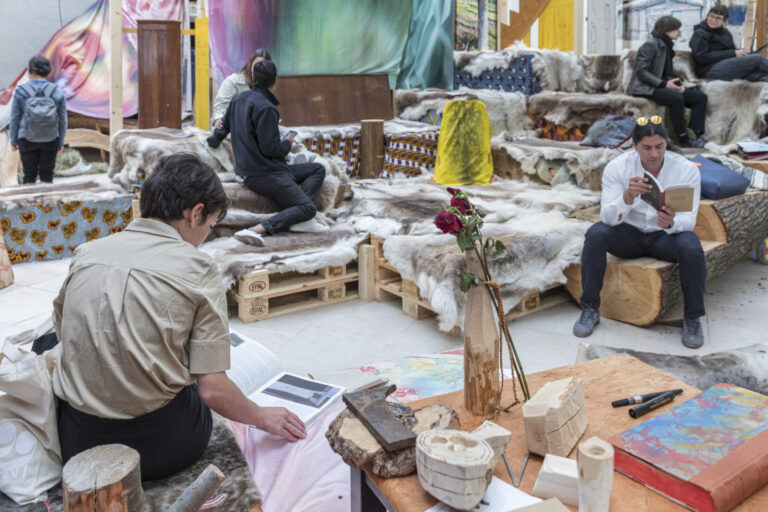
This article attempts to offer a systemic discussion about the paradigm shift away from the neoliberal Washington consensus and its ramifications for the worlds of performing and visual arts. The article first provides an overview of discussions of political economy in the arts, in which the typically speculative arguments are contrasted with sociological and historical knowledge which reveals a limit to them. The article then describes contemporary political economy in the era of post-globalization and makes a few proposals on how the arts can think through it.
Review of Spectacle and Diversity: Transnational Media and Global Culture by Lee Artz (Routledge)
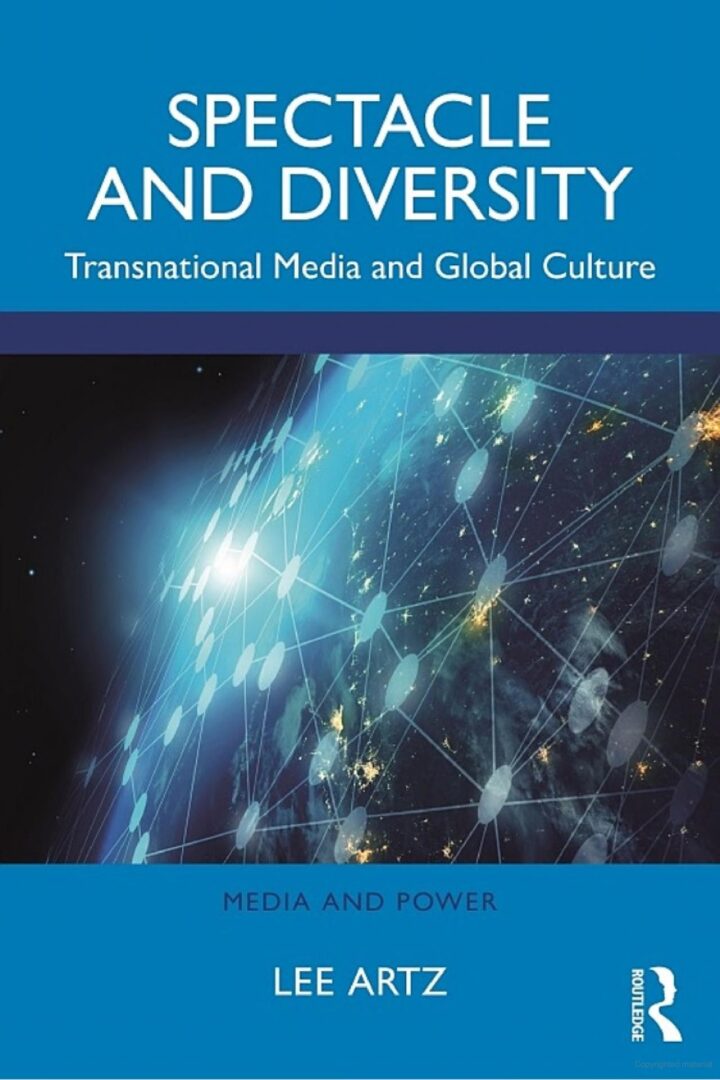
Lee Artz’s Spectacle and Diversity: Transnational Media and Global Culture brings to our attention the ways transnational media has created representations of global culture. By analyzing examples of nations with transnational media networks he acknowledges how each nation’s media culture has become a reflection of transnational ideals. Artz critiques the transnational ideals that benefit elites and the careful fusing of the themes such as self-interest, social mobility, and individual successes into media to maintain the status quo. The book concludes with a plea for a non-capitalist international movement to bring forth a new media wave, which might benefit the interests of humanity.
Review of The Anti-Capitalist Chronicles by David Harvey (Pluto Press)

The Anti-Capitalist Chronicles is a collection of accessible, loosely connected essays by influential Marxist geographer David Harvey. Based on episodes of Harvey’s podcast of the same name, the book tackles topics related to the contemporary and historical crises of global capitalism. In nineteen brief, topical chapters, Harvey appropriates and reimagines Marxian categories and anti-capitalist frameworks of various kinds in order to report on the changing shape of global capitalism considered as a historically distinct social formation, the internal logics and contradictions which govern capital’s movements in the world, and the obstacles to be overcome by socialist politics.
Political Power and the Industrial Development of Cultural Artifacts in China

With national policy support on industries that produce cultural goods and artifacts, Chinese industries have developed quickly in recent decades. Some cities and their industries are led by the central government, while others are led by the local government. In this paper, the author uses ceramic industry clusters in Jingdezhen city (central-led) and Longquan city (local-led) as a comparative study to illustrate the political power relations of government-led cultural artifact industry development in China. In sum, the excessive emphasis on political hierarchy and centralized control of production management will weaken the cultural essence of the local cultural artifacts. The localized government-led development strategy is positive to preserve the cultural essence and design a befitting local industry development strategy in Chinese cities.
Introduction: Political Economies of Basic Income
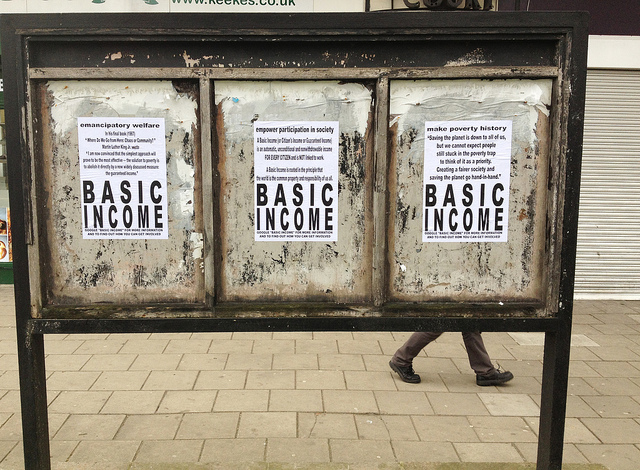
Basic income is an idea almost as old as capitalism itself, appearing very early in the course of its historical development. The emergence of the idea of a basic income in the first few centuries of capitalism’s development in England became inextricably linked to economic crisis. Unsurprisingly, interest in basic income plans have resurfaced yet again in the post-2008 conjuncture. Current debates about basic income often invoke the framework of a morality play about personal responsibility, work ethic, and frugality that obfuscate organic features of the capitalist social formation, such as economic crisis. Therefore, this forum returns to the Marxist approach to answer the persistent questions that basic income provokes, and to help enlarge the Left debate on basic income that exists on the margins of public discourse.
“Nothing gold can stay:” Labor, Political Economy, and the Birmingham Legacy of the Culture Industries Debate
Over the course of the last 150 years or so, we can see three distinct phases of the culture industry. More specifically, there have been (at least) three eras marked by different configurations of the relationship between culture, politics, the dominant mode of production and the commodification of culture. Cultural Studies emerged from the second era, whose contours I’ll explore here; and we are now in a liminal phase brought on by the uncertain conflagration between the neoliberalism, convergence culture, and nascent popular uprisings under the banner (and hashtag) #occupyeverywhere. This third phase, or conjuncture, once again reconfigures these relations, making it important to revise the theoretical assumptions and political strategies that were adhered to in an earlier era of “the culture industry.” I will outline the direction I think this points to both in our understanding of the culture industries and in terms of political and theoretical strategy going forward.