The Politics of Commemoration
It is April 25, 2024. Portugal commemorates the fiftieth anniversary of the Carnation Revolution. The country wakes up to a beautiful sunny day; no clouds and warmer than usual for the time of year. Spring is lavishly green and flowery. Around three o’clock, I am standing at the top of the Avenida da Liberdade (Avenue of Freedom) in the center of Lisbon, joining the annual parade that celebrates the freedom and democracy conquered by the revolution that overthrew a forty-year authoritarian right-wing dictatorship (Estado Novo). I am not alone. In fact, I am like an atom vibrating in a highly compact mass of people that literally covers the whole avenue and surrounding arteries. The crowd waves national flags and is dressed in red garments; the carnation is the symbol of our (barely) bloodless revolution. I feel both thrilled and overwhelmed by the crowd. The energetic circuit that binds everyone is palpable and electrifying: people’s faces (all ages, races, and socioeconomic backgrounds) are radiant. Their bodies are pulsing with delight at being there, at being part of the huge crowd mobilized by the same purpose: to march down the avenue in a ritual celebration of freedom.
Yet, in a strange way, being there also feels tense. Instead of the average hour-long wait for people to gather before starting the parade, this year the standing lasts for more than two hours. The parade is immobile, but nobody knows why. Standing very close to other bodies in the sun quickly leads to fatigue and impatience. Some of the people get through the crowd via adjacent streets, invading all coffee shops and stores that are open. Others endure the wait. Despite the obvious discomfort, the atmosphere is sparkling, festive, and generous. I nevertheless soon begin to feel anxious and disheartened as my whole body craves to move and the intensity of the crowd begins to feel oppressive.
Finally, after three hours, the parade begins to move. We walk down the avenue, often stopping. People are enthusiastic, singing along to famous revolutionary tunes, inebriated by the palpable joy that makes their faces glow. Yet the parade ends abruptly. Unlike previous years, the crowd reaches Praça dos Restauradores and then a narrow “gate” marked by two road safety bays.1 Instead of flowing into the square (Praça do Rossio) for the usual gatherings and rallies, like a sort of “climax” of the ritual, it feels like “the end of the party,” as if we have failed to perform the collective celebration. Only at the end of the day do we understand the scale of what had happened: a gigantic and dense crowd (only seen in this proportion in 1974) had completely occupied the streets and stopped the flow of the march, much to the surprise of the authorities who did not anticipate such mobilization.
This fiftieth anniversary of the Carnation Revolution had created a lot of anticipation surrounding the parade. A commemorative commission, created in 2021 by the socialist government, planned and funded public engagement activities. As a result, the revolution animated debates in the news, podcasts, social media, and generally in private conversations.2
The parade became established as a national popular event in 1982, “organized by a committee created under the Council of the Revolution, which was made up of various individuals, members of different political parties, but who did not represent them,” according to the Associação 25 de Abril.3 The year 1982 was a turning point of the revolutionary process: the constitution was revised for the first time after the dictatorship, extinguishing the Council of the Revolution (a military organ with political power), and democratic institutions started to take shape. However, the country endured increasing political instability and divisiveness caused by an economic and social crisis that led to 1983’s Economic Adjustment Program (Fundo Monetario Internacional [FMI]) intervention. Significantly, the parade helped build collective unity beyond political parties by invoking revolutionary ideals and arousing affects of freedom. The headline of the Diário de Lisboa newspaper the day after the parade in 1982 was: “April 25 Marked by Unity.”4 Described by the newspaper director and university professor Piteira Santos as the “largest anti-fascist convergence since the party of May 1st, in 1974,” the multitude in the streets confirmed the “political will” expressed in a manifesto signed by relevant national personalities covering a diverse political spectrum, which summoned the people to celebrate the revolution.5 This “political fact” forever changed what had until that point in time been a symbolic military parade into a popular celebration.
The fiftieth year of the April 25 commemorative commission program “Art for Democracy” had given substantial government funding for a special series of events curated by cultural venues (one million euros for forty-five performing and visual arts projects6). Teatro Nacional D. Maria II (National Theatre in Lisbon), under the artistic direction of Pedro Penim, presented a five-month curatorial program of eighteen commissioned projects. One of these productions by the company Mala Voadora was 25 de Abril de 1974 [April 25, 1974], a fifty-minute performance designed to tour the country and ignite the debate among teenagers—the target audience—about the role of media in contemporary democracy through the memory of the revolution. Unlike a typical Mala Voadora show, 25 de Abril de 1974 is a portable and low-budget production. Well-known for its large casts and lavish scenography by José Capela, Mala Voadora requires very few technical and scenic resources for this production, being incomparably cheaper than most of their shows. From a cultural distribution perspective, one could imagine it would quickly become the best-selling show of the year, especially in the context of a “small and peripheral” labor market7 and an incipient theatre venue network.8 However, despite the commemorative context and these optimal touring conditions, from April 2024 to April 2026, the production was presented in only fourteen cities across Portugal. Strangely, both curators of prestigious venues and local municipalities did not choose this production to commemorate the revolution. Like the bodies in the parade, the production did not manage to flow, to circulate. Is there a connection between the politics of commemoration of April 25 and the affective economies of freedom of the current “populist moment”?9
In this text, I consider forms of celebrating, performing, and capturing freedom in paradoxical times. Drawing on Sara Ahmed’s work on affect, Sruti Bala’s on participation, and Franco Berardi’s on freedom, and through an analysis of the staging of the fiftieth anniversary of the Carnation Revolution; and 25th of Abril 1974 by Portuguese company Mala Voadora I argue that freedom emerges not solely as a historical achievement of an inalienable right, but as an embodied experience enhanced by theatrical dispositifs. Unrelated to the Carnation Revolution but relevant to the ways freedom can be staged for audiences, I will also consider the production The Seagull by Argentinian director Guillermo Cacace. Premièred in 2023, in Buenos Aires, the performance was developed for three years due to the pandemic restrictions. This context of confinement informed not only the creative process but also its aesthetic strategies, giving rise to a performance proposing a paradoxical sense of shared freedom around a table. I begin this article with a discussion of the relationship between populism and notions of freedom, describing the nuanced usage and political capture of the latter to examine its paradoxes in the present. I then examine how the aforementioned artistic productions critically engage with the paradoxes of freedom and reset the conditions of experience of its affective-sensorium. The spatial configuration and audience engagement of both productions open the space for unexpected forms of spectatorship.
Freedom & Populism
According to the 2025 Rule of Law Report by Liberties – Civil Liberties Union for Europe (an non-governmental organization that promotes civil liberties in the EU), Europe’s democratic recession is increasing, with “alarming signs of the EU degrading the rule of law from within.”10 The rise of far-right populism, the political contexts in the US (one could also add Gaza and Iran), and the war in Ukraine are identified in the report as major geopolitical contributors to this. Far-right populism in particular capitalizes on a generalized discrediting of institutions, weakened welfare states, exacerbation of economic and social inequalities, and a fabricated sense of ever-present crisis that builds on the emotional impact of an unspecified threat that easily becomes attached to the bodies of the other: of migrant, racialized, and gendered bodies.
Due to right-wing populist anti-establishment claims and appeals to the need for change, the appalling rise of these political parties across Europe has been perceived as a reaction against neoliberalism. However, several authors have argued that right-wing populism is, instead, in line with or even a result of neoliberal legacies, policies, and strategies.11 Clara Mattei posits that austerity has been a strategy to fix and re-establish the “order of capital” since the First World War, re-employed when civil rights, life quality, and freedom are socially mature and expanded.12 James Putzel argues that neoliberal commodification of politics and social services, rising inequality, and inadequate social policies have generated resentment, cynicism, and insecurity,13 all of which have made people receptive to exclusionary and divisive populist rhetoric. Not only have emotions like fear, humiliation, and resentment become the glue between neoliberalism and far-right populism, but they have also satisfied the emotional needs of a neglected electorate.
First appearing at the end of the nineteenth century, the notion of “populism” is not exclusive to the right or the left. Goran Petrović Lotina and Théo Aiolfi have researched left-wing populism, analyzing not only its progressive forms but also its embodied and performative features.14 Contemporary right-wing populism has been addressed from a theatrical perspective, in which emotions play a major role. Drawing upon Ernesto Laclau’s logico-discursive approach that emphasizes the gulf between the elite and the people,15 Benjamin Moffitt, Pierre Ostiguy, and Francisco Panizza bring forth the “discursive-performative” approach to populism.16 Moffitt claims that populisms are inherently theatrical and can be better understood as a political style, highlighting three key features: the conflict between people vs elite, bad manners, and the imminence of crisis/threat.17 Seen as a political style, populism involves “repertoires of embodied, symbolically mediated performance.”18 Here, I will be using the term populism to refer to far-right forces anchored in performative strategies of affect mobilization and theatrical modes of engagement.
Freedom carries the revolutionary affects of change, the impetus of a “new beginning,” in Hannah Arendt’s terms.19 Liberation, she argues, is a condition for freedom, not the full meaning of the term, which involves “participation in public affairs.”20 In a neoliberal framework, however, freedom is reduced to the absence of restraints from owning property, from the circulation of goods and commodities, from taxes and regulations, from moral and ethical duties to the other, the common good, and the planet. At a time of proliferating social and economic inequalities, such a distorted sense of freedom is used by far-right populists to divide people (us/them) and enforce exclusionary policies. Yet, as Arendt reminds us, true freedom is only possible among equals.21
Freedom can be understood as a competitive affective economy that fuels, mobilizes, and compels bodies to enact, perform, and expand their vital energy. Political forces understand it as a powerful resource. Recalling Bojana Cvejić and Ana Vujanović’s proposition of the public sphere that can only be constituted by performance,22 I suggest that freedom can only truly empower people when it is performed by them, either in the exercise of democratic rights (such as voting) or through the intensification of its qualities as a public affect in celebratory rituals or artistic productions. Any of these performances can only take place in spaces of appearance where one can be present in public to others. In order to activate an affective economy, freedom demands a space of appearance to be performed.
Embracing promises of freedom, empowerment, and emancipation, participatory projects—a gesture both aesthetic and political–actively engage spectators, aiming at sharing with the audience freedom of choice, power of decision, and the possibility of actively participating in the work. The “social turn” in art and performance has produced artistic work in tandem with academic criticism.23 Theorists like Claire Bishop have criticized the idealization of participatory art, namely of its assumed inherent potential for political empowerment and emancipation, because participatory work is often deprived of the antagonistic tension required in the exercise of democracy.24 In participatory art, spectators have the option to participate but it often feels as though there is no option but to participate. Starting from another intriguing paradox of participation, Sruti Bala has proposed to think of participation instead as gestural:
If we are only able to participate in ways that are already deemed acceptable, or proper, then, sooner or later, our participation becomes an instrument of our own subjugation and pacification rather than a means of freedom. Participation, even in the guise of non-participation, becomes necessary to resist the imperative of participation.25
The question of freedom emerges here in terms of the option to participate or not. Perhaps indirect participation could be the best way to describe a mode of participation for productions that stage, more than demand, an active participation from the audience through fictional settings, as well as through an intensified circulation of affect. As I will elaborate in my analysis of the 25th of Abril 1974 and The Seagull, fiction and scenic design can create a space of freedom for the audience even if the audience does not explicitly participate in the action. Performance and theatre practices offer audiences a wide range of options in degree of participation: from the modern tradition of the “passively” seated spectator in the auditorium to the more demanding work of participatory art.26 However, even a physically passive audience has a specific function in the unfolding of the theatrical encounter. As a collective entity, it creates an affective resonance, intensifying the circulation of affect in the auditorium, which is both social (a group of people gathered in a room) and aesthetic (a group of people re-affecting the stage and impacting the aesthetic materiality of the performance), regardless of the singular experience of each spectator.
Sticky Freedom
The parade on April 25 performs a social ritual increasingly attracting younger crowds in recent years, especially since the pandemic. Walking down Lisbon’s Avenida da Liberdade in a parade headed by a military tank—a remnant of the original military parade, invoking the military siege of Carmo military headquarters that epitomized the coup—hundreds of people celebrate the victory of freedom over oppression, which also put an end to the colonial wars in Africa. Today, an intergenerational event, the parade reactivates the circulation of affects of joy, enthusiasm, and hope that mobilized and empowered bodies in the streets. The performativity of the parade—the movement involved in marching down the avenue that performs the parade, its embodied action —is crucial to the engagement of bodies in a rhythm that connects them and allows affect to circulate and “jump” across times.27 In this sense, the lack of movement of bodies engaging in a collective rhythm in the fiftieth anniversary parade, as discussed earlier, compromised the performativity of the festive ritual, hence diminishing its potentiality.
Yet, freedom’s symbolic and performative potential is not exclusive to the Left, as in the April 25 parade. Freedom has been captured, distorted, and re-signified by the populist far-right to designate unbounded self-serving actions as well as unimpeded circulation of entitlement and violence towards others, in particular marginalized others. These utterances are widely spread: in far-right parties’ names (Freedom Parties in Austria and the Netherlands), in campaign slogans such as Javier Milei’s “Viva la Libertad, carajo” [Long live liberty, damnit!], an ongoing catchphrase in his social media, in Trump’s announcement of Liberation Day regarding import taxes in the US a couple of months after taking office, and used in association with fun and carelessness in culture events of far-right communities and social media.28 Alberto Toscano names it “fascist freedom,” that is, the “freedom to dominate, to rule” which merges with the neoliberal individualist freedom (“market freedom, freedom to own”), sharing imaginaries and values.29 By reclaiming freedom in protest actions and political speeches or rallies, far-right parties and authoritarian regimes have re-oriented the circulation of affects associated with freedom for the purposes of polarization and division between “us and them.” As Putzel reminds us, the new far-right is a threat to “the arenas in which people have fought for and won more progressive social policies in the past.”30 Such kinds of freedom are not made for all, and it surely does not feel free for everyone alike.
Perhaps the paradox of fascist freedom became visible for the first time at a global scale during the pandemic, when extreme right-wing groups organized anti-mask protests, claiming individual freedom (or rather entitled white privilege) in reaction to law-enforced lockdown measures.31 Care in protecting the common good, public health, and the most vulnerable in society became factors of repudiation. Franco Berardi sees this clearly. He encourages us to “rethink the rhetoric of freedom,” arguing that it is based on a misunderstanding: if ontologically one is free because one can decide for oneself using the capacity of free will, politically one is bound by the capitalist political economy: by “entangled contexts, namely neoliberal techno-capitalism, that constrains the possibility of free will.”32 In a more recent article, Berardi suggests that the currency of freedom for the far-right consists in the entitlement of “being brutal” to maintain white privilege and a colonial neoliberal system: a “brutalismo supremacista libertario” [libertarian supremacist brutalism].33 Berardi further suggests that a radical change in modes of human perception and communication—deriving from the brutality imposed by neoliberalism on social life and from the immersive information/gaming environment of contemporary societies—created a fertile ground for the dynamic increase of “an energy” that fuels fascist freedom. He argues that it is not possible to oppose and stop this energy “through voluntary action,” even though this intention is increasingly absent among political actors. In his view, this kind of energy can only come to an end when it is consumed, exhausted, or when its effects are catastrophic enough to make it stop.
Such energy is vital to affective economies of freedom and to the capital they generate. In her work The Cultural Politics of Emotion, Sara Ahmed proposes the concept of “affective economies” to describe the circulation of “objects of emotion” that produce affective value through accumulation.34 The more these objects circulate, through the repetition of social and cultural narratives, the greater their accumulated value or capital. Ahmed suggests that what circulates in public spaces is not so much emotions but rather the effects of emotional mediation responsible for shaping the body of the other and configuring its affective value as positive or negative. Thus, the greater the movement—through performative repetition—between the object and the effect, the greater the affective value generated.
Yet it is not only a matter of the circulation of the effects of emotional mediation but of their stickiness: accumulation of value derives from the adherence of affects to the bodies of others through repeated cultural narratives, which makes some words sticky to certain bodies and slippery to others. The effects of such circulation make bodies viscous and affects saturated.35 Saturation seems like an appropriate term to characterize the co-opted status of freedom. Far-right discursive and communication apparatus—in the sense that Foucault proposed thinking of the systemic relationship between different disciplines, institutions and discourses that articulate the said as much as the unsaid36—have been sticking freedom to a destructive drive of unbounded and individualist action. Every occurrence repeats and intensifies this stickiness, generating affective economies of freedom at odds with democratic ideals. As such, one can say freedom is currently saturated with brutal affects, a self-centered pursuit of pleasurable unaccountable actions destined to legitimize entitlement to violence.
Brutal affects circulate in the public sphere and run parallel to conflicting affective economies of freedom that stem from enthusiastic desire for justice, solidarity, and dignity for all; the exhilarating new beginning that is yet to come. Thus, one could say there is a vast array of affective economies struggling to direct and re-configure the energy of the present with different goals: at one end of the spectrum, brutal affects saturate one kind of economies of freedom, expanding unbounded spaces of neoliberal interest; at the other end, gentle affects are re-attached or re-sticked to freedom, resisting the dominant re-signification and strengthening democratic values.37 By gentle I do not necessarily mean positive affect that is harmonious or free of paradoxes but the affective quality that underscores aspirations of equality, social justice, and dignity that democracy fosters. In other words, gentle affects refer to the forceful disavowal of any kind of us/them enemy narratives that weaponize freedom to divide and conquer.
The problem at hand is that it is not in the nature of such affects to “stick” but to “slide.” There is no simplistic adherence of left-wing and right-wing to economies of gentle or brutal affects. In fact, brutal and gentle economies of freedom share something in common, regardless of the type of affective capital they accumulate: joy, enthusiasm, and a sense of community. Brutal affects also drive the energetic motor that nurtures a vast array of people to paradoxically violent and exclusionary discourses allegedly “authorized” by the right of freedom. No matter how much destruction they entail, brutal economies of freedom also build community, which is reinforced by a sense of belonging and hope of change to which culture and the arts are crucial. Conversely, gentle economies advocating democratic values, namely those generated by left-wing politics, often voice violent and exclusionary statements towards the other (oppressor).
I propose that imagination, as an immense human faculty that shapes social and cultural subjectivities, can significantly contribute to coping with the death drive of brutal affects. The performing arts can play a significant role in potentializing imagination as they interrupt and suspend everyday time-space, offering conditions of lived experience and perception of a world distinct from the techno-communication apparatus. Moreover, the encounter with live performance increases the potential of building a sense of community and belonging, as it is an event shared and lived through by the audience, and they can create both spaces of visibility of the immersive information-saturated environment we live in and the conditions for feeling free in the safety of fictional and artistic contexts. Even though limited in a sense to the time and space of the aesthetic event, the experience activated by affects of freedom is stored in the body, inoculating the audience with a felt sense of other possible ways of understanding what being free means and feels like.
Reperforming the Revolution: 25th of Abril 1974 by Mala Voadora
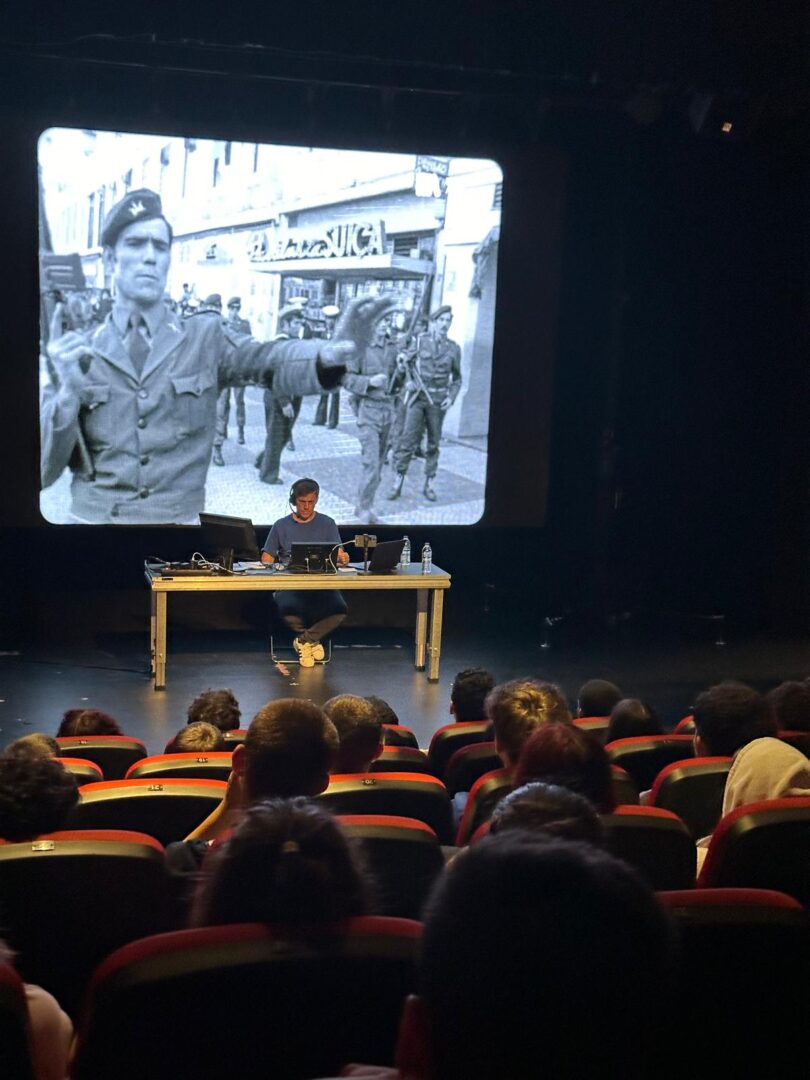
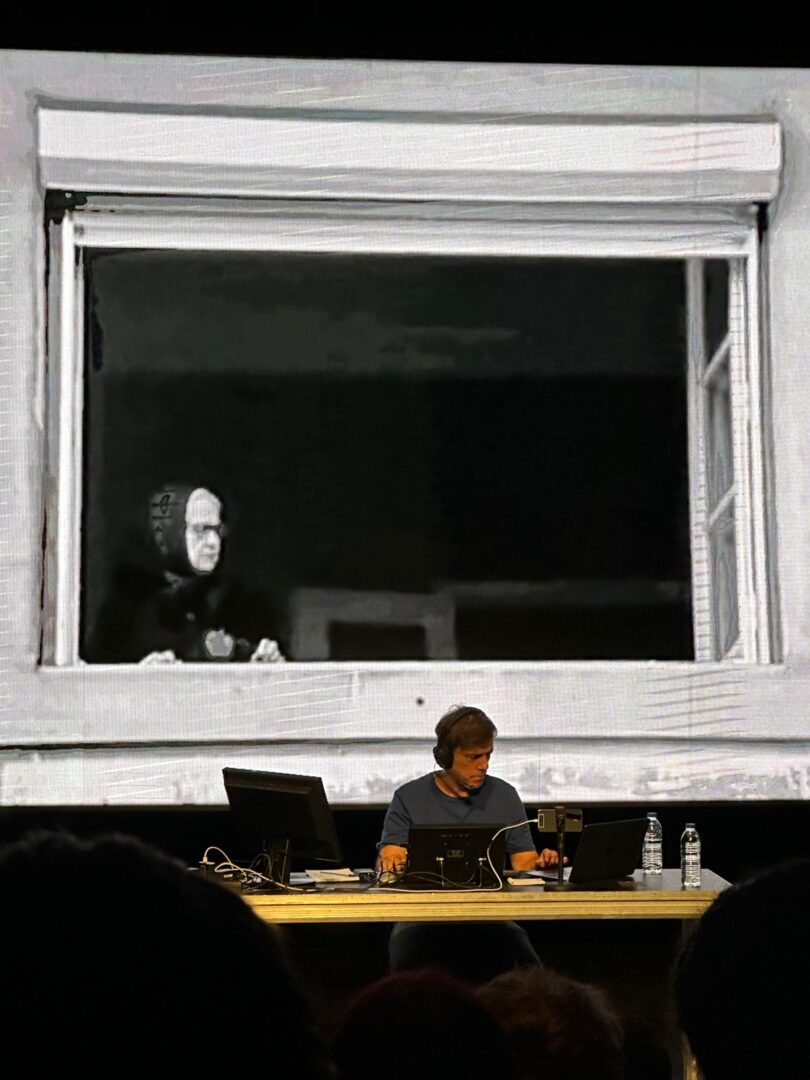
Stripped down to bare minimal theatrical and technological elements, the casting-session-like performance is conceived, written, and performed by Andrade, co-founder of Mala Voadora together with scenographer José Capela. Sitting at a desk with computers and a screen behind him, Andrade plays a cinema director selecting extras from all over the country to participate in his new movie about a revolution. As the lead protagonist of his movie is “the people” (as he says at some point), he needs a large number of extras to occupy streets, squares, and regional assemblies. The fictional plot consists of an “imagined” revolution that would have taken place on April 25, 1974, to overthrow a fascist regime (historical fact) which ends, more than fifty years later, with the election of a populist far-right leader (dystopic fiction for democracy). The playfulness between historical facts and fiction through temporal and spatial ambiguities, reinforced by the performative acting style of Andrade, is at the core of the production. All images are credited to the national TV archives (RTP), although they are used as if they were being captured in the present, with Andrade instructing the “actors” as if they were on a movie set. Likewise, the audience becomes an implicit extra and indirectly participates in the revolution or in (re)making a revolution as “the people.” The performance brings forth a critique of the contemporary populist Western democracies not only by activating collective memory (through the reconfiguration of historical facts in a fictional past) but also, perhaps more importantly, by presenting an imagined scenario (through the fictional projection of the present as a possible future).
Inspired by John Smith’s peculiar short movie The Girls Chewing Gum (1976),38 Andrade uses his voice as a commanding device to both anonymous people and public figures on the screen, pretending to anticipate what they should say and what they should do. Such artifice creates a potent comic effect while satirizing the indistinction between true and false that runs through the mediated modes of how the world is constituted for us today. According to Berardi,39 one of the critical consequences of contemporary information environments of electronic stimuli is precisely the impossibility of discerning truth from falsehood. The production 25th of Abril 1974 tackles this issue in a humorous and subversive way, for the merging of temporalities and the indistinction of fact and fiction open a space for critically engaging with the present. A dramaturgy of edited image and sound seeks to disclose the contemporary processes of manipulative narratives and fake news.
Following an apparent temporal arch, the performance unfolds in a sequence of three parts: past, present, and future. Yet the temporal borders are blurred. The first ten minutes present an edited sequence of archive images of the Salazar regime, its heroes (Fatima and football)40 and demons (for instance, soldiers’ Christmas messages to their families during liberation wars). When the light changes slightly and the image of the actual audience is projected onto the screen, Andrade stands up to directly address the audience. He introduces himself as the director of a movie about a revolution that will take place and thanks the audience for coming from different places in Portugal to participate in the casting. The fictional pact is set and all audience members become involuntary participants in the movie, hence, in the revolution. During his introduction, images of historical moments of popular assembly continue to be displayed on the screen, to which Andrade suddenly addresses his words as well, encapsulating spectators and images of people in a single time-space warp. Real people in 1974 (assembling to celebrate the revolution and to democratically organize to discuss the future of the country) and real spectators gathered in the theatre are all now extras of a movie that fabricates a revolution. Multiple layers of time collapse into a fuzzy past-present-future, both imagined and real, potential and actual, true and false. The actions in the script are historical facts. The movie characters are some of the politicians relevant to the sequence of events, from the military column led by Captain Salgueiro Maia, from Caldas da Rainha41 to Largo do Carmo (in the center of Lisbon, close to Av. da Liberdade). Military tanks and people take over the streets in a festive mood to reclaim freedom and democratic rights. Original TV broadcast images are edited and presented as live takes directed by Andrade, as he instructs both “actors” and his crew in the imaginary set.
The last section of the production is precipitated by images of relevant politicians from the last thirty years, in a compact fast forward narrative to the present moment. The leap into the future happens through images of an electoral victory of André Ventura, president of the only far-right party in Portugal with seats in parliament since 2019 (Chega). Reversing the dramaturgical strategy, Andrade uses recent tv broadcast images to tell a story of that which did not happen as if it was a fact. More than fiction, the production creates a friction that stresses the processes of mediatized and techno-capitalist reality-making processes we are exposed to in our daily lives, undermining citizens’ freedom and free will in democracy. Dystopia for some, utopia for others, the end of the piece leads spectators straight to an informal conversation with Andrade (possible only when presented for school audiences, not for a general audience). Andrade does not leave the stage after the applause. He asks questions and stimulates debate about the layers of fiction and reality of the performance. One could say this moment becomes the second-end scene of the production: an opening of a space for dialogue, which is decaying in our polarized societies; a space of appearance before others with different opinions, perceptions, and doubts.
On the one hand, 25th of Abril 1974 takes historical facts and fictionalizes them, presenting history in reverse (as a potential future that happened in the past), collapsing times, and reinforcing the manipulative and distorted operations one witnesses every day in the media and social networks. On the other hand, the production opens a suspended time through a dystopic projection in the future. Every time this production is performed, it makes the revolution happen again, and again. Its performative potential lies in a cross-temporal history and fiction that repeats and intensifies the enthusiasm for new beginnings—the pathos of novelty—associated with freedom that is “actually” also performed by the audience’s embodied experience.42 Such bodily experience, unfolding together with an involuntary participation in the “labor of fiction” stimulates and fuels an economy of gentle affects.43
Philosopher Jacques Rancière proposed that the labor of fiction acts upon the frame of the real to create dissensus, hence a labor of reframing, of shedding light on obscured or unperceived realities, making the invisible visible.44 Mala Voadora’s production changes the frame of the theatre by stating it as a movie casting, hence implicitly making the audience the extras of a revolution in contracted times (past, present, and future) and characters in it, both real and imaginary. The national event of an historical revolution moves down to the scale of a theatre auditorium, condensing its energy and making it happen (as if) in the present. Used in a theatrical frame, edited images and sound create a narrative that makes visible forms of emotional manipulation and disinformation that remain hidden in our social interactions, especially within the digital world, emphasizing how reality is constructed in many ways like fiction. Thus, fiction is the playful means through which the 25th of Abril 1974 creates the conditions for the experience of an affective-sensorium of freedom; it is because it is an embodied experience that the strategy of rendering visible what is invisible—the distinction between true and false—can create a more effective level of awareness and potential for debate. Whereas Voadora’s production uses fiction as a key device for generating an economy of gentle affects, Guillermo Cacace’s The Seagull generates such an economy through the creation of a space of shared vulnerability.
Freedom as a Condition of Vulnerability: The Seagull, by Guillermo Cacace
Anton Chekhov’s four-act play The Seagull takes place in a Russian countryside family property on the shore of a mysterious and haunting lake. One can hear the birds singing in the bucolic landscape as if the soundtrack for Treplev’s play were presented at sunset to family and guests. The young and beautiful Nina stars in the piece, dreaming of becoming an actor in Moscow. Her connection to the lake is profound and paradoxical: she claims to know every secret of it, but she is also under its disturbing influence, a lurking force (like the enormous waves Masha later claims to see in Act four) pushing her to an abyss. The lake is both peaceful and turbulent, quiet and stormy, inspiring and depleting; it is contradictory like human nature with its bright and dark sides. Nina claims to be attracted to the lake like a seagull in the first act and identifies with a seagull (“I am a seagull . . . no, I am an actress”) in her final deranged dialogue with Treplev, the young writer who is in love with Nina but cannot survive a broken heart. A symbol of freedom and happiness, the seagull is killed by brutal free will. Burning with jealousy due to Nina’s infatuation with celebrity writer Trigorin, Treplev kills a seagull and throws it at Nina’s feet while Trigorin, seeing the dead seagull, imagines a short story in which a man kills a free and happy young woman “just because he can” (my translation from the Spanish script). Thus, the seagull symbolizes both freedom and its inherent vulnerability to the shifting political and economic conditions that entitle humans, for instance, to commit brutal acts of violence in the name of freedom, as we witness today.45
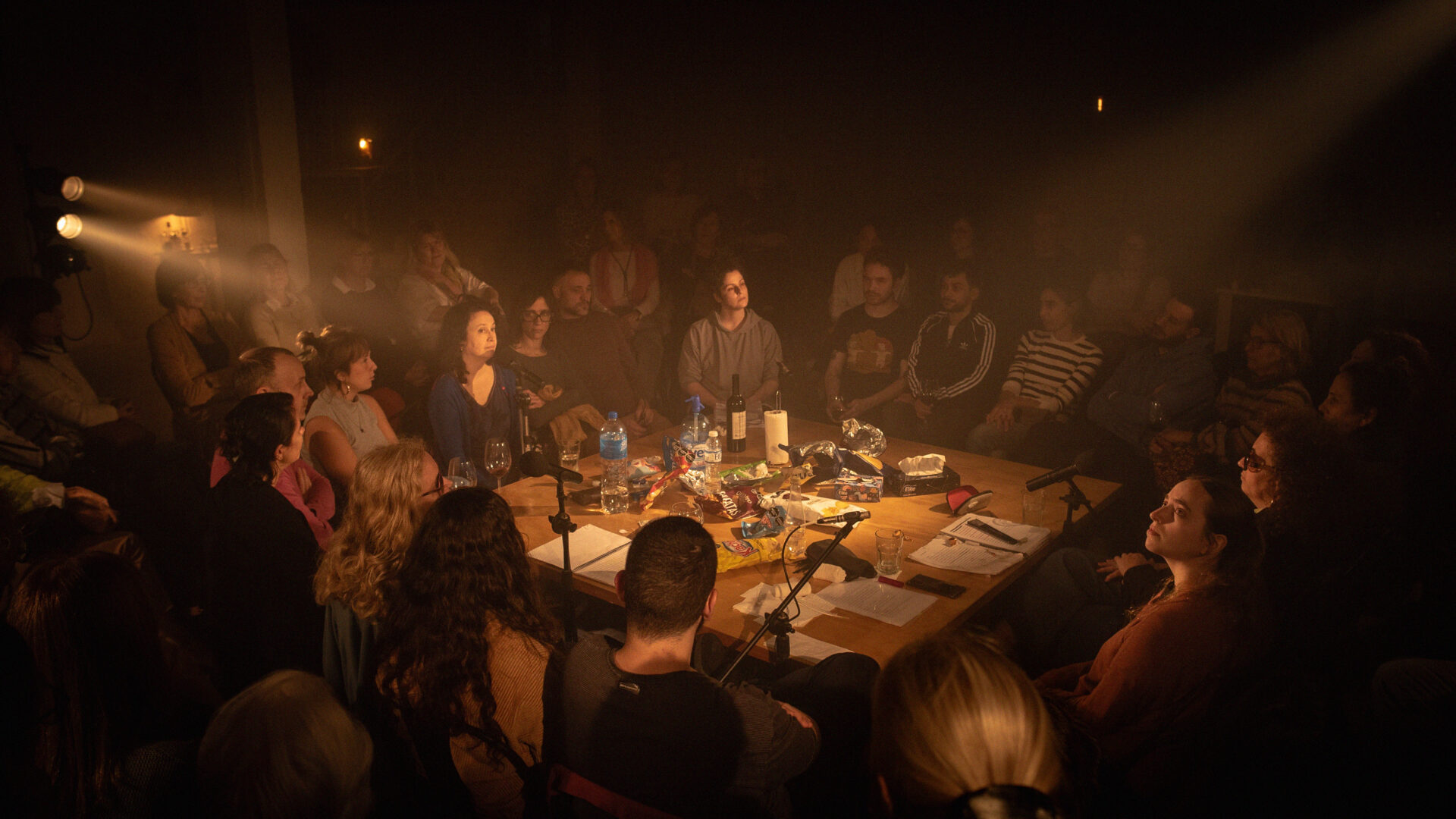
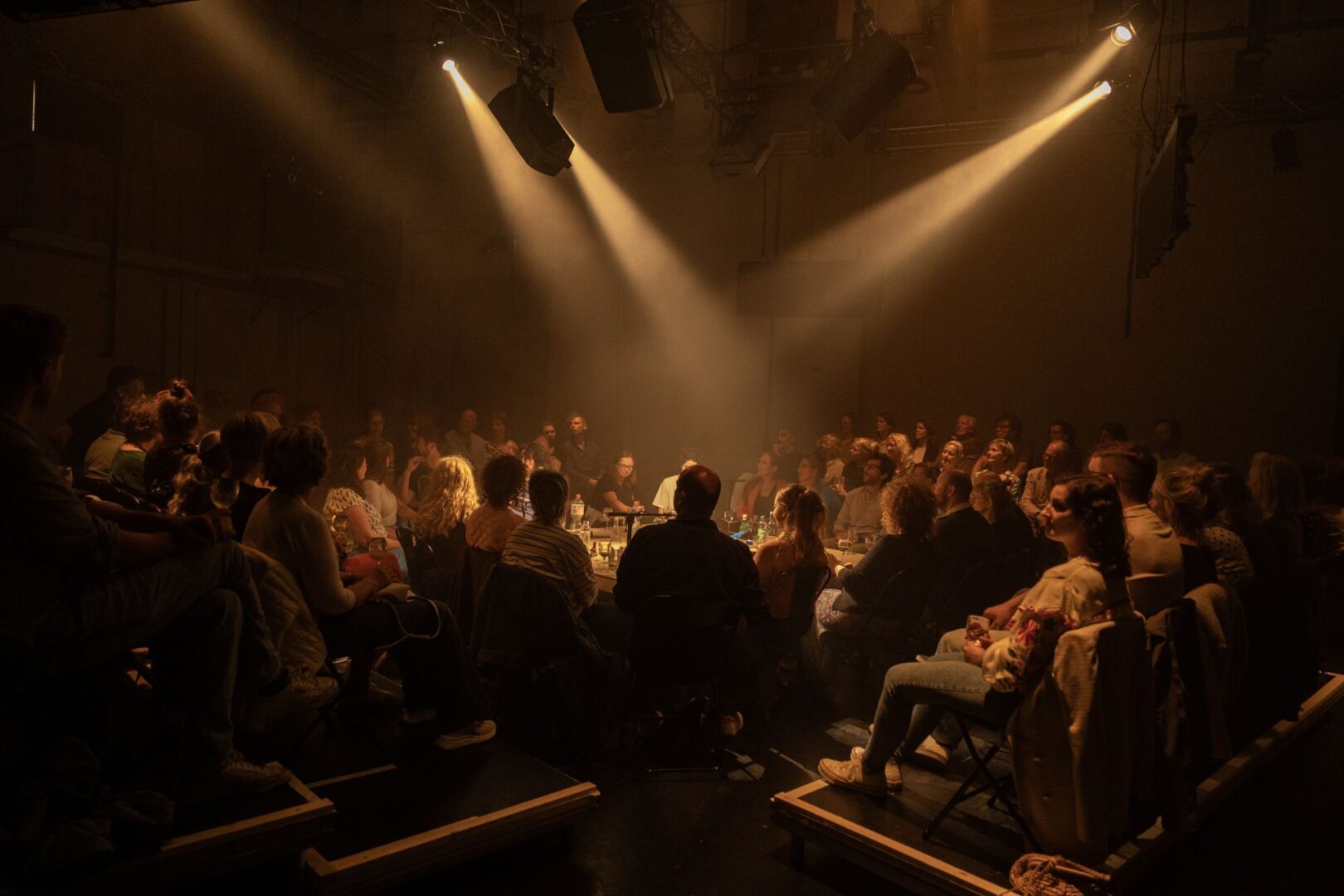
The importance of freedom as a form of public participation is key to the mise-en-scene of Chekhov’s The Seagull by Argentinian director Guillermo Cacace. Premiered in 2023 in Buenos Aires, the production has been touring internationally and, not coincidentally, has been met with very receptive audiences in Europe. Juan Ignacio Fernández wrote the dramaturgical version of the play for a cast of five female actors who play the main characters, irrespective of their age, looks, or gender. In fact, very much like Andrade in the 25th of Abril 1974, they do not even wear costumes. Drinking wine, they sit at a large table with what seems to be party leftovers: Arkadina on one side, Trigorin and Masha at the other two, Treplev and Nina facing each other at two corners. Among them and behind an auditorium divided into four sections surrounding the table, sits the audience, who is invited to join the party (or what is left of it) with a glass of wine or water offered at the entrance of the scenic space. Although this production does not claim to be feminist, it is hard not to think of how the female cast reinforces the idea of vulnerability (of the seagull) against violence; women are, in fact, one of the main targets of patriarchal and exclusionary far-right politics.
Theatricality is strategically downplayed, and the plot stripped to the bare minimum to emphasize proximity with the audience, as well as to enhance a space of sociability that does not however involve direct participation; a space of public appearance shared by actors and spectators, who are also looked at by the rest of the audience in the stalls. Again, a kind of staged participation or staged attendance re-framed the space usually attributed to spectatorship. I was lucky to have experienced the production seating in the first row, close to Nina, with an occasional opportunity to exchange gazes with the actors. More than participation, Cacace’s scenic apparatus of The Seagull proposes a space of vulnerability being together in public, between performers and spectators, making room for multiple interweaving of temporal, spatial, individual, and collective layers. It is from this space that the conditions of possibility for the experience of freedom emerge in Chekhov’s classic. The scenic space does not break theatrical conventions; it instead brings the affective and sensorial nature of lived experience to the surface of theatrical encounter as a space of freedom.
In a preamble to the performance, Guillermo Cacace himself, sitting in a small stage management desk set between two audience stands, displays on a screen two WhatsApp messages he had sent to the cast just before the rehearsals started, emphasizing the dates. The first rehearsal was planned for March 22, 2020, but on March 20 it pivoted to a Zoom meeting because of the COVID-19 pandemic.46 The readings over Zoom lasted for a year and a half, every Sunday at 10:30 p.m. Cacace says: “we were researching The Seagull but we were also a survival group.” When the successive lockdowns were over, they asked friends to join them around a table. Everyone brought something to drink and eat. It was like a party. This phase of the project lasted for a couple of months. The planned scenography involved filmed scenes and some technological apparatus. Yet, on the first rehearsal in the theatre venue, Cacace asked the cast to do one last table read before moving on to the stage. And suddenly, the table became the frame for the staged version,47 putting aside the filmed material and the physicality of the bodies in space.
The conditions of production became the backbone of the director’s artistic vision for the play and the table, in turn, a stage on its own, a frame for spectral appearances; a table that is also an imaginary haunted lake around which we gather, like Cacace and the actors’ friends gathered for dinner to attend repeated rehearsals. By invoking these multiple realities, the performance carries the individual and collective affective memories of the creative process. Chekhov’s words activate the affective remains of other productions of The Seagull, other deaths and dreams, other parties and encounters, as reminders of the particular conditions that define our freedom of speech, movement, and gathering in public. In this sense, Cacace’s Seagull opens a space for the circulation and intensification of gentle affects that underlie an affective economy of freedom. The opening to indirect and unsolicited participation is a real risk making the production vulnerable, as any spectator can easily take action and disturb the performance, just like young Treplev kills the seagull: because he can. Conceived as a space of shared vulnerability instead of a violent imposition of authoritative and brutal economies where only a few are actually free, freedom is shared among equals.
Cacace’s The Seagull clearly moves beyond a direct critical approach of the present moment. Perhaps due to the political situation in Argentina since 2023 (when the far-right ultraliberal president took office), the production immerses the audience in a place of imagination, resetting the conditions of experience of freedom as a key feature of this staging of Chekhov’s classic. Transforming the proscenium into a four-sector auditorium surrounding a table-stage, Guillermo Cacace brings performers and spectators side by side in a modern agora. Along with the spatial arrangement that created a relation of closeness and proximity with the audience, the cuts and extensive editing of the dramaturgical version of the script, performed by a cast consisting solely of women, shortens the time of the original play and intensifies the dramatic love story and its fatal and hopeless ending—fatal and hopeless as the pandemic for many. It turns the ghosts of the pandemic, of spectral Seagulls, of the memories of shattered dreams, into tangible realities. It makes possible the emergence of spaces of appearance that need the presence of others (the audience) to perform positive forms of freedom.
Closing Thoughts
In her theory of affective economy, Ahmed posits that the subject is neither the origin nor the destination of emotional circulation but rather a “point of impact” of its trajectories.48 Immersed in the circulation of emotions in the public space, forms of subjectivity are part of a continuous flow of exchanges and referrals. Like the subject’s unique relationship to emotions is linked to where it stands in the dynamics of affective economies, a production such as 25th of Abril 1974 stands in a place of intersection of ambivalent and paradoxical affective economies of freedom. Drawing on Ahmed, I suggest that this production can be considered a point of impact of competing affective economies of freedom. Opposite ends of a wide range of affective economies are anchored in contrasting interpretations of democracy: one anchored in freedom as a democratic right and another anchored in the right of freedom as legitimation of unbounded action. The restraints of the circulation that the 25th of Abril 1974 performance unexpectedly suffered contradict the April 25 commission’s investment in this work.
As Ahmed reminds us, however, the greater the repetition of the circulation of affects, the greater the affective value accumulated. While the ritual of the march activates and increases an affective economy of gentle affects embodied through its performance, the parade of the fiftieth anniversary of the revolution manifested in the streets the collision of two antagonistic affective economies of freedom, epitomizing the tensions of the political and social moment.
How does one address this invisible, though decisive, battle of forces? What can performance do to create barriers to brutal affects and increase the accumulation of capital of gentle ones? As the two artistic productions discussed in this article reveal, one of the ways of doing so is, as with the 25th of Abril 1974, by making visible existing tangible tensions (such as the misinformation in the media and social media) and, as with The Seagull, by re-imagining forms of freedom in spaces shared in vulnerable ways with the public.
Acknowledgment
The author would like to thank political economist Amarilis Felizes for her kind assistance and sharp comments on Portuguese cultural policies for the arts.
Funding
This work was funded by national funds from the Fundação para a Ciência e a Tecnologia (ref. 2023.10839.25ABR) in the realm of the project FREEWILL – “Free will and the will for freedom: Affect in Performance of Democracy” (ICNOVA – FCSH – UNL).
Notes
- It is noteworthy to flag that these safety bays might not have been there from the beginning, as various people I have discussed this article with do not recall them. However, this was my experience at the time I reached Restauradores square. ↩
- However, only a couple of weeks before the event, Portugal elected fifty far-right members to take seat in the parliament—a shock to the Left and to all democrats as the far-right party Chega had elected ten members of parliament only in the previous elections. This triggered both celebration and protest. ↩
- Alfredo Vieira, email message to author, January 14, 2026. ↩
- Diário de Lisboa, April 26, 1982, https://archive.org/details/cc_dl_06837.187.29321. ↩
- Fernando Piteira Santos, “Política de A a Z,” Diário de Lisboa, April 26, 1982, https://www.cd25a.uc.pt/en/page/500, 5. ↩
- According to the official website of the commemorative commission, https://50anos25abril.pt/iniciativas/arte-pela-democracia. ↩
- Vera Borges, “Grant-Flipping Across Europe: How Portuguese Artists Navigate Precarity to Sustain Aspirations Beyond Recognition,” Poetics 113 (2025), https://doi.org/10.1016/j.poetic.2025.102059. ↩
- The majority of performing artists do not have a space of their own and often complain about the difficulties of touring their productions in Portugal. Although there has been a cultural policy for the arts since the revolution, the infrastructure that can indeed support and sustain circulation has only recently been created (in 2019) and regulated (in 2021). As “a model of good practice, which has long been demanded by the arts sector, local authorities, and citizens,” the RTCP network {theatre and cine-theatre Portuguese network} together with the financial support grants for the programming of theatres, established public funding arts at a national level (“Portaria n106/2021,” Diário da República, May 25, 2021, 73–78, at 73). RTCP gathers 85 venues, mostly in the center and north regions, mainly run by public funds, town councils or municipal companies (81.2%). José Soares Neves, Sofia Costa Macedo, Jorge Santos, e Maria João Lima, eds., Atlas Artístico e Cultural de Portugal (Direcção-Geral das Artes, 2024): 174–5). ↩
- Chantal Mouffe, For a Left Populism (Verso, 2018), 27. ↩
- Liberties, Rule of Law Report 2025, p. 6, https://www.liberties.eu/f/vdxw3e. ↩
- Clara E. Mattei, The Capital Order. How Economists Invented Austerity and Paved the Way to Fascism (University of Chicago Press, 2022); James Putzel, “The ‘Populist’ Right Challenge to Neoliberalism: Social Policy between a Rock and a Hard Place,” Development and Change 51, no. 2 (2020): 418–41; and Quinn Slobodian, Hayek’s Bastards: The Neoliberal Roots of the Populist Right (Penguin Books, 2025). ↩
- Clara E. Mattei, The Capital Order. How Economists Invented Austerity and Paved the Way to Fascism (University of Chicago Press, 2022). ↩
- James Putzel, “The ‘Populist’ Right Challenge to Neoliberalism: Social Policy between a Rock and a Hard Place,” Development and Change 51, no. 2 (2020): 418–41. ↩
- Goran Petrovic Lotina, Théo Aiolfi, William C. Boles, and Anja Hartl, eds. Performing Left Populism. Performance, Politics and the People (Methuen, 2023). ↩
- Ernesto Laclau, On Populist Reason (Verso, 2005). ↩
- Benjamin Moffitt, Pierre Ostiguy, and Francisco Panizza, eds., Populism in Global Perspective. A Performative and Discursive Approach (Routledge, 2021). ↩
- Benjamin Moffitt, The Global Rise of Populism: Performance, Political Style, and Representation (Stanford University Press, 2016). ↩
- Moffitt, The Global Rise of Populism, 13. ↩
- Hannah Arendt, On Revolution (Penguin Books, 1965), 32. ↩
- Arendt. On Revolution 32. ↩
- Arendt, On Revolution, 75. ↩
- Bojana Cvejić and Ana Vujanovic, Public Sphere by Performance (B_ books, 2012). ↩
- See for example, Claire Bishop’s Artificial Hells. Participatory Art and the Politics of Spectatorship (Verso, 2012) and “Antagonism and Relational Aesthetics,” October 110 (2004): 51–79; and Shannon Jackson, Social Works: Performing Art, Supporting Publics (Routledge, 2011). ↩
- Bishop, Artificial Hells, 65. ↩
- Sruti Bala, The Gestures of Participatory Art (Manchester University Press, 2018), 7–8. ↩
- Ana Pais, “Re-Affecting the Stage: Affective Resonance as the Function of the Audience,” Humanities 5, no. 3 (2016): 79. ↩
- Rebecca Schneider, Performing Remains: Art and War in Times of Theatrical Reenactment (Routledge, 2011). ↩
- Maggie Nelson, On Freedom. Four Songs of Care and Constraint (Random House, 2021). ↩
- Alberto Toscano, Late Fascism. Race, Capitalism and the Politics of Crisis (Verso, 2023), 72. ↩
- James Putzel, “The ‘Populist’ Right Challenge to Neoliberalism: Social Policy between a Rock and a Hard Place,” Development and Change 51, no. 2 (2020): 421. ↩
- See Askanius et. al. 2024; AAV 2022. ↩
- Franco Berardi, “Freedom and Potency,” E-flux, #116 (March 2021), https://www.e-flux.com/journal/116/378694/freedom-and-potency. ↩
- Franco Berardi, “Brutalismo Suprematista Libertario,” Il Disertore, May 24, 2024, https://francoberardi.substack.com/p/brutalismo-suprematista-libertario. ↩
- Sara Ahmed, The Cultural Politics of Emotion (Edinburgh University Press, 2004), 44. ↩
- Ahmed, The Cultural Politics of Emotion, 11. ↩
- Michel Foucault, Power/Knowledge. Selected Interviews and Other Writings 1972–1977, edited by Colin Gordon (Pantheon Books, 1977), 194. ↩
- It is worth noting that the same kind of re-signification process occurs with flags. In Brazil, the national flag was captured by Bolsonaro’s supporters ever since the 2013 civil protests. Only after two major international events—the 2022 football World Cup and, in 2025, Fernanda Torres’ Oscar nomination for Best Actress and her Golden Globes win for the same category for her role in Walter Salles’ I’m Still Here—has the flag been rescued to re-signify national union. ↩
- John Smith, The Girls Chewing Gum, 1976, archived 2015 by Austerlitz Film Gallery, https://vimeo.com/120689555. ↩
- Franco Berardi, “Brutalismo Suprematista Libertario,” Il Disertore, https://francoberardi.substack.com/p/brutalismo-suprematista-libertario. ↩
- António de Oliveira Salazar was a Portuguese dictator who served as President of the fascist regime “Estado Novo,” from 1932 to 1968. Known as the three Fs, the three pillars of the regime were: fado, Fátima, and football. Music, Catholicism, and sports were the basis of Salazar’s policy of ignorance to control the people. ↩
- Captain Salgueiro Maia was one of the leading figures of the Carnation Revolution. In the dawn of April 25, 1974, he led the military forces from Caldas da Rainha to the Lisbon military headquarters in Largo do Carmo, close to Avenida da Liberdade. During the siege, flower merchant, Celeste Caeiro, placed a red carnation in the barrel of a rifle, sparking a collective movement that symbolically marked the revolution as a bloodless one. ↩
- Hannah Arendt, On Revolution (Penguin Books, 1965), 34. ↩
- Jacques Rancière, Dissensus. On Politics and Aesthetics, edited and translated by Steven Corcoran (Continuum, 2010), 141. ↩
- Rancière, Dissensus, 141. ↩
- See also Vera Gottlieb and Paul Allain (eds.), The Cambridge Companion to Chekhov, (Cambridge University Press, 2006); Geoffrey Borny, Interpreting Chekhov, (Anu Press, 2006); Anatolii, Éfros, The Seagull: an insider’s account of the groundbreaking Moscow production, (Routledge, 2019). ↩
- RAN (Radicalization Awareness Network) Practitioners, COVID-19, Violent Extremism and Anti-Government Movements (2022), https://home-affairs.ec.europa.eu/system/files/2022-10/spotlight_anti-government_extremism_102022_en.pdf; and Tina Askanius, Bàrbara Molas, and Amarnath Amarasingham, “Far-Right Extremist Narratives in Canadian and Swedish COVID-19 Protests: A Comparative Case Study of the Freedom Movement and Freedom Convoy,” Behavioral Sciences of Terrorism and Political Aggression 17, no. 2 (2025): 164–84. ↩
- Guillermo Cacace in conversation with the audience the day I attended the production, June 22, 2025, at FITEI Festival (Oporto). ↩
- Ahmed, The Cultural Politics of Emotion, 46. ↩