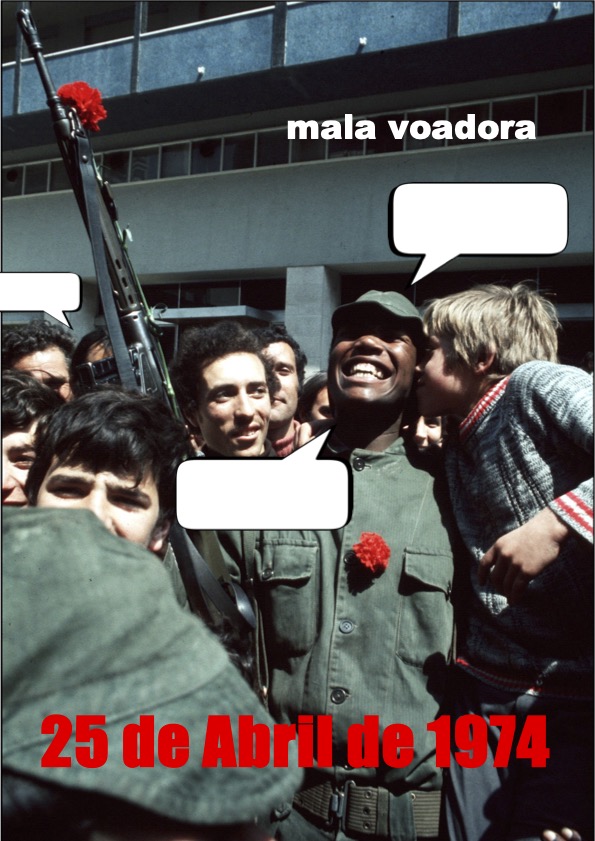
This article proposes the concepts of “brutal” and “gentle” affects as a critical framework to analyze affective economies of freedom in paradoxical times. Drawing on Sara Ahmed’s work on affect, Sruti Bala’s on participation, and Franco Berardi’s on freedom, it argues that freedom emerges not solely as a historical achievement of an inalienable right, but as an embodied experience enhanced by theatrical dispositifs. I consider forms of celebrating, performing, and capturing freedom in paradoxical times, including the staging of the fiftieth anniversary of the Carnation Revolution; the production 25th of April 1974 by Portuguese company Mala Voadora; and The Seagull by Argentinian director Guillermo Cacace. I begin with a discussion of the relationship between populism and notions of freedom, describing the nuanced usage and political capture of the latter to examine its paradoxes in the present. I then examine how these productions critically engage with the paradoxes of freedom and reset the conditions of experience of its affective-sensorium.
Keyword: freedom
Anti-Blackness as Disavowal and Condition: Rethinking Foucault’s “Carceral Society”

Recent calls to “defund the police” have seen a plethora of movements decry state funds allocated to the police and ask that those funds be placed elsewhere. In this article, we return to Michel Foucault to analyze how calls for rebalancing budgets away from the police force and towards social projects both rely on political categories established in Foucault’s work and encapsulates an aporia that emerges through them. Locating shifts towards the carceral in the context of European modernity, Foucault suggests that policing moves away from the spectacular torture and punishment of sovereign and state and towards technologies of power that proliferate across the social body. Here, we suggest that in this movement between sovereignty and power emerges a central tension that Foucault is incapable of resolving—between an exteriorized sovereignty (death) that necessarily appears at the extreme limits of power (life)—which threatens to destabilize the domain of power altogether. Race—as it appears in the European frame and reaching a zenith in Nazi Germany—encapsulates Foucault’s attempted mitigation. If anything, this exacerbates the problem by rendering the terms of inclusion in the domain of power (of making life live) incoherent. To see why, we go on to show how freedom from racial slavery—as space of incapacity—is the conduit through which entry is possible into the differentiated power that supposedly limits the social. But as such, the slave precisely indexes the aporia for Foucault that cannot be sutured. The implications of this can be seen in the calls to defund the police insofar as it implicitly repeats Foucault’s shift from police to social power.
The Black Shoals Dossier

This dossier collects four reflections on The Black Shoals: Offshore Formations of Black and Native Studies (2019) with responses by its author Tiffany Lethabo King. This dossier is based on an American Studies Association 2021 roundtable organized by Beenash Jafri.
Review of The Long Emancipation: Moving Toward Freedom by Rinaldo Walcott (Duke University Press)
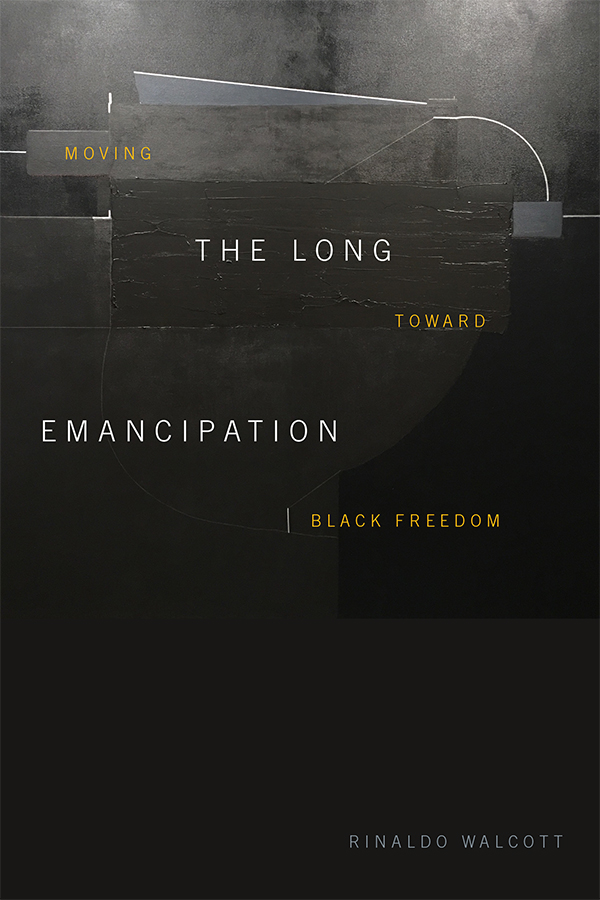
In The Long Emancipation: Moving Toward Freedom, Rinaldo Walcott argues, through the use of short essays, that the Black experience can be understood through the lens of the constant struggle for emancipation. For Walcott, true freedom for Black people was never attained with emancipation and in fact, emancipation is still an ongoing process. Each chapter interrogates an aspect of Black life and death that according to Walcott create the space for Black freedom to exist.