Introduction
The 60th Venice Biennale was meant to be an elegy to the figure of the foreigner. Foreigners Everywhere, proclaimed in the title of the show, with curator Adriano Pedrosa borrowing the phrase from a 2002 artwork by the group Claire Fontaine.1 For Pedrosa, there is an omnipresence of foreigners in the contemporary world—not only because everyone literally encounters foreigners in daily routines, but because deep inside, we are all foreigners to ourselves: the foreigner is indeed the de facto condition, the ontology of human existence. While stemming from this broad idea of foreignness, stretched to include almost everything, Foreigners Everywhere more explicitly grappled with minoritarian agents of foreignness—the excluded others of Western modernity: the stranger, the migrant, the queer, the refugee, and the Indigenous.2 In the spaces of the Arsenale, Giardini, and the numerous national pavilions sprawling across the city, these minoritarian figures, positioned in opposition to modernity’s majoritarian epistemic framework, appeared in the 60th Venice Biennale to have agency and voice. It was as if the “inappropriated” and “monsterized” others escaped the straitjacket of modernity’s epistemological pigeonholing—to recall Donna Haraway3—now taking center stage in the world’s most renowned contemporary art exhibition. Pedrosa’s gesture of restoring the inappropriated other rehearsed the strategy of Manifesto Antropófago (1928) by Brazilian poet Oswald de Andrade, which called for Brazilian culture to evolve by embracing its anti-Christian Indigenous roots while “devouring” rather than merely imitating European influence. The manifesto served as both an implicit and explicit reference of this center staging.4
In this article, I focus on a particular figure of foreignness in the 60th edition of the Venice Biennale—the “Indigenous”—whom I read as a symbolic actor within its cultural-political economy to help us navigate how spectacular shows encompass and perform otherness. The Indigenous can be seen as the minoritarian figure par excellence across the Global North’s artistic imagination in the last decade or so. At least since documenta 14 in 2017, which included some limited Indigenous art, such as works by Beau Dick and Sámi art communities, and later, the 2022 Biennale with much more Indigenous involvement—including Jaider Esbell, the transformation of the Nordic Pavilion into the Sámi Pavilion, and others—the term “Indigenous” promises various things at once: it offers visibility to expropriated otherness in the artistic core, and at the same time, it prompts this very core to unlearn dominant (i.e., Western-centric) hierarchies and epistemologies.5
The “Indigenous” in this discourse typically becomes an umbrella term for countless heterogeneous communities existing in radically different geographies and historical periods. What mostly binds these Indigenous groups together is ethnic cleansing, expropriation, displacement, and subjugation brought upon them by colonial powers. In other words, the term “Indigenous” expresses first and foremost a form of negative bonding insofar as it assembles and speaks on the basis of historical trauma—and by doing so, it expresses a highly heterogeneous singularity with diverse histories, needs, locations, and cosmologies.
I employ a cultural-political-economic perspective to theorize the Venice Biennale, a global institution striving to maintain and expand its relevance as a major site of artworld consecration. From a political-economic standpoint, cultural production is conditioned by political-economic concerns that aim to maximize value (symbolic or economic) for the institution. Following Larissa Buchholz’s analysis of the global art field as bifurcated between a market and a prestige subfield,6 and the broader Bourdieusian spirit of analyzing art institutions as self-reproducing entities,7 I read the Venice Biennale as operating within the prestige subfield, where symbolic capital is accrued through curatorial gestures and institutional positioning. For the Venice Biennale, one way of doing so is by continually welcoming difference—cultural, ethnic, sexual, and so on—amidst the rise of decolonial narratives problematizing the primacy of Western modernity and critiquing its exclusions. These processes pressure major Global North institutions to perform their “universality” in terms of (global) inclusiveness.8 At the same time, within the assemblage of different forces, desires, and vested interests that make up the Venice Biennale, there are various gatekeeping technologies,9 as I shall call them, that are subject to the institution’s forces yet retain the power to act somewhat autonomously. These technologies, I will argue, can therefore set in motion the production of symbolic exchange in the form of narratives, content, images, representations, and social relations.
From a cultural-political-economic perspective, then, if the Venice Biennale strives to maintain its relevance by welcoming various forms of difference, the figure of the “foreigner”—and its constituent parts—enables specific forms of symbolic production, exchange, and socialization. In turn, these symbolic forms are enacted within a massive exhibition in terms of scale, demanding possibly hundreds of hours to be properly experienced, and thus significant time and money, an aspirational middle-class audience, passport privilege, and an inherent drive toward spectacle.
The guiding research question driving this article is: If the figure of the Indigenous indeed gains visibility and symbolic legitimacy through a high-profile exhibition like the Biennale, how—and by whom—is the “Indigenous” ultimately consumed? This article first proposes reading the Venice Biennale through the lens of its cultural-political economies, then examines representations of the Indigenous in its 60th edition. I argue that the primary framing devices or “moments” of this representation are cosmologies, objects, alternative modernisms, and memory. I use the term “moment” here not to suggest a chronological sequence or discrete historical phase, but to designate curatorial forms that construct a provisional clustering of aesthetic, discursive, and institutional strategies through which the Indigenous becomes legible within the Biennale’s political economy. These moments coexist, overlap, and reinforce each other rather than unfolding linearly. In the final section, I analyze what these moments produce when embedded within the Biennale’s political economies and ask whether there are alternative pathways for exhibiting and producing knowledge about the “Indigenous” that uphold cultural complexity.
The Cultural Economies of Venice Biennale and Global North Artworlds
The Venice Biennale (1895 to present) is the world’s oldest biennial, having evolved from primarily showcasing European art before World War II to becoming a major international art institution that regulates global cultural economies of value, prestige, and distinction. The Biennale’s system of national representation is expected to function as a kind of UN or Olympics of the arts—though this assembly is far from organic, being instead marked by flows of unequal exchange.10
For instance, the Giardini, originally public gardens created under Napoleon Bonaparte, was gradually transformed into a site for national pavilions. Yet this space encapsulates uneven cultural economies, where historical power relations continue to shape contemporary hierarchies.11 This arrangement manifests what Okwui Enwezor, the 2015 Venice Biennale artistic director, termed a “trajectory of empire.”12 Of the thirty national pavilions in the Giardini, more than half are European, while Egypt remains the only country on the African continent with a permanent pavilion (and no sub-Saharan country has one).13 These spatial politics mirror colonial histories, where pavilion construction coincided with imperial violence. When Belgium became the first nation to erect a pavilion in 1907, King Leopold II was simultaneously orchestrating his brutal Congo Free State regime. Similarly, Germany and Russia’s pavilion constructions (in 1909 and 1914, respectively) preceded their rulers’ imperial warfare during World War I. The national pavilions in the Giardini—particularly those of France, Germany, and the United Kingdom, with their large, strategically positioned structures—command disproportionate visibility, enabling a spatial hierarchy that reflects and reproduces global cultural power dynamics.
Despite the national competitiveness of the Biennale’s gardens (or probably because of it), the Giardini, from a political-economic perspective, is a key gatekeeping technology in the institution’s repertoire of value. This is because for a country to have a national pavilion in the Giardini means rarity and cultural prestige—it offers symbolic value through the recognition that this country is taken seriously (or has been taken seriously at least at some point in the past) in the global arena. This recognition functions like a currency that can be converted into diplomatic value for the country in question or economic value for Venice and the Biennale itself.
To give an example, in 2025, after a deal with Pietrangelo Buttafuoco, the Venice Biennale’s president freshly appointed by the Meloni government, Qatar became the third country allowed to construct a pavilion in the Giardini in the last fifty years—after Australia in 1988 and South Korea in 1995. This deal translates to cultural and diplomatic capital for Qatar, while for Venice and the Biennale, it means economic benefit—it involved a donation of 50 million euros to the Municipality of Venice, besides other benefits.14 A parallel logic operates at the level of the institution, where in 2026 the Biennale appointed its first-ever “Exclusive Partner,” the LVMH-owned jeweller Bulgari, contracted across three editions through 2030; prestige is here converted into corporate sponsorship just as, with Qatar, it is converted into diplomatic and municipal capital.
Over time, then, the Venice Biennale evolved into the archetype of the prestigious exhibition across global art-scapes, an amply recognizable brand with symbolic power not only for individual countries but also for the art market.15 Indeed, for Vittoria Martini, “La Biennale di Venezia is one of the most highly ingenious and effective brands modern culture has ever produced, so much so that it has stood the test of time, has become the foundational brand for all following biennials, and created the most widespread exhibition format in our contemporary world.”16 The strategies of the Venice Biennale for (global) relevance change according to the individuals who each time enact its organization and the evolving socio-political circumstances. One such defining circumstance for Larissa Buchholz has been the discourse around the “global,” which for art biennials has become an “immanent logic” redefining “the game of contemporary art from within.”17 To be considered “global,” and therefore maintain and expand institutional legitimation, Global North institutions, like the Venice Biennale or documenta, need to be open to alterity and thus inclusive in terms of participants, concepts, and themes. A global appeal, however, is not only manifested by participants’ identities but by the evolution of discourses: in 2015 Okwui Enwezor embraced a “global” Marx, in 2022 Cecilia Alemani an expansive post-human meditation on the body and the more-than-human, and in 2024 Pedrosa elevated the foreigner into the principal object of investigation.18
We should not forget, however, that the claim to diversity and inclusion always—especially in contexts that appear liberal—displays limits, which are contingent upon the broader conflicts among local, regional, and international flows. A case in point is the 2022 exhibition documenta fifteen, curated by the Indonesian collective ruangrupa.19 While the choice of ruangrupa meant to extend documenta beyond Eurocentric practices and narratives, paradoxically, the event edged toward the opposite direction, manifesting the parochial limits of documenta. The process-based curation of ruangrupa alienated typical art critics and crowds while, more crucially, many participants’ criticism of Israel was reproached as antisemitic, clashing with Germany’s national culture and laws to the point that a year later, the remaining members of the Finding Committee of documenta 16—Simon Njami, Gong Yan, Kathrin Rhomberg, and María Inés Rodríguez—resigned en masse, stating: “In the current circumstances, we do not believe that there is a space in Germany for an open exchange of ideas and the development of complex and nuanced artistic approaches that documenta artists and curators deserve.”20
The “epistemic impasse” that documenta fifteen triggered, as Giulia Bellinetti called it,21 resulted in the downgrading of documenta’s global prestige insofar as the inclusion of alterities clashed with German national (art) histories, laws, and degrees of tolerance. While the Venice Biennale is less prone to similar catastrophes, partly because of its more structurally decentralized character, it is always threatened, like any other global site, with the delegitimizing specter of censorship and the subsequent demotion of its universal status; it is subject to specific sources of funding, organizational practices, and national ideologies, among others, that condition what will be shown and may in turn provoke dissent. The 2026 Venice Biennale, curated by the late Koyo Kouoh under the title In Minor Keys, is a case in point. Protests and widespread dissatisfaction greeted the inclusion of the Israeli pavilion (relocated to the Arsenale after the temporary closure of its official Giardini site, officially for renovation) and the Russian pavilion (in its Giardini location, open only for the preview days). Parallel actions, meanwhile, expressed solidarity with cultural workers and the Global South. One was a strike on May 8, organized by the Art Not Genocide Alliance (ANGA) in protest of Israel’s participation, which echoed a longer history of protest, boycott, and demonstration at and around Venice (most famously in 1968, when the Biennale was massively disrupted).22 And another was the pointed invitation of the Indonesian collective Taring Padi — whose banner had been removed from ruangrupa’s documenta fifteen — to exhibit new banners at the autonomous space Sale Docks and to paint murals on the external walls of the Morion social center in Venice.23
Besides the North-South dichotomies, the political economy of the Venice Biennale (as with any biennial) is predicated upon the joint venture of expansion and rarefication—that is, its expansion regarding topics, representations, identities, countries, and events, among others, but in a way that the exclusiveness of the high-art brand is retained. This mandate to expand, even exclusively, generates an overpowering environment for the vast majority of visitors, as within a limited timeframe, not only is it impossible to see all artworks, but “seeing” is compelled to (a structural) superficiality, to say the least, since the visitor is typically running from venue to venue. For most visitors, then, an overall impression of the exhibition will remain rather than an understanding in the Bildung sense of the word. How, then, does the “Indigenous” play out within this context of display abundance?
The “Indigenous,” or the Constitutive Other of Modernity
There are more than 476 million Indigenous people on the planet, according to the UN, spanning all continents and over ninety countries – 6.2% of the global population.24 Europe, where the Biennale occurs, is home to the smallest Indigenous population compared to any other continent of the world, comprising peoples such as the Sámi of northern Scandinavia and the Russian North, while Asia and the Pacific alone account for roughly 70% of the global Indigenous population.25
The concept of “Indigenous” is typically associated with European settler colonialism, which involved land and resource expropriation, physical extermination, disregard for colonized cosmologies, Christian enforcement, and more. However, the designation cannot be limited to European settler colonialism, as there are Indigenous populations in places never colonized by Europeans. It includes self-defined Indigenous communities as well as peoples predating (nation-) states, maintaining control over cultural, social, economic, and spiritual life.
Yet even this broader designation risks oversimplification by lumping distinct groups together. Decades ago, the social work scholar Hilary N. Weaver asked:
Are we talking about Indians, American Indians, Natives, Native Americans, Indigenous people, or First Nations people? Are we talking about Sioux or Lakota? Navajo or Diné? Chippewa, Ojibway, or Anishinaabe? Once we sort that out, are we discussing race, ethnicity, cultural identity, tribal identity, acculturation, enculturation, bicultural identity, or another form of identity?26
The United Nations, for its part, argues that “no formal universal definition of the term is necessary, given that a single definition will inevitably be either over- or underinclusive, making sense in some societies but not in others.”27 Beyond semantic broadness, the key point here is that “Indigenous” refers to groups with radically diverse histories, lifeways, and community-building practices, from food systems to spiritual traditions. Rephrasing the earlier question: How does this heterogeneity function within a political-economic context of rarefied expansion, where “understanding”—let alone deciphering complexity—becomes an arduous task?
I suggest examining the Indigenous figure not merely through representation (e.g., how “correctly” Indigenous art and culture are portrayed—though this remains vital) but as part of the Venice Biennale’s broader political economy. This is not to dismiss the value of empowering visibility but to ask: What kind of visibility is possible in a spectacular show, and for whom? Before discussing the potentials and limits of Indigenous presence in a mass event like the Biennale, I analyze four framing moments at the 60th edition—“cosmologies,” “objects,” “alternative modernisms” and “memory”—which, as we will see, frequently intertwine.
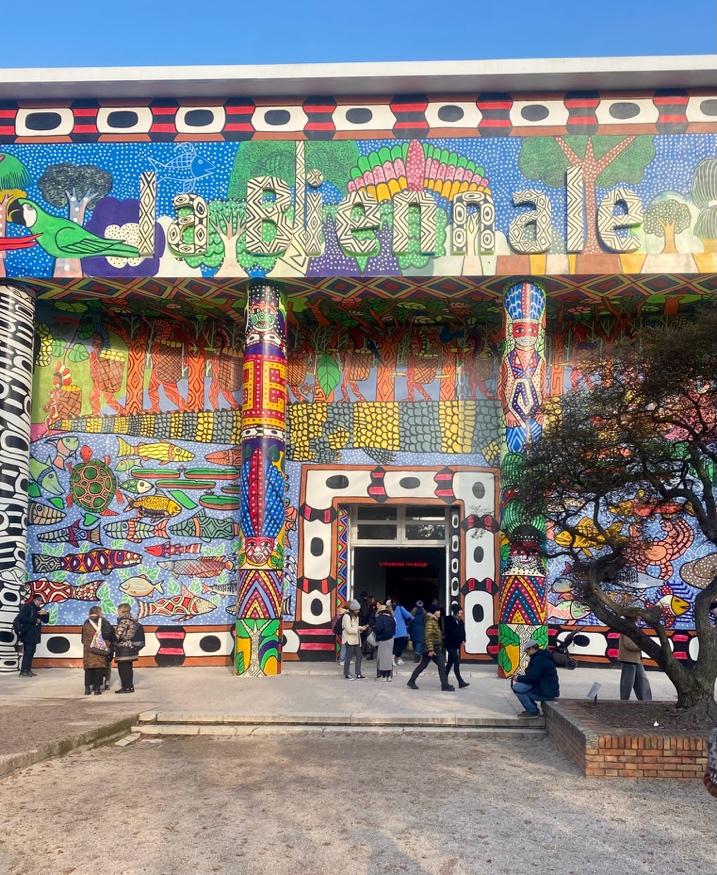
The first, and most visible, moment in Foreigners Everywhere constructed the Indigenous in spiritual terms, that is, a cultural whole expressed through non-Western, non-monotheistic cosmological systems. Probably the most prominent work expressing this cosmological otherness was the mural painted by the collective MAHKU (Movimento dos Artistas Huni Kuin) on the facade of the Central Pavilion in the Giardini (see Figure 1). The Huni Kuin are an Indigenous people living in settlements along the Peru-Brazil border. According to the Biennale’s description, MAHKU “painted the story of kapewë pukeni (the alligator bridge),” a myth describing “the passage between the Asian and American continents through the Bering Strait,” connecting “the visible aspects of their art to the invisible nature of their visions through the association and translation between traditional village practices and the parameters and conventions of the art world.”28
This cosmological imagination from Amazonia extended to other artists and works, including Joseca Mokahesi’s drawings of myths, André Taniki’s shamanistic visions, and Santiago Yahuarcani’s depictions of ancestral deities and jungle motifs. These works framed indigeneity in terms of spiritual and stylistic independence from Western modernity, presenting distinct ways of life requiring preservation, reflection, and historization.
The MAHKU mural attracted particular attention due to its prominent placement at the entrance of the Giardini’s Central Pavilion and its highly photographable nature. Yet beyond its visual appeal, we must question how such Indigenous representation can transcend aestheticized storytelling when these complex cosmologies are inevitably reduced to a few images and brief descriptive texts.
We can extend this question to the second moment of Indigenous practice in Foreigners Everywhere, which placed more emphasis on “objects” as aesthetic and storytelling devices. These objects were aesthetically diverse but shared a consistent exhibitionary purpose, what I shall call the “archaeological-metonymical” approach. As archaeological items, Indigenous objects assumed specific functions (cultural, technical, aesthetic) within their societies (e.g., Julia Isídrez29 and Bolivian Pavilion30), while as metonymical items they served as microworlds offering glimpses into various Indigenous cultures (e.g., Mataaho Collective31 and Jeffrey Gibson32).
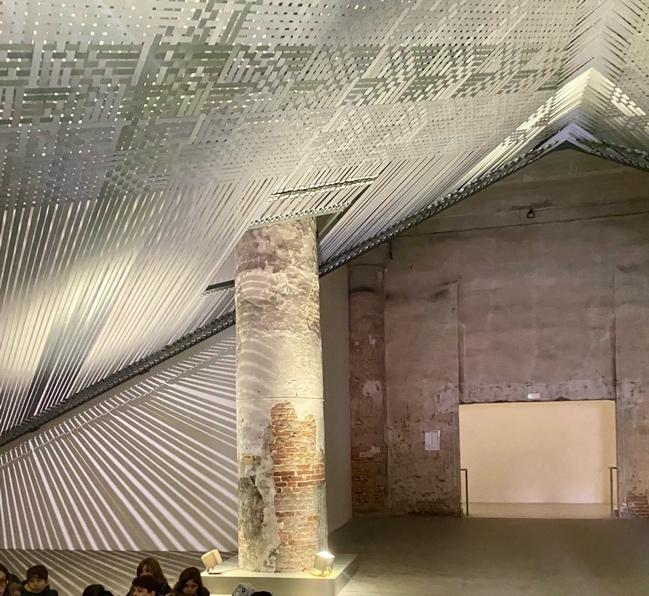
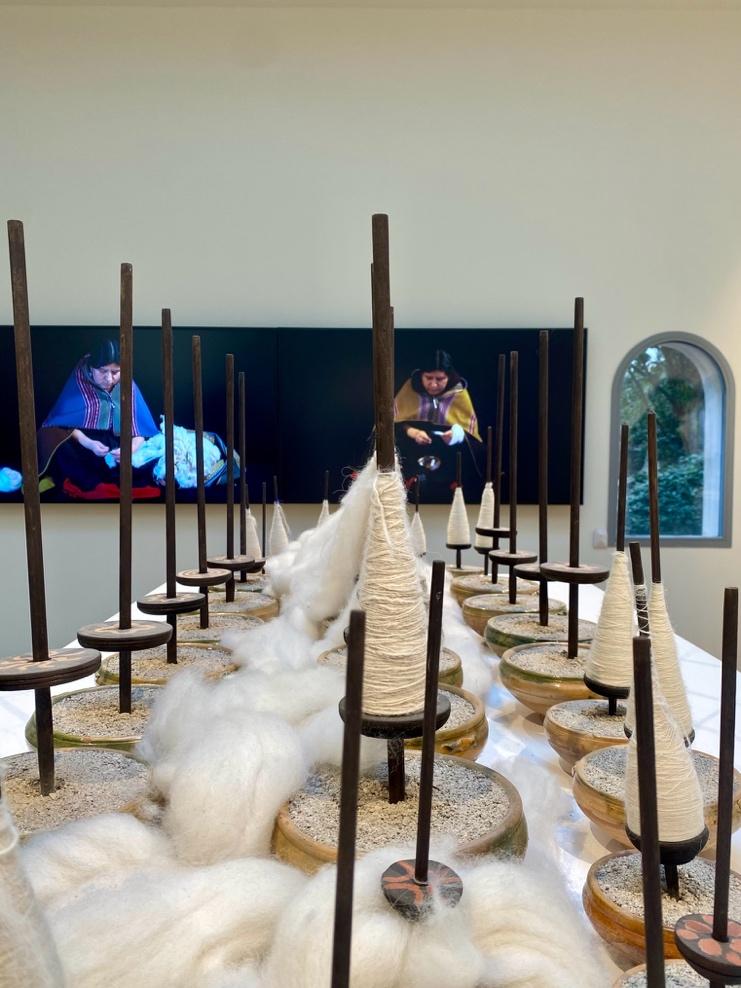
The descriptions of these archaeological-metonymical objects consistently emphasized technique and related concepts of toil, collectivity, and manual labor, establishing symbolic differentiation from industrialized (post)conceptual art. Indigenous labor was framed as collective or transgenerational, signalling a departure from the individual artist model in favor of collaborative creation. The Mataaho Collective from Aotearoa/ New Zealand—winner of the Golden Lion for best participant in Pedrosa’s curated exhibition—exemplified this with Takapau (2022) (see Figure 2), a vast, meticulously woven installation greeting visitors in the Arsenale. Referencing traditional birth-giving mats, the prize committee praised it as “a feat of engineering . . . made possible by the collective strength and creativity of the group”, while noting its archaeological dimension as referencing “matrilinear textile traditions . . . hark[ing] back to ancestral techniques.”33 Individual Indigenous artists were similarly framed through transgenerational labor. Julia Isídrez, for instance, was presented as a “Guaraní Indigenous artist and ceramicist who learned pottery from her mother,” where tradition’s transmission appears valuable to Guaraní culture. Isídrez here emerges as a craftsperson sustaining authentic tradition amid post-traditional cynicism. This archaeological narrative extended to Bolivia’s pavilion, where objects functioned less as artworks than as indices of an Indigenous way of life (see Figure 3).34
The third moment of Indigenous representation refers to “alternative modernisms,” where Indigenous artists are positioned within (Western) art history rather than principally being framed as carriers of distant and authentic practices. Here, the Indigenous assumes the autonomy characteristic of individual modern artists, developing an aesthetic language that converses with modern cultural and aesthetic repertoires.
The cases of alternative Indigenous modernisms are several, with many relating to the medium of painting. For instance, Selwyn Wilson is presented as “a founding figure of Māori modernism,” the “first Māori to graduate from a New Zealand art school,” and whose “Study of a Head is the first contemporary Māori artwork to enter any art collection in New Zealand.”35 Wilson inhabits an alternative modernity—a Māori modernity—that depends on yet remains relatively independent from Kiwi modernism, that is, already a peripheral Western modernism.
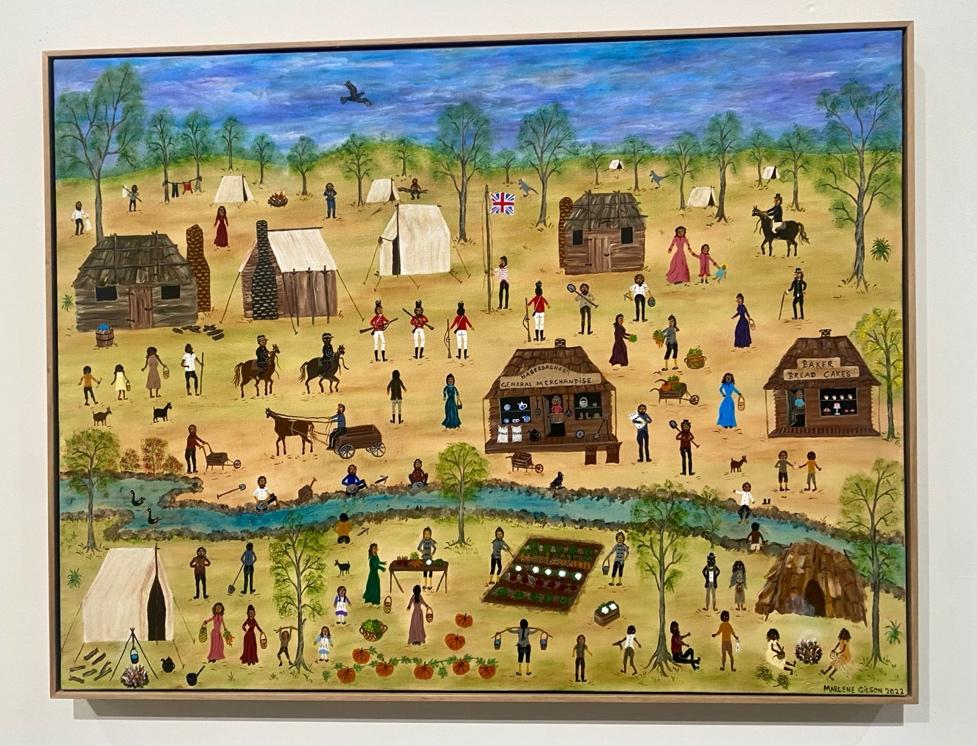
Other examples include Sandy Adsett’s paintings with colorful patterns, “interpreted as geometric abstraction” (a typical art historical rather than Māori category); Emmi Whitehorse’s non-figurative works responding to oil extraction on native Navajo lands, described as “abstracted large-scale poetic landscapes of the US Southwest;”36 and Marlene Gilson’s works that “redress the art historical record that has rendered Aboriginal people, communities, and culture absent”37 (see Figure 4). These paintings function as objects in the art historical sense insofar as they claim space to intervene in contemporaneity—here, the Indigenous shapes history rather than merely urging preservation or indexing a non-modern socio-spiritual life.38
The fourth moment of Indigenous representation at the 60th Venice Biennale refers to memory, particularly political memory. This is best exemplified by Archie Moore’s full-room installation kith and kin, which won the Golden Lion for best national pavilion (representing Australia). kith and kin features Moore’s hand-drawn family tree in chalk on blackboard walls set around the Australian pavilion, documenting his multi-year journey of tracing Aboriginal ancestry. Through archival and digital research, Moore claims to have mapped more than 65,000 years of family history—the tree serving, in his words, as “proof of identity—evidence of my Aboriginality.”39 The drawing is punctuated by several large holes symbolizing disruptions: colonial massacres, forced removals, and other violences that created gaps in personal and collective history. At the room’s center, Moore displayed archival records of First Nations incarcerations, demonstrating how colonial legislation systematically targeted Indigenous peoples. The work thus intertwines familial memory with institutional documentation of discrimination, revealing colonialism’s structural rather than incidental violence.
This framing presents indigeneity in explicitly political terms, contrasting with other Biennale representations. Here, the Indigenous emerges as an agent of historical reckoning, using modernity’s own documents to expose colonial systems designed for dispossession—institutions that, rather than embodying progress, enabled and normalized violence.
Between Visibility and Fetish
The activation of Indigenous agency within the Venice Biennale’s cultural-political economy produces a tension: while the exhibition platform enables unprecedented visibility for Indigenous artists and narratives, this visibility is inevitably mediated by the institution’s gatekeeping technologies and market logics. The four framing moments I have examined—cosmologies, objects, alternative modernisms, and memory—make indigeneity empowered yet at the same time constrained by the Biennale’s gatekeeping technologies. What then does the Biennale do in relation to Indigenous art and the ways it is received, circulated, and assigned value beyond the exhibition in the social world?
Most definitely, as the symbolic value gained by exhibiting in the Venice Biennale can be converted to economic value, the Biennale’s speculative economy manifests most visibly in the art market’s response, that is, in an increase in prices. In an article for The Art Newspaper, Georgina Adam asks whether the artworld adage “See in Venice, buy in Basel”40—referring to how the hypes that the Venice Biennale sets pick up in the famous Basel art fair that follows—holds water vis-à-vis Indigenous art. Many of these artists, for Adam, were known locally but “just lacked the international exposure;” for instance, Isídrez’s prices are now “ten times higher than 18 months ago.”41 This market conversion reflects how the Biennale has the capacity to transform indigeneity into a legible category of investment, where authenticity as a symbolic currency translates to an economic one.
This speculation in prices depends on how the category of “Indigenous art” is mobilized to perform authenticity. This was evident in the framing mechanisms around “Indigenous bios” employed in Foreigners Everywhere, particularly their emphasis on artists’ origins and identities, which, while validating Indigenous perspectives, also commodifies these very perspectives. Minority and especially Indigenous artists have to manifest (at least some) identitarian authenticity for their art to be truer, a requirement ostensibly less present in other artists’ descriptions. In Foreigners Everywhere, nearly all Indigenous artists were framed in terms of how their cultural identity relates to their work; the examples are numerous: “Kay Walking Stick, born to a mother of Scottish–Irish descent and a Cherokee father . . . [reinscribes] Indigenous presence onto a history;”42 “Emmi Whitehorse, a Diné Indigenous artist . . . highlights the native ecologies using a traditional Diné/Navajo concept known as Hózhó;”43 “Joseca Mokahesi was born in the Brazilian Amazon and lives in the Watoriki (windy mountain range) community, located in the Yanomami Indigenous lands”;44 “Marlene Gilson is a Wathaurung/Wadawurrung Elder and Traditional Owner . . .”45 This identitarian framing is double-edged insofar as on the one hand it turns the spotlight to Indigenous histories, yet on the other hand, it does so within a regime of speed where identity is necessarily fetishized rather than its complexities learned or reflected upon.
This spectacularization follows certain patterns. In both the moments of “cosmologies” and “objects,” Indigenous practices prioritize preservation, that is, the restoration of threatened cultures, spiritual and material. These can produce the Indigenous as somewhat frozen in time, a relic whose cultural tropes need to maintain this authenticity or identitarian continuity. The Indigenous in these two moments inhabits contemporaneity insofar as it is anchored in tradition, not because it experiments with or negates this tradition, as is the case with European avant-gardes. The Indigenous tradition is different from what is regarded in Global North settings as universal tradition, that is, European tradition, insofar as Indigenous tradition occupies a static temporality, a sacred cosmology that the Indigenous can hardly afford to negate—or even if they do, Biennale viewers are not informed about it. Yet this very fetish offers viewers a consoling hope—that somewhere a glimpse of uncontaminated otherness, a radical difference, still persists across the world’s sprawling uniformity. The motifs of feathers, beads, and textiles interweaving with alternative cosmologies, spiritualities, and deities excite a faraway curiosity by being almost definitely unfamiliar territories to the average Biennale viewer, who mostly comes from a rather class-privileged background. Here, the Indigenous other hinges upon a decontextualized simplification that, even if appearing to critique colonialism (as with MAHKU’s mural or Mataaho Collective’s installations), their display within the Giardini’s colonial setting marks them as spectacles of difference.
The moment of Indigenous modernisms, in turn, inserts Indigenous identities within an already legible discussion across the field’s vocabularies, insofar as it converses with art historical territories. Modernisms then grant the Indigenous a sense of contemporaneity, which, on the one hand, unfreezes these communities from historical burdens but, on the other, may subsume the Indigenous within the broader project of Western artistic modernity. In this project, there is already an established hierarchy of styles, masters, and tropes so that the value of alternative Indigenous modernities appears as a dialogical deflection from the original, valorizing what they do differently from the core and thus first and foremost valorizing the core itself. The framing of figures like Selwyn Wilson or Sandy Adsett then demonstrates that while Indigenous modernisms can remake rather than reject Western paradigms, this framing may carry its own erasures; when Whitehorse’s works become abstracted landscapes or Gilson’s paintings redress art history, their specific cultural contexts risk being subsumed by the Western universalizing gaze. In turn, the moment of memory, exemplified in Archie Moore’s kith and kin, is the most vividly empowering insofar as it produces both Indigenous artistic and political agency, employing lyricism to expose colonial violence. The fact that this critical archival intervention was presented within Australia’s pavilion shows this country’s effort to reckon with its colonial past yet in a (lyrical) way that implies rather than makes manifest colonial violence. We do not see what these holes or documents did to real people, but we are invited to imaginatively recollect their histories across hundreds of years. And again, the Biennale’s culture of speed, where visitors spend minutes absorbing 65,000 years of history, is not helping to provide any contextual understanding.
The Venice Biennale is a vast institution dependent on complex and often conflicting gatekeeping technologies, with the hundreds of hours required pointing to a machine for accelerated consumption. It would thus be naïve to argue that in this predetermined context Indigenous artists are able to “occupy” the institution or even have the capacity to exploit this visibility without being consumed by it. In this light, Oswald de Andrade’s devouring of the metropolitan center mobilized by Pedrosa is a less convincing metaphor. In this overpowering setting, the political stakes are less about “Indigenous agency”—for example, how the Indigenous (self)represent—and more about the ways that the gatekeeping technologies upon which the political economy of the Venice Biennale operates are able to facilitate a more coherent space for Indigenous representation. A slower exhibition could offer the opportunity for a more educational and less spectacular understanding of Indigenous cultures. Or, even within the inherent spectacle of Venice, a more focused thematic representation of specific Indigenous territories and histories, rather than using a term that encompasses everything and nothing at the same time, could give space to the complexities of specific peoples. It is especially these complexities of Indigenous people, social, cultural, and economic complexities, that were flattened in Foreigners Everywhere.
Notes
- Adriano Pedrosa, “Introduction,” La Biennale di Venezia, https://www.labiennale.org/en/art/2024/introduction-adriano-pedrosa ↩
- Pedrosa, “Introduction.” ↩
- Donna J. Haraway, “The Promises of Monsters: A Regenerative Politics for Inappropriate/d Others” in Cultural Studies, ed. Lawrence Grossberg, Cary Nelson, and Paula A. Treichler (Routledge, 1992), 295–337. ↩
- Pedrosa, “Introduction.” ↩
- For information on the Sámi Pavilion, see https://oca.no/thesamipavilion. On Jaider Esbell’s participation in Venice Biennale (2022), see https://www.labiennale.org/en/art/2022/milk-dreams/jaider-esbell. ↩
- Larissa Buchholz, The Global Rules of Art: The Emergence and Divisions of a Cultural World Economy (Princeton University Press, 2022). ↩
- See, in particular, Pierre Bourdieu, The Rules of Art: Genesis and Structure of the Literary Field (Stanford University Press, 1996); Andrea Fraser, 2016 in Museums, Money, and Politics (MIT Press, 2018); and Chin-tao Wu, “Biennials Without Borders?,” New Left Review II/57 (May/June 2009): 107–15. ↩
- Buchholz, The Global Rules of Art. ↩
- I use here “technology” in the Foucauldian sense as a framework for conceptualizing operations of power, a dispositif that strategically arranges discourse, institutions and practices. ↩
- Vittoria Martini described the politics of Venice Biennale closer to NATO rather than the UN as they rely on geopolitical alignments. Vittoria Martini, “Art Has Nothing to Do with the UN: Internationalism as Rhetoric at the Venice Biennale,” Verso Blog, May 2026, https://www.versobooks.com/blogs/news/art-has-nothing-to-do-with-the-un-internationalism-as-rhetoric-at-the-venice-biennale?srsltid=AfmBOopSSII-. ↩
- Vittoria Martini, “Art is Not an Innocent Field: Reflection on the Borders of the Venice Biennale” in Routledge Companion to Art Biennials, ed. Panos Kompatsiaris (Routledge, 2026), 25–37. ↩
- Okwui Enwezor, interview by Michelle Kuo, “Okwui Enwezor Talks with Michelle Kuo about the Upcoming 56th Venice Biennale,” Artforum, May 2015, https://www.artforum.com/columns/okwui-enwezor-talks-with-michelle-kuo-about-the-upcoming-56th-venice-biennale-223829. ↩
- While the pavilion was built in 1932, Egypt started using it from 1955 onwards. ↩
- “Qatar covers Venice with money: 50 million to the municipality. Here’s what it will get in return,” Finestre Sull’ Arte, July 29, 2024, https://www.finestresullarte.info/en/news/qatar-covers-venice-with-money-50-million-to-the-municipality-here-s-what-it-will-get-in-return. ↩
- Clarissa Ricci, “Biennials as administrative hubs of contemporaneity”in The Routledge Companion to Art Biennials, ed. Panos Kompatsiaris (Routledge, 2026), 485–94. ↩
- Vittoria Martini, “How La Biennale as a Brand was Born: Venice as the Archetype of a Biennial City,” OBOE Journal 1, no. 1 (2020): 100, https://doi.org/10.25432/2724-086X/1.1.0008. ↩
- Buchholz, The Global Rules of Art, 57. ↩
- For more information on these editions, see the 56th International Art Exhibition (https://www.labiennale.org/en/art/2015/biennale-arte-2015-all-worlds-futures) and 59th (https://www.labiennale.org/en/news/biennale-arte-2022-milk-dreams), respectively. ↩
- For more information, see https://www.ruangrupa.org. ↩
- Simon Njami, Gong Yan, and María Inés Rodríguez, “Documenta Resignation Letter,” e-flux, November 16, 2023, https://www.e-flux.com/notes/575919/documenta-resignation-letter. ↩
- Giulia Bellinetti,“documenta fifteen: continuities and ruptures in the epistemic impasse of an art biennial,” in The Routledge Companion to Art Biennials, ed. Panos Kompatsiaris (Routledge, 2026), 463–72. ↩
- See Anita Orzes, “Redefining the Biennial Aims and Model: Venice and Sao Paulo in a Shared Debate After the Outbreak of the Crisis (1968–1969),” in The Routledge Companion to Art Biennials, ed. Panos Kompatsiaris (Routledge, 2026), 76–88. ↩
- For more information, see https://www.saledocks.net. ↩
- United Nations, “Indigenous Peoples,” https://www.un.org/en/fight-racism/vulnerable-groups/indigenous-peoples. ↩
- FAO, “Indigenous Peoples in the Asia-Pacific region Factsheet on Indigenous Women for Asia and the Pacific,” Food and Agriculture Organization of the United Nations (2018), https://openknowledge.fao.org/handle/20.500.14283/ca2045en. ↩
- Hilary N. Weaver, “Indigenous Identity: What Is It, and Who Really Has It?” American Indian Quarterly 25, no. 2 (Spring 2001): 240, https://www.jstor.org/stable/1185952. ↩
- United Nations, State of the World’s Indigenous Peoples, 2018, https://www.un.org/development/desa/indigenouspeoples/wp-content/uploads/sites/19/2018/03/The-State-of-The-Worlds-Indigenous-Peoples-WEB.pdf. ↩
- MAHKU (Movimento dos Artistas Huni Kuin), La Biennale di Venezia, 2024, https://www.labiennale.org/en/art/2024/nucleo-contemporaneo/mahku-movimento-dos-artistas-huni-kuin. ↩
- Julia Isídrez, Venice Biennale (2024) https://www.labiennale.org/en/art/2024/nucleo-contemporaneo/julia-isi%CC%81drez. ↩
- Bolivian Pavilion (2024) https://www.labiennale.org/en/art/2024/bolivia-plurinational-state. ↩
- Mataaho Collective, Venice Biennale (2024) https://www.labiennale.org/en/art/2024/nucleo-contemporaneo/mataaho-collective. ↩
- Jeffrey Gibson, Venice Biennale (2024) https://www.labiennale.org/en/art/2024/united-states-america. ↩
- Biennale Arte 2024: official awards, La Biennale di Venezia, 2024, https://www.labiennale.org/en/news/biennale-arte-2024-official-awards. {Italics by author.} ↩
- For this 60th Venice Biennale, Russia allowed the Bolivian Pavilion to temporarily move in its prestigious location (Russia did not participate as a result of the Ukraine war). This gesture highlights the fact discussed above, that is, how the gatekeeping technologies and colonial architectures of Giardini offer symbolic currency that can be exchanged in choreographies of diplomacy, capital, and prestige. ↩
- Selwyn Wilson, La Biennale di Venezia, 2024, https://www.labiennale.org/en/art/2024/portraits/selwyn-wilson. ↩
- Emmi Whitehorse, La Biennale di Venezia, 2024, https://www.labiennale.org/en/art/2024/nucleo-contemporaneo/emmi-whitehorse. ↩
- Marlene Gilson, La Biennale di Venezia, 2024, https://www.labiennale.org/en/art/2024/nucleo-contemporaneo/marlene-gilson. ↩
- In this category we could include Jeffrey Gibson as well. ↩
- Archie Moore, interview by Vivienne Chow, “‘Now I Know How Michelangelo Felt’: Archie Moore on Drawing 65,000 Years of Indigenous History,” Artnet News, April 22, 2024, https://news.artnet.com/art-world/archie-moore-venice-biennale-golden-lion-interview-2500717. ↩
- Georgina Adam, “Will Indigenous Artists See a Venice Biennale Boost at Art Basel?,” The Art Newspaper, June 10, 2024, https://www.theartnewspaper.com/2024/06/10/will-indigenous-artists-see-a-venice-biennale-boost-at-art-basel. ↩
- Georgina Adam, “Will Indigenous Artists See a Venice Biennale Boost at Art Basel?” ↩
- Kay Walking Stick, La Biennale di Venezia, 2024, https://www.labiennale.org/en/art/2024/nucleo-contemporaneo/kay-walkingstick. ↩
- Emmi Whitehorse, La Biennale di Venezia, 2024. ↩
- Joseca Mokahesi Yanomami, La Biennale di Venezia, 2024, https://www.labiennale.org/en/art/2024/nucleo-contemporaneo/joseca-mokahesi-yanomami#:~:text=Joseca%20Mokahesi%20was%20born%20in,landscapes%20from%20his%20people’s%20universe. ↩
- Marlene Gilson, La Biennale di Venezia, 2024. ↩
