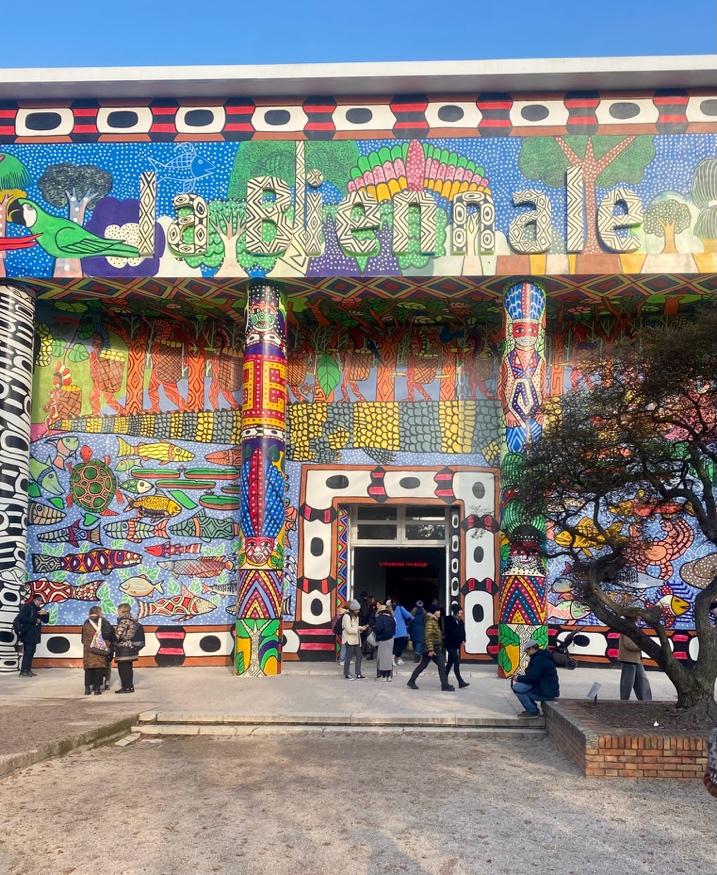
The 60th Venice Biennale, Foreigners Everywhere, placed the figure of the foreigner at its center, drawing on Adriano Pedrosa’s curatorial idea that foreignness is a pervasive condition of human existence. Within a broad spectrum of “minoritarian foreigners,” the “Indigenous” emerged as a particularly charged symbolic figure. This article situates the Biennale as a global institution whose strategies of expansion and rarefication sustain its symbolic power, examining four “framing moments” of Indigenous representation in the 60th edition: cosmologies, objects, alternative modernisms, and memory. These framings variously spiritualize, aestheticize, historicize, and politicize Indigeneity, producing visibility around Indigenous cultures in an exclusive environment where viewership is characterized by cultures of speed. The article argues that the institutional framing of Indigenous artists’ biographies and traditions simultaneously validates and commodifies identity, with “authenticity” serving as symbolic and economic capital. While such visibility can create opportunities for recognition and market access, it also may fetishize and flatten heterogeneous Indigenous histories into a universalized category of “the Indigenous.” The article explores how the Biennale’s pursuit of global relevance depends on the spectacular inclusion of difference, a process in which otherness—and, here, Indigeneity—is made visible but also subject to institutional power and gatekeeping logics. Reading the Indigenous not only through the lens of representation but also as a symbolic actor within the exhibition’s cultural-political economy, the article concludes by reflecting on whether alternative curatorial strategies—slower, more focused, and territorially specific—can create space for Indigenous representation beyond spectacle, enabling forms of knowledge production that better acknowledge the diversity and historicity of Indigenous peoples.
Keyword: curation
Unsettling Political Economies: Instituting, Blurring, and Monstrous Space-Making
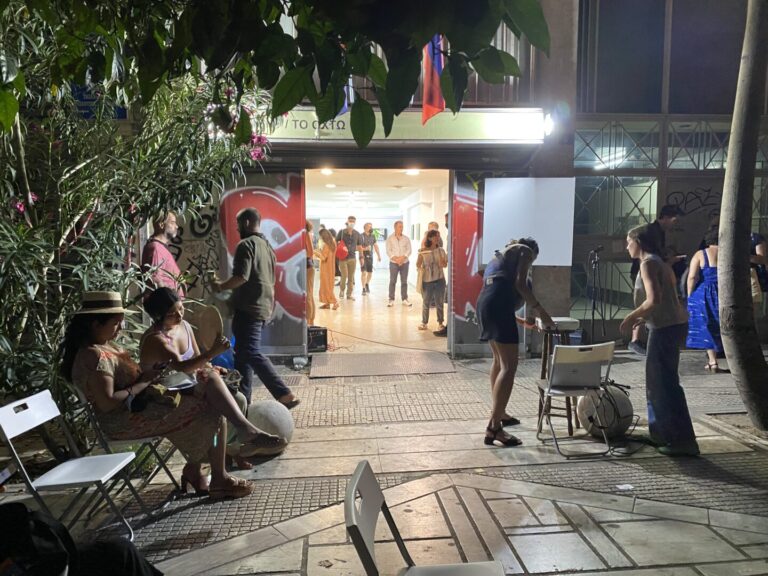
This article explores the ways in which emergent cultural space-making practices—particularly practices of “instituting,” “blurring,” and “monstrous space-making”—challenge and ephemerally unsettle political and economic systems. It focuses on the history of the cultural space, EIGHT Critical Institute for Arts and Politics, in Athens, Greece. The concept of “instituting” is discussed as a form of space-making that refuses structuralization, while “blurring” signifies a process of dissolving boundaries and categories to create fluid, unpredictable spaces that resist fixed identities. The notion of “monstrous space-making” is introduced as a method of excess and refusal, capable of disrupting dominant political economies. The article argues that these practices, rooted in modes of “militant curating” and critical spatial interventions, operate as performative acts of reconfiguration—offering ways to produce new relations, economies, and imaginaries within contested landscapes. It suggests modes of continuous, open-ended spatial interventions that do not seek to fix existing systems but to deform and reimagine them from within.
Editors’ Introduction

Reflecting on editorial labor, this introduction considers how the work of cultural studies can be furthered through community, amplification, and world-building. Advancing a curatorial, developmental model in contrast to a gatekeeping one, we consider what a horizontal approach to editing looks like in practice.