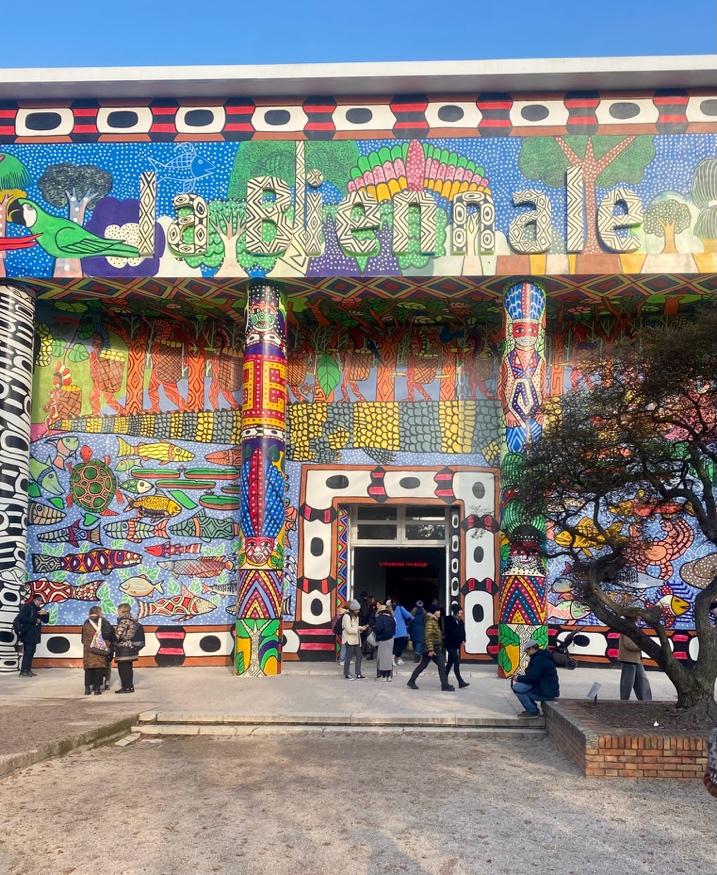
The 60th Venice Biennale, Foreigners Everywhere, placed the figure of the foreigner at its center, drawing on Adriano Pedrosa’s curatorial idea that foreignness is a pervasive condition of human existence. Within a broad spectrum of “minoritarian foreigners,” the “Indigenous” emerged as a particularly charged symbolic figure. This article situates the Biennale as a global institution whose strategies of expansion and rarefication sustain its symbolic power, examining four “framing moments” of Indigenous representation in the 60th edition: cosmologies, objects, alternative modernisms, and memory. These framings variously spiritualize, aestheticize, historicize, and politicize Indigeneity, producing visibility around Indigenous cultures in an exclusive environment where viewership is characterized by cultures of speed. The article argues that the institutional framing of Indigenous artists’ biographies and traditions simultaneously validates and commodifies identity, with “authenticity” serving as symbolic and economic capital. While such visibility can create opportunities for recognition and market access, it also may fetishize and flatten heterogeneous Indigenous histories into a universalized category of “the Indigenous.” The article explores how the Biennale’s pursuit of global relevance depends on the spectacular inclusion of difference, a process in which otherness—and, here, Indigeneity—is made visible but also subject to institutional power and gatekeeping logics. Reading the Indigenous not only through the lens of representation but also as a symbolic actor within the exhibition’s cultural-political economy, the article concludes by reflecting on whether alternative curatorial strategies—slower, more focused, and territorially specific—can create space for Indigenous representation beyond spectacle, enabling forms of knowledge production that better acknowledge the diversity and historicity of Indigenous peoples.
Keyword: cultural economy
Shit in Our Time: An Unsettling Epoch of Metabolic Disturbance
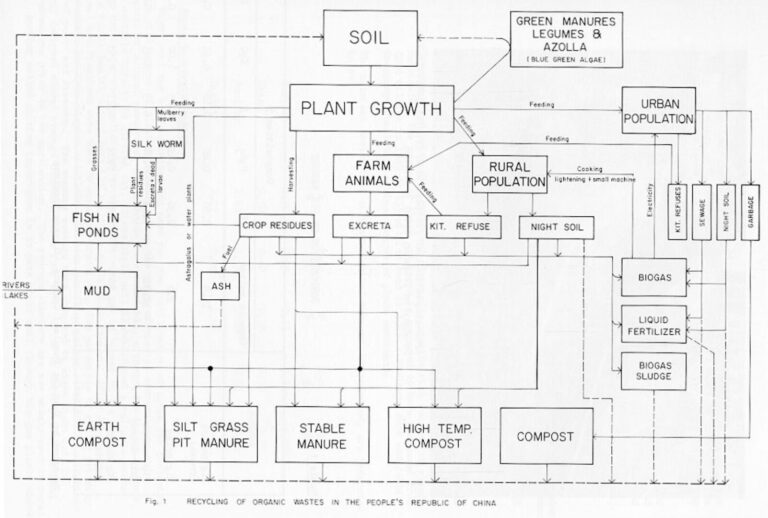
Human waste, often regarded as a source of disease, disgust and impurity, is being redefined as “humanure” by environmental activists, serving as a solution to land degradation in the midst of the anthropogenic crisis. Although a circular view that humans are not merely consumers of food but the producers for healthy soils has arisen, it can easily be overlooked. In China, the beneficial use of human waste, or “nightsoil,” for food production has a long history. Drawing from my mother’s intimate experience with humanure during the socialist era in China, I explore the metabolic politics of humans and soils. This politics reveals a unique cultural economy that was once constituted to complete a cyclic change from food production to consumption, intertwining the valuation method of humanure, toilet technologies, and the rural–urban exchange. I introduce the context of metabolic disturbance to rethink environmental sustainability in relation to the dynamics of our farming practice and sanitation/disposal system in China and beyond. I propose alternative ways to value human waste, aiming to nourish our civic imagination of food by transforming our metabolic relationship with soil, agriculture, food, and waste.