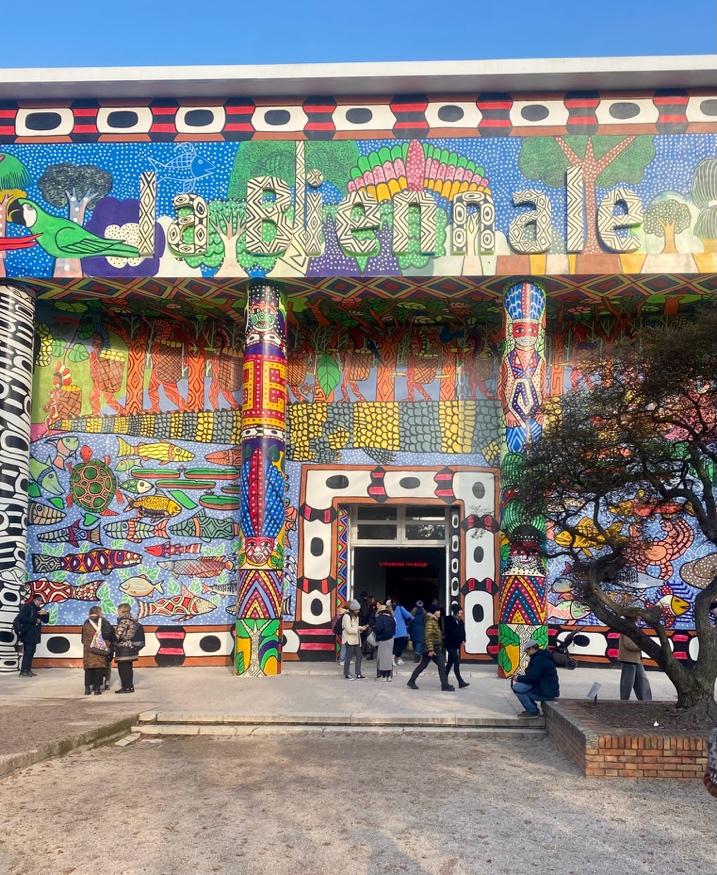
The 60th Venice Biennale, Foreigners Everywhere, placed the figure of the foreigner at its center, drawing on Adriano Pedrosa’s curatorial idea that foreignness is a pervasive condition of human existence. Within a broad spectrum of “minoritarian foreigners,” the “Indigenous” emerged as a particularly charged symbolic figure. This article situates the Biennale as a global institution whose strategies of expansion and rarefication sustain its symbolic power, examining four “framing moments” of Indigenous representation in the 60th edition: cosmologies, objects, alternative modernisms, and memory. These framings variously spiritualize, aestheticize, historicize, and politicize Indigeneity, producing visibility around Indigenous cultures in an exclusive environment where viewership is characterized by cultures of speed. The article argues that the institutional framing of Indigenous artists’ biographies and traditions simultaneously validates and commodifies identity, with “authenticity” serving as symbolic and economic capital. While such visibility can create opportunities for recognition and market access, it also may fetishize and flatten heterogeneous Indigenous histories into a universalized category of “the Indigenous.” The article explores how the Biennale’s pursuit of global relevance depends on the spectacular inclusion of difference, a process in which otherness—and, here, Indigeneity—is made visible but also subject to institutional power and gatekeeping logics. Reading the Indigenous not only through the lens of representation but also as a symbolic actor within the exhibition’s cultural-political economy, the article concludes by reflecting on whether alternative curatorial strategies—slower, more focused, and territorially specific—can create space for Indigenous representation beyond spectacle, enabling forms of knowledge production that better acknowledge the diversity and historicity of Indigenous peoples.
Keyword: immigrant
Cultural Space as Resistance: Racialized and Immigrant Communities’ Artistic Practices and the Political Economy of Urban Development in Canadian Cities
In Canada, Indigenous, racialized, and immigrant communities face systemic challenges in securing and sustaining cultural spaces due to real estate speculation, funding disparities, and exclusionary urban policies. These barriers not only threaten the continuity of cultural expression but also diminish the visibility and influence of marginalized artistic practices. This article explores how these communities resist spatial erasure through artistic interventions, grassroots activism, and alternative funding models, positioning their creative practices as sites of political-economic critique and creating alternative futures. The article emphasizes the connections between colonialism, anti-Black racism, and Islamophobia in contested cultural space dynamics.By mapping sites of artistic resistance and community-led cultural preservation, this article reveals the transformative potential of art as a tool for reimagining urban futures. It argues that sustainable multicultural urbanism requires policies that protect and invest in culturally significant spaces, recognizing them as vital components of both social infrastructure and political resistance. This article emphasizes the importance of recognizing culture as the fourth bottom line as part of urban development projects. The findings offer insights for policymakers, urban planners, and cultural organizations committed to fostering inclusive and equitable urban environments. Ultimately, this article contributes to the conversation on political economy and the arts by demonstrating how racialized and immigrant communities’ creative practices challenge dominant narratives of urban development, asserting their right to cultural sustainability and spatial justice.
Queer Provisionality: Mapping the Generative Failures of the Transborder Immigrant Tool

Alison Reed investigates the border- and boundary-crossing performance of Electronic Disturbance Theater 2.0’sTransBorder Immigrant Tool (TBT), an incomplete cell phone program that offers GPS, guidance, and poetry to those attempting to cross into the United States across the Mexico/US border. Reed suggests a provocation-based performance of “queer provisionality,” revealing the aesthetics of oppressive power structures by juxtaposing them to social utopias. Interrogating the national neoliberal project of both US liberalism and US conservatism, Reed’s essay is also a transcription of the performances launched around TBT, the social and political machinery set into motion by Electronic Disturbance Theater’s failed utopian project.