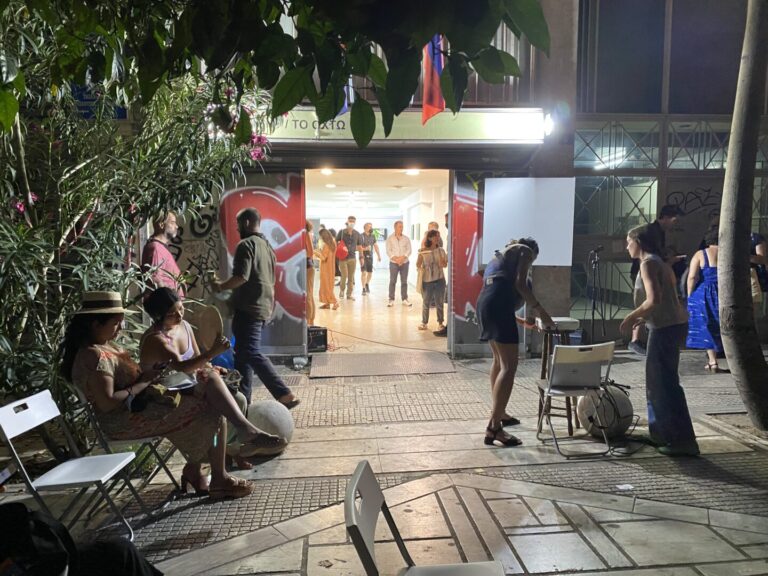
This article explores the ways in which emergent cultural space-making practices—particularly practices of “instituting,” “blurring,” and “monstrous space-making”—challenge and ephemerally unsettle political and economic systems. It focuses on the history of the cultural space, EIGHT Critical Institute for Arts and Politics, in Athens, Greece. The concept of “instituting” is discussed as a form of space-making that refuses structuralization, while “blurring” signifies a process of dissolving boundaries and categories to create fluid, unpredictable spaces that resist fixed identities. The notion of “monstrous space-making” is introduced as a method of excess and refusal, capable of disrupting dominant political economies. The article argues that these practices, rooted in modes of “militant curating” and critical spatial interventions, operate as performative acts of reconfiguration—offering ways to produce new relations, economies, and imaginaries within contested landscapes. It suggests modes of continuous, open-ended spatial interventions that do not seek to fix existing systems but to deform and reimagine them from within.
Keyword: grassroot
Sideways Fences: Resisting Gentrification in Boyle Heights, a Los Angeles Community

From the introduction of hipster IPA beer to fences that go sideways (instead of up and down), Oscar Arguello’s Sideways Fences (2017) explores the gentrification of Boyle Heights, a predominately Latino/a community near downtown Los Angeles. Sol, the main character, is pregnant and lives with her boyfriend Estéban, who drinks too much and spends his discretionary time fixing up a ’52 Chevy. Early in the play, Eva, Sol’s sister, crashes with the couple. The play centers around the trio’s stressed relationship and Sol and Estéban’s upcoming eviction, which is related to the creation of new condos. While at first glance the play appears to embrace common stereotypes including the wayward Latina (Eva) and the alcohol prone Latino, a closer analysis illuminates Arguello’s artistic layering of stereotypes to make legible the conditions/structures that produce the situations in which the trio find themselves.