Here, Katerina Paramana introduces the articles in the “Political Economy and the Arts” special section of this issue. In the current climate of geopolitical upheaval (from Ukraine, to Gaza, Iran, Venezuela, and Greenland), the articles illuminate what arts do to produce resistance at a micro level by re-writing problematic narratives, visibilizing marginalized communities, imagining alternative models and futures, and working towards equitable space-making.
Keyword: space-making
Unsettling Political Economies: Instituting, Blurring, and Monstrous Space-Making
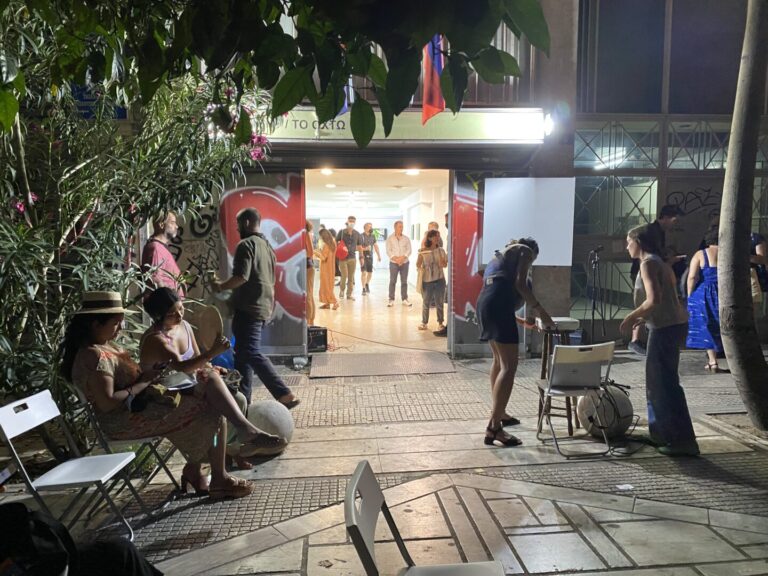
This article explores the ways in which emergent cultural space-making practices—particularly practices of “instituting,” “blurring,” and “monstrous space-making”—challenge and ephemerally unsettle political and economic systems. It focuses on the history of the cultural space, EIGHT Critical Institute for Arts and Politics, in Athens, Greece. The concept of “instituting” is discussed as a form of space-making that refuses structuralization, while “blurring” signifies a process of dissolving boundaries and categories to create fluid, unpredictable spaces that resist fixed identities. The notion of “monstrous space-making” is introduced as a method of excess and refusal, capable of disrupting dominant political economies. The article argues that these practices, rooted in modes of “militant curating” and critical spatial interventions, operate as performative acts of reconfiguration—offering ways to produce new relations, economies, and imaginaries within contested landscapes. It suggests modes of continuous, open-ended spatial interventions that do not seek to fix existing systems but to deform and reimagine them from within.