We’re in a new phase now. Or maybe we aren’t. It’s hard to have a sense of the tides when floating in choppy water. Or rather, what can we really tell about our historic moment by reading the news every day? It is a sort of mysticism—sorting and sifting through the headlines and leads trying to discern some new pattern, some turn or development that might make yesterday’s or last month’s or last year’s events somehow more meaningful or inconsequential. But the news of today has a sticky feeling to it, like we’ll be dealing with it long into the future. A toxic spill that will need remediation across a span of time that seems unimaginable. The half-life of today’s events is longer than we can currently think.
The work in this issue emerges in times that are troubling and overwhelming. This is not a new position for those working in cultural studies. Perhaps the defining feature today is a lack of clarity, a foggy sense of action and ideology. In the US this stems in large part from the White House and what seems to be the prevailing political strategy of doing something, saying something else, and then changing that messaging rapidly and without apparent concern for consequences. Whereas it is sometimes satisfying to point this out, the inconsistencies and incompetence are perhaps too obvious, maybe too profound, to not be a shrewd tactic in themselves. We are not writing about a single political party here.
This attitude towards state communication—brash, uncommitted to responsibility for upholding stated values, seemingly uninterested in a reputation for honesty or capable of follow-through of any specific agreements, plus blatantly self-serving—was at some point in time itself a kind of disruption of the status quo. It’s not like we could trust the apparatus before this “new phase,” yet it is disturbing how quickly we are becoming (or have become?) accustomed to these patterns of behavior and modes of discourse. The pretense of politics—as about the wishes of the people, as about anything other than powerful infighting—is coming to be treated as excess rather than requirement. It has been both tragedy and farce that recent administrations have protected someone who is not performing as we expect presidents to perform. Not to get too mired in US party politics. The figurehead problem exists in, emerges from, and shapes the same milieu as the rapid transformation of US political infrastructure; as one source reports, the “daily news can’t adequately convey the administration’s sabotaging of our government, economy, alliances and environment.”1 Indeed, something seems to be accelerating here.
The Long 2025
Beginning, perhaps, in the summer of 2024 with the obvious decline of US President Joe Biden and the public spectacle of an assassination attempt against candidate Donald Trump, we might identify then the most recent period as the “long 2025,” with the escalation of Immigration and Customs Enforcement (ICE) activity and then official “drawdown” in early 2026 marking a ragged end to the long year.2 The summer of 2024 was followed by a rush through a bizarre election campaign into a period engulfed by fascist imagery, AI pseudo-realism, and rapid-fire breaks from various norms, rules, and laws. There have been some attempts to hold it all together, to look back and offer some perspective. But for some of us, attempting to keep up with the news since the summer of 2024 has been like a kind of fever dream, with daily news and social media feeds pushing the bounds of credulity. For example, Wikipedia divides the year up by quarters and has nearly as many entries for events significant enough to be remembered as there are days in the year.3 Time Magazine attempted a similar appraisal at the end of 2025.4 Even as we live with the consequences, so much seems to have changed during the long 2025 that it is sometimes difficult to gauge our distance from it.
On the one hand, the events of this long 2025 are exceptional for their dissolution of the status quo. Yet on the other hand, the unpredictable and uncontrollable consequences of racial capitalism, fascism and US imperialism, and global climate devastation are not new to this period of history and have long established precedents.5 Perhaps what is new is that history is felt as uncontrollable. Popular attention to the events of the long 2025—varyingly chaotic, strident, exhausted, passionate, and/or overwhelmed—reflects a perceived transition “back into” history, in contrast to the early part of the twenty-first century which was shaped by a more widespread sentiment of the US’s permanent status as the center of global hegemony. The current “foggy sense of action and ideology” with which we began this introduction is in part a reflection of the dissolution of the felt-solidity of the turn of the millennium. This felt-solidity—inflected by what was experienced by some of the US public as trustworthy information, predictable supply chains, and thriving commodity fetishism—reflects a certain remove of US culture from history itself.
The Minnesota Conjuncture?
Amidst this, the long 2025 seemed to come to head with the so-called surge in ICE policing across the US and its borders, in the early parts of 2026. State-sponsored violence against immigrants continues, even as the news is now focused on other matters from the US midterm elections and gerrymandering to the price of gas and the US–Israel war on Iran—all of which might eventually become legible as perhaps a new turn in the recent political trajectory. Treating the Minnesota winter of 2026 as a conjuncture, we can examine the elements that inform and constitute it.
Following noted accelerations in Los Angeles, Chicago, and New York by the US pseudo-police ICE, in December 2025 Minneapolis and St. Paul, Minnesota (the “Twin Cities”) became a hotbed of militarized state-sanctioned xenophobic violence. At first approximately 1,000 and by January more than 3,000 federal ICE employees arrived in the Twin Cities to stay at hotels around the Mall of America, eat at Hooters and Chipotle, and rent luxury SUVs—equipped with fake plates under the auspices of the Minnesota DMV. Through January they indiscriminately snatched up Black, Brown, Asian, and Indigenous Minnesotans as well as random protestors; they smashed windows and broke down doors to drag people from their cars and homes to the Whipple Building (located near the MSP Airport and historical Fort Snelling) or to local collaborating jails such as the Sherburne County Jail. These detainees were held without charge, with no medical attention and in abysmal conditions, for as long as federal agents could keep them. While hundreds were taken by bus caravan to the nearby airport and flown to more long-term detention facilities in other states, many more were released within a handful of days. The arrests may have served other purposes from surveillance to biometric collection, but they may also have simply been a form of intentional disruption, an exertion of power, a flex of carceral infrastructure, and/or a test of what they could get away with.
Cultural responses to the surge ranged. The most prominent was the attention and action of a wide swath of Minnesotans, influenced by existing (more and less formal) local activist groups, and in consultation with and inspiration from other organizing already happening nationwide. Among those activated were a variety of people with diverse interests and goals, from influencers looking to capitalize on the views, to violent alt-right counter-protesters, to established community political organizations. But importantly (and predominantly) it was soccer moms and biker dads and nonbinary auncties and Catholic clergy and college students and military veterans and farmers and off-duty nurses and grandpas in plaid jackets and grandmas in snow suits and neighbors and everyone else who didn’t want a military incursion into their neighborhoods. The cultural response was, in short, Minnesotans—delivering groceries, sheltering in place, yelling in the streets, recording ICE activity, throwing winter block parties, putting up blackout curtains, connecting neighbors with resources, standing outside detention centers, crying on each others’ shoulders, staying calm-voiced on the group call in crisis after crisis, mourning, and dancing, and blowing whistles in the snow. And there was some national media attention, which increased dramatically after the murders of white protesters Renée Good and Alex Pretti. There were mass protests in Minnesota on January 23 and nationally on January 30. By February 12, national media reported on Trump’s border czar’s announced drawdown from Minneapolis: a change in tactics and narrative, and as a result a change in public discourse about and understanding of ICE, immigration, and the people of Minnesota.
Culture in Response
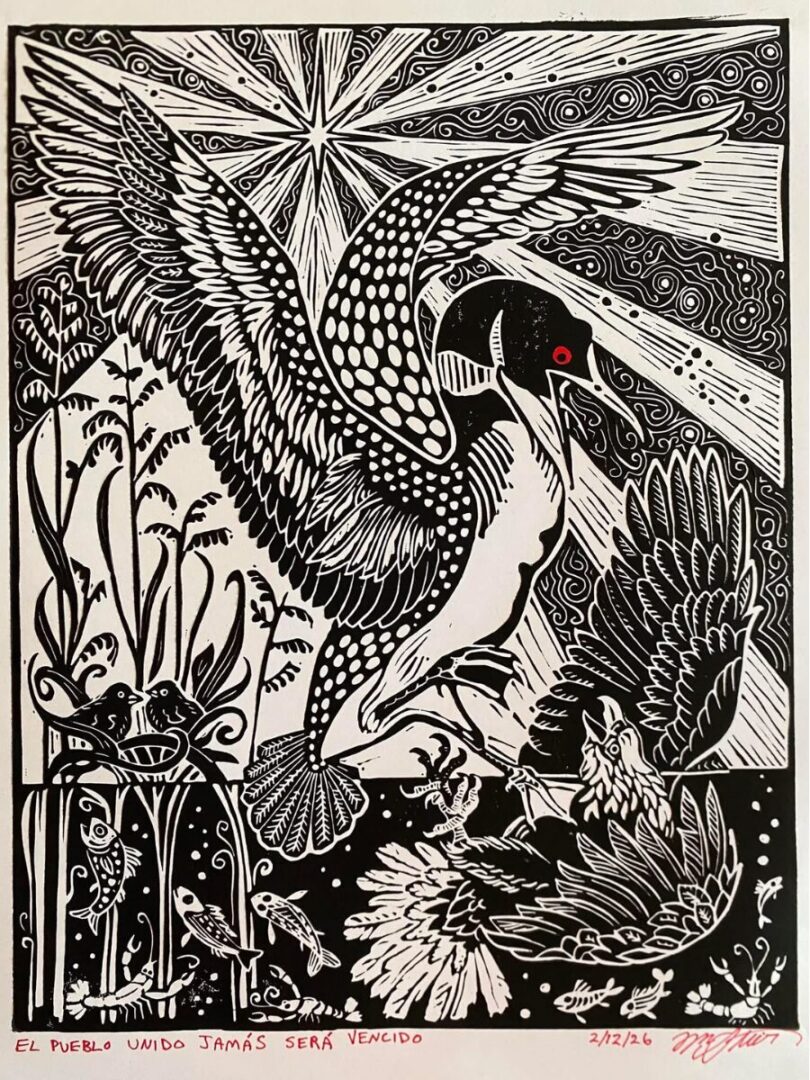
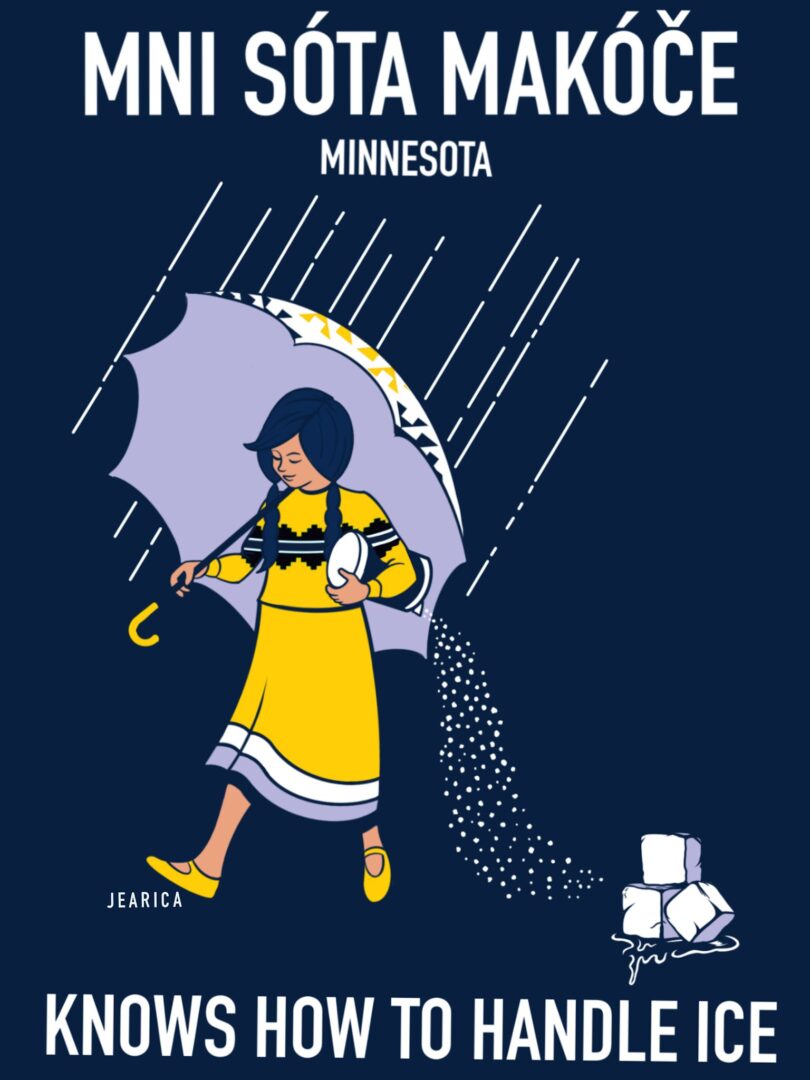
There have been an enormous number of cultural artifacts created in response, including art, speeches, documentaries, podcasts, and information-sharing documents. One prominent image is the Rebel Loon, the Minnesota state bird flying under the north star also depicted on the state flag, its red eyes amplified. A community project is archiving some of the many depictions that have been made of the symbol, as well as other resistance imagery (see Figs. 1 and 2).6
Musical responses prove particularly interesting. Local publisher MinnPost compiled over fifty new protest songs across two lists, plus compilation albums from musicians both internationally known and very local to the Twin Cities.7 Many of the songs have videos and are available on YouTube.8 One such video features a crowd of Minnesotans packed into the storied music venue First Avenue, singing/screaming the lyrics to Rage Against the Machine’s anthem “Killing in the Name Of” as Tom Morello plays the guitar.9 The songs are compiled and shared and seem to proliferate.10 They are played on local radio and linger now months after the height of the “Metro Surge” phase of militarized incursion, protests, and state murders. It’s a reminder, perhaps, that music has a way of sticking around, something we all know, of course, if you have ever listened to a classic rock station playing protest songs from the 1960s and 70s.
On the national stage (of the National Football League, no less), Bad Bunny’s Super Bowl LX halftime performance undoubtedly speaks to the possibilities of musical intervention into the larger cultural narrative around ICE and US imperial power in February 2026. Rich in imagery of Puerto Rican culture and resistance, the performance celebrates Latinae and pan-American culture, a stark contrast to the notion of borders and narratives of exclusion on which anti-immigrant sentiment depends. Bad Bunny, himself critical of ICE on past occasions, looks directly into the camera at one point to say:
Mi nombre es Benito Antonio Martínez Ocasio, y si hoy estoy aquí en el Super Bowl 60, es porque nunca, nunca dejé de creer en mí. Tú también deberías de creer en ti. Vales más de lo que piensas. Confía en mí.
(My name is Benito Antonio Martínez Ocasio, and if I’m here today at Super Bowl 60, it’s because I never, ever stopped believing in myself. You should also believe in yourself. You’re worth more than you think. Trust me.)
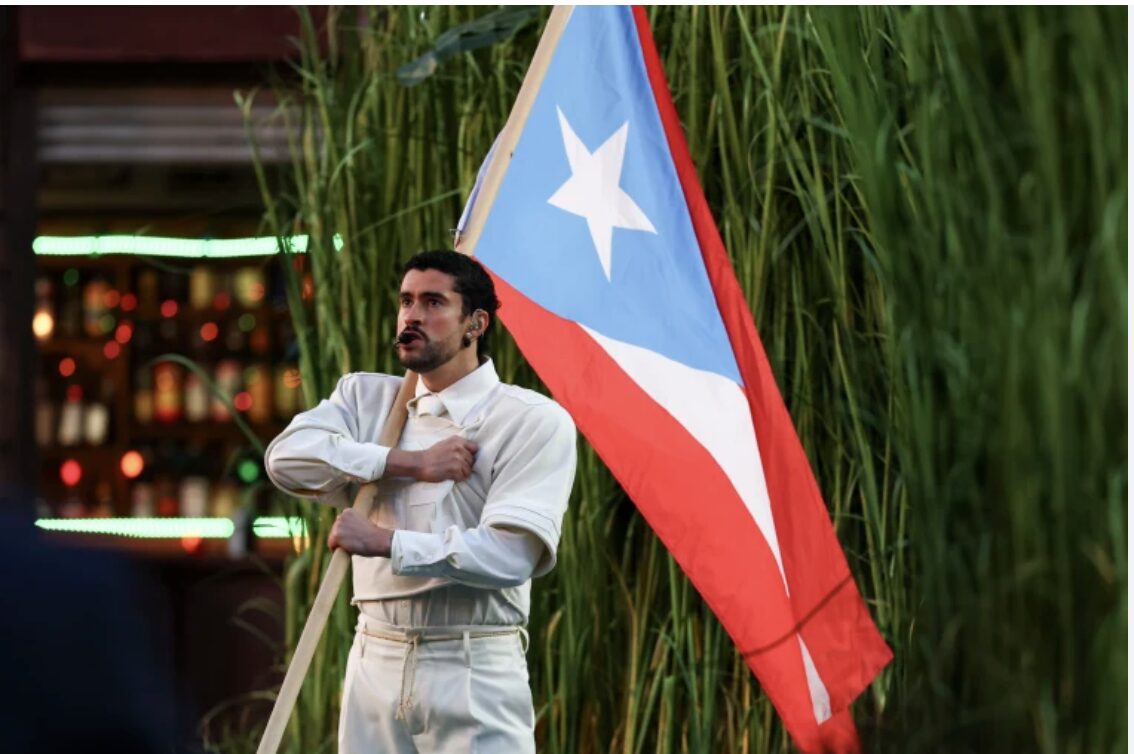
Later in the halftime show, Ricky Martin performs “Lo que le pasó a Hawaii,” a reminder of the extraction and exploitation perpetrated upon Hawai’i, the most recent state admitted into the US and an ongoing site of settler colonialism. The halftime show ends with a procession of flags from across the continent, ordered and named from south to north, culminating with the statement, “Seguimos aqui” (“We are still here”). Lest we get distracted by the cultural attention to the most visible forms of resistance, survival and life within an antagonistic state is the most essential and widespread direct action. Vitally, it’s not only music that sticks around; people, too, persist.
In the days after the January 24, 2026 murder of Alex Pretti, musicians including Joan Baez, Billy Bragg, Patti Smith, Bruce Springsteen, Jesse Welles, U2, and others responded with songs mustering international attention. Springsteen’s “The Streets of Minneapolis” resonates sonically and politically with 1960s-era American folk rock. With an emphasis on the one hand on President Trump and his appointees as well as the overreach of the DHS, and on the other on the scrappy residents facing down over-inflated infrastructures of violence with only their own “blood and bones, and these whistles and phones,” the song highlights the disproportionate positions and stakes between state power and the people’s resistance. It’s pop music with an explicit political agenda, a summoning of group strength and hope.11
Minneapolis musician Geoffrey Lamar Wilson (as part of the band LAAMAR) sings a powerful ode to Renée Good—who was murdered on January 7, 2026—and the resistance in “Who Is She to You.”12 With lyrics that alternate between addressing himself, people threatened by ICE activities, fellow activists, and, in the more urgent and rapid chorus, even a hypothetical ICE agent, LAAMAR urges the listener to reflective engagement. He concludes with a potent and purgative repetition, referencing perhaps the car in which Good was shot, or perhaps the resistance movement as a whole: “Drive it like you mean it. Drive it like you mean it, pedal to the floor. Drive it like you mean it. Drive it like you mean it, we ain’t scared no more.”
Billy Bragg’s “City of Heroes” also sounds like his classic work, although with Bragg the explicit political message comes as no surprise: “City of Heroes” critiques the spread of fascism rather than a single US American political party.13 Through tight comparison between current and historical Nazi power-building the first half of the song structures an incrementalist suppression of resistance made possible by group silence and inaction. The bridges celebrate the Twin Cities as a site of belonging and collective witnessing, leading to the chorus’s repetition of “I got in their face,” a call to simple but meaningful and direct action. Like Bragg, listeners are roused to get in the face of those who commit any act of oppression.
And there are many others. “Blacked Out Ford,” has Minnesota band Roe Family Singers crooning over a washboard rhythm about a common ICE intimidation tactic, deriding other ICE misbehavior and celebrating standing up to them.14 Queer punk Doll Chaser screams, on behalf of many Twin Cities residents, that “cowards playing cops in SUVs” need to “get the fuck out.”15 Both songs embrace lyrical action, warning fascists to “expect my resistance” (in the case of the Roe Family Singers tune) or that they’ll “leave with new holes” (in the case of the Doll Chaser). And punk stalwarts NOFX and Dropkick Murphys have joined the chorus, the former with the song “Minnesota Nazis” and the latter as part of “Punk and Hardcore against ICE.” Dropkick Murphys—along with Boston hardcore band Haywire—growl “no accountability, and violence every day” about masked agents of terror on “Citizen I.C.E.”16 The number of songs keeps growing, doing the fundamental cultural work of expressing, and perhaps spreading, the affectivity that precedes them.
In This Issue
Kathy Carbone’s article “Documenting Displacement Through Art: Participatory Digital Archiving as Resistance and Solidarity” chronicles and theorizes the collaborative archival work of The Amplification Project: Digital Archive for Forced Migration, Contemporary Art, and Action. The project emerges from the poignant observation that “Archives primarily contain records about refugees rather than by refugees.” The Amplification Project counters through a web-based archive of materials that offer a view toward migrant and refugee life and art and experience from their perspective. The article examines the processes and problems of such work, offering insights into both refugee archivemaking and the subject position of researchers and their roles in curating and facilitating these archives.
Ben Spatz’s “cryptojewish speculations for a new planetary” examines how the “geopolitical figurations of jewishness” have become ever more complex and contested following October 2023, and offers us an opportunity to reconceptualize Jewishness through a Black studies lens. Moreover, by carefully thinking alongside Indigenous and Black studies scholarship, as well as that in ethnic studies and cultural studies, they propose that a “new kind of critical jewish studies could make valuable contributions to these conversations, but only if jewishness itself is repositioned in a much broader and less eurocentric frame: what I call here a black planetary.” Rather than solely situating Jewishness as a static identity—or indeed, even as fluid identities—Spatz instead asks their readers to consider the figure of the cryptojew, who emerges as a “historical yet never fully knowable figure that is ripe for critical fabulation in apprenticeship to black studies,” and who already lies at the heart of critical theory writ large. In these ways, he configures a rereading of Jewishness that is, and has been, resistant to the reaches of whiteness and propriety.
Alyssa Manansala asks two central questions in “The (Neo)colonial Sentimentality of 90 Day Fiancé and the Figure of the Heartless Filipina,” wherein she examines the relationship between Jenny and Larry, two participants in the aforementioned reality show. First, “How does the series’ deployment of the figure of this couple form enable an ideological encoding of normative ideologies that bolster the ongoingness of US Empire in the Philippines?” And second, “what do we make of the Filipina’s recursive and historical function as a metonymical symbol for the exploitation of women’s bodies in the Global South?” In conversation with scholars in Filipinx studies, postcolonial studies, and feminist studies, Manansala argues that the framing of Jenny and Larry—she has the pragmatic woman who simultaneously offers endless care while being mercenary in her actions, he as a hapless man out of his depth looking for love—works to both encode her as heartless and him as sentimental. In contrast, Manansala proposes to decode Jenny and how the show “deploys the figure of the Filipina to encode and reproduce, on one hand, ‘proper’ subjecthood and citizenship in terms of assimilability, and, on the other, ongoing anxieties about miscegenation, foreign/immigrant invasion, the primitivity of postcolonial peoples, and the contamination of the white liberal subject.”
Lateral on occasion publishes interviews with important theorists and philosophers. In “Blackness and the Sociality of Sports: A Conversation with Fred Moten,” Charles Athanasopolous and Roberto Sirvent talk with Moten about the structures that turn Black life and Black lives. Their conversation ranges through arenas that subdivide Black life, including sports, art, and the plantation—the last of which Moten calls “an individuation machine.” These spheres are rife with ambivalence, and there is no possible pure position to consider with respect to figures participating in them. But, then, Moten reminds us, liberation does not depend on purity. Black life “persists in and through“ ambivalences of these arenas, resulting in a complex, human relationship with power structures. The conversation provides insights into how complicity and accompaniment may, unlike the terms of inclusion, be used to undermine individuation.
This issue also features the debut of Years editor Josen Diaz’s reimagining of this special section. Moving through, with, and beyond Years in Cultural Studies, Diaz invites new scholarship taking up cultural studies as practice. In their positioning of the section, they compellingly argue for using a “years” frame to creatively and expansively think history, memory, and—by asking “who and what is made possible by a particular retelling and who and what is occluded by that retelling”—the relationship between people, culture, and power.
In “A Year of Baking, Building Community, and Developing Divergent Pedagogical Practices During Uncertain Times,” E. Vivian Leigh takes up Diaz’s call to “practice cultural studies by attending to a year,” working with Peter Elbow’s “process of writing-cooking” in her kitchen and, ultimately, her classroom. Exceeding the writing studies binary of social constructionism and expressivism, Leigh posits, and experiments with, divergent pedagogy as a means of generating classroom engagement. The result is a unique take on the significance of the year 2020, through which cultural work, material context, and personal experience serve as one means for understanding the world.
This issue offers another installation of Political Economy and the Arts, a recurring special section edited by Katerina Paramana that debuted in the Fall 2024 issue. Political Economy and the Arts offers poignant insights into both the changing political landscapes and ongoing artistic interventions. An open call for this collection of work yielded a diverse range of contributions that speak to “what arts do to produce resistance and change in micro systems by re-writing problematic narratives, visibilizing marginalized communities, imagining alternative models and futures, and working towards equitable space-making.” Paramana has again brought together important voices to address pressing questions of representation, resistance, and the political economy of artmaking and cultural production.
This issue concludes Beenash Jafri and Laura J. Kwak’s tenure as Lateral‘s book review editors. We are grateful for their stewardship of approximately one hundred reviews since 2018—an enormous amount of editorial labor—and we welcome Charles Athanasopoulos, Annie O. Hui, and Corinne Mitsuye Sugino as Lateral‘s new book review editors.
Notes
- Rebecca Solnit, “The United States Is Destroying Itself,” The Guardian, April 12, 2026, https://www.theguardian.com/commentisfree/2026/apr/12/united-states-trump-destruction. ↩
- Jason Rantala, “Despite Claims of a Drawdown in Minnesota, Suburban Observers Say ICE Still Active as Ever,” CBS News, February 26, 2026, https://www.cbsnews.com/minnesota/news/ice-still-active-minnesota-despite-drawdown-observers-say. ↩
- See “Timeline of the Second Trump Presidency (2025 Q1),” Wikipedia, https://en.wikipedia.org/wiki/Timeline_of_the_second_Trump_presidency_(2025_Q1); “Timeline of the Second Trump Presidency (2025 Q2),” Wikipedia, https://en.wikipedia.org/wiki/Timeline_of_the_second_Trump_presidency_(2025_Q2); “Timeline of the Second Trump Presidency (2025 Q3),” Wikipedia, https://en.wikipedia.org/wiki/Timeline_of_the_second_Trump_presidency_(2025_Q3); and “Timeline of the Second Trump Presidency (2025 Q4),” Wikipedia,https://en.wikipedia.org/wiki/Timeline_of_the_second_Trump_presidency_(2025_Q4). ↩
- Brian Bennett, “Timeline: Key Moments in Donald Trump’s Turbulent 2025,” Time, December 17, 2025, https://time.com/7340573/donald-trump-timeline-first-year-second-term. ↩
- Jeanelle K. Hope and Bill V. Mullen, The Black Antifascist Tradition: Fighting Back from Anti-Lynching to Abolition (Haymarket, 2024); Susan Koshy, Lisa Marie Cacho, Jodi A. Byrd, and Brian Jordan Jefferson, eds., Colonial Racial Capitalism (Duke University Press, 2022); Daniel Brock, “Environmental Genocide: Native Americans and Toxic Waste,” The American Journal of Economics and Sociology 57, no. 1 (1998): 105–13, https://doi.org/10.1111/j.1536-7150.1998.tb03260.x; Dylan Rodriguez, White Reconstruction: Domestic Warfare and the Logics of Genocide (Fordham University Press, 2020); Winona LaDuke and Ward Churchill, “Native America: The Political Economy of Radioactive Colonialism,” Journal of Ethnic Studies 13, no. 3 (1985): 107–32, https://doi.org/10.1177/089692058601300306. ↩
- The Rebel Loon Archive, https://therebelloonarchive.com. ↩
- Jim Walsh, “‘Streets of Minneapolis’: 32 Protest Songs Inspired by the Twin Cities’ ICE Resistance,” MinnPost, January 30, 2026, https://www.minnpost.com/arts-culture/2026/01/streets-of-minneapolis-32-protest-songs-inspired-by-the-twin-cities-ice-resistance, and Jim Walsh, “Profiles in Courage: 23 More Protest Songs Inspired by the Twin Cities ICE Resistance,” MinnPost, March 25, 2026, https://www.minnpost.com/arts-culture/music/2026/03/profiles-in-courage-22-more-protest-songs-inspired-by-the-twin-cities-ice-resistance. ↩
- Such as on Animuz’s “Defend Minnesota!” playlist, https://www.youtube.com/playlist?list=PLGtnMbL0THcMSwo8_Vg2aC2mNJlwXoxmj. ↩
- Brent Henke, “Tom Morello – Killing in the Name of – First Avenue – 1/30/26,” YouTube, January 30, 2026, https://www.youtube.com/watch?v=u8zCJWYF2e4. ↩
- A Bandcamp compilation is available at https://fckice.bandcamp.com/album/mutual-aid-fundraiser. ↩
- Bruce Springsteen, “Bruce Springsteen – Streets of Minneapolis (Official Audio),” YouTube, January 28, 2026, https://www.youtube.com/watch?v=wWKSoxG1K7w and Nick Corasanti, “Bruce vs. Donald,” The New York Times, May 3, 2026, https://www.nytimes.com/2026/05/03/briefing/bruce-springsteen-donald-trump.html?unlocked_article_code=1.flA.g0BG.4zUF9yg1Vak6&smid=url-share. ↩
- “LAAMAR,” First Avenue & 7th St Entry, https://first-avenue.com/performer/geoffrey-lamar-wilson, and LAAMAR, “Who Is She To You,” BandCamp, January 8, 2026, https://laamar.bandcamp.com/track/who-is-she-to-you. ↩
- Billy Bragg, “Billy Bragg – City of Heroes,” YouTube, January 28, 2026, https://www.youtube.com/watch?v=IKOW2ZikGW8. ↩
- Roe Family Singers, “New Roe Family Singers protest song ‘Blacked Out Ford,'” YouTube, February 20, 2026, https://www.youtube.com/watch?v=RzcH6kKKbd0. ↩
- Doll Chaser, “Put Traffic Cones Over Tear Gas Canisters,” BandCamp, January 20, 2026, https://dollchaser.bandcamp.com/track/put-traffic-cones-over-tear-gas-canisters. ↩
- Dropkick Murphys, “Dropkick Murphys – Citizen I.C.E. (feat. Haywire) (Official Music Video),” YouTube, March 13, 2026, https://www.youtube.com/watch?v=mSrDkRm7_78, and NOFX, “Minnesota Nazis,” YouTube, January 28, 2026, https://www.youtube.com/watch?v=sU6s6VEJxrU. ↩